
One thing I keep coming back to is what actually happens after a player’s career is over. We spend so much time talking about Shohei Ohtani, Aaron Judge, Munetaka Murakami or the next rookie that we almost forget the hobby has already answered this question several times. Retirement is almost like a second draft. Suddenly the statistics stop changing, the Hall of Fame discussions eventually come to an end and the collector community quietly decides who it wants to carry into the future.
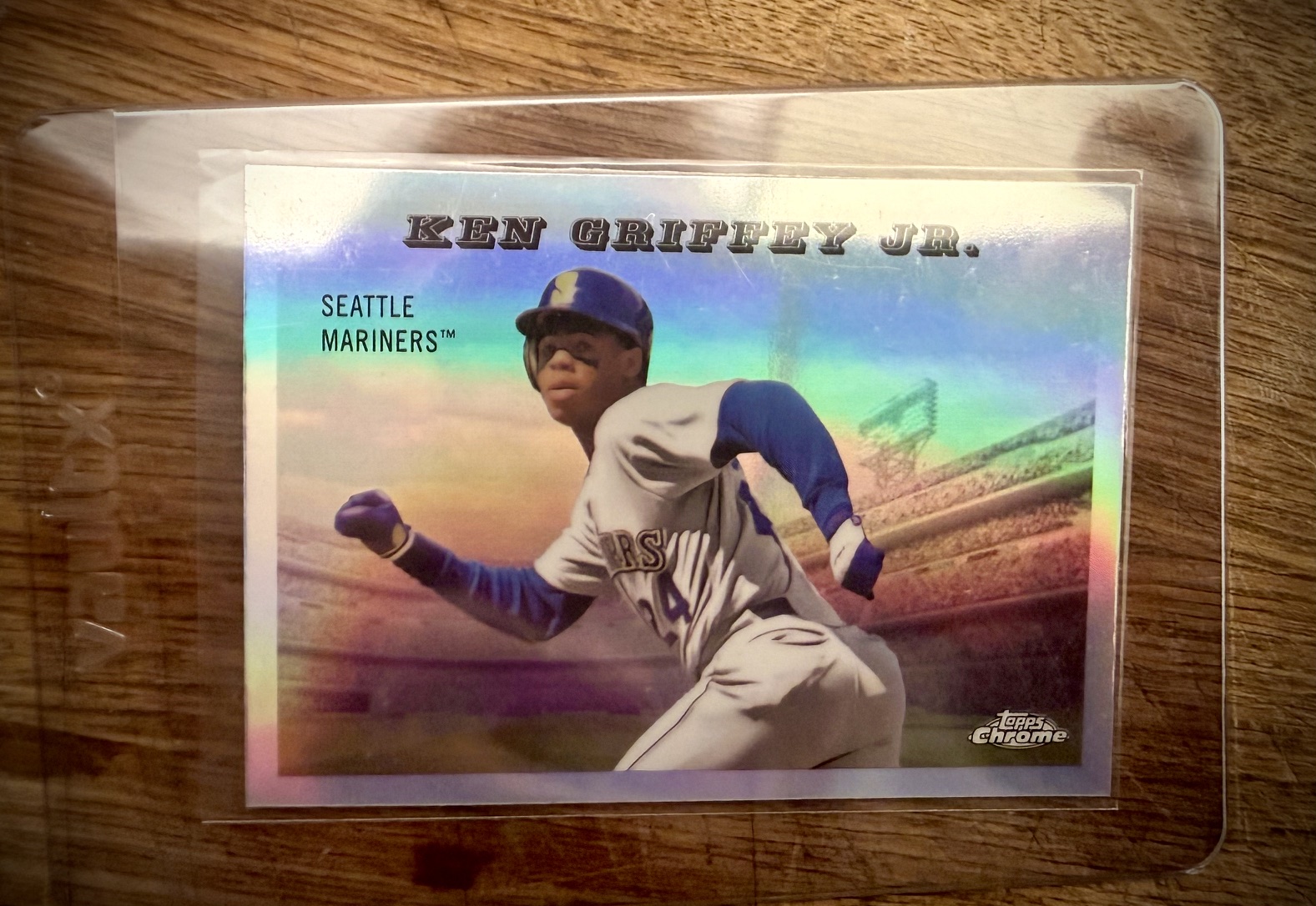
The funny part is that this decision has very little to do with pure logic. If baseball cards were only about statistics, Hall of Fame plaques and championships, the market would look completely different. It doesn’t. Somewhere along the way collectors simply fall in love with certain players and never really stop buying them. Ken Griffey Jr. is one of those names. Nolan Ryan belongs there. Derek Jeter as well. Bo Jackson might be the strangest example because, if we’re brutally honest, his baseball résumé alone doesn’t explain the prices. It explains part of them, certainly, but not all of them. The mythology became bigger than the career itself. Nike campaigns, football, baseball, the image, the “what if” story after the injury—collectors are buying all of that at the same time.
Hall Of Fame Doesn’t Automatically Mean Hobby Icon
That becomes obvious the moment you start looking at other Hall of Fame players. Frank Thomas was one of the greatest hitters of his generation. David Ortiz has moments in baseball history that will never disappear, especially in Boston. Paul Goldschmidt will almost certainly be remembered as one of the defining first basemen of his era. None of those players are ignored by the hobby. Their cards sell, their autographs have buyers and serious collectors absolutely appreciate them.
But appreciation and obsession are two completely different things.
Some players become permanent hobby favourites. Others become respected Hall of Famers that collectors are happy to own but rarely chase with the same intensity. I don’t think there is a formula for that. If there were, somebody would have written it down years ago. Instead, the market behaves much more emotionally than people like to admit.
Sometimes I think collectors spend hours analysing WAR, OPS, ERA or MVP voting while making their buying decisions almost entirely from memory. They remember Griffey’s swing. They remember Jeter diving into the stands. They remember Bo Jackson running up the outfield wall. Those images become part of the card itself, even though they never appear on the cardboard.
The Market Builds Its Own Heroes
That is probably why I have become increasingly sceptical whenever somebody tells me a player is “undervalued.” Compared with what? Compared with the statistics? Maybe. Compared with another Hall of Famer? Possibly. But collectibles have never behaved like spreadsheets.
The hobby creates its own hierarchy, and once that hierarchy becomes established it is remarkably difficult to change. One generation starts grading Griffey cards, the next generation sees Griffey everywhere, dealers keep stocking Griffey because demand stays high, auction houses produce strong results and new collectors conclude that Griffey must be one of the essential names to own. The same thing happens with Nolan Ryan or Derek Jeter. Nobody ever votes on it. There is no committee deciding who belongs in the hobby’s inner circle. The market simply repeats the same preferences often enough that they begin to look like objective truth.
I find that much more interesting than the prices themselves because it tells you the hobby isn’t just collecting baseball players.
It is collecting stories.
Why Some Players Slowly Disappear
The uncomfortable reality is that there are only so many places in collectors’ long-term memory. Every generation produces dozens of outstanding players, but only a handful remain permanent hobby favourites twenty or thirty years later. The others do not suddenly become bad players. Their careers do not disappear. Their Hall of Fame plaques stay exactly where they always were.
What changes is attention.
Collectors slowly stop building around them. Fewer people decide to complete every parallel. Fewer people pay strong premiums for high-end grades. Fewer discussions revolve around those names. The market doesn’t collapse. It simply becomes quieter, and over decades that quietness becomes visible in prices.
Maybe that is why I never believe the argument that statistics alone determine value. If they did, the market would look much tidier than it actually does.
Instead, it behaves much more like football supporters arguing in a pub. Everybody has favourites. Everybody remembers different moments. Everybody carries different nostalgia.
And somehow millions of those personal preferences eventually turn into market prices. That probably isn’t rational.
It is probably the most human thing about collecting.
This essay is part of Sports Memorabilia: The Ultimate Guide.