
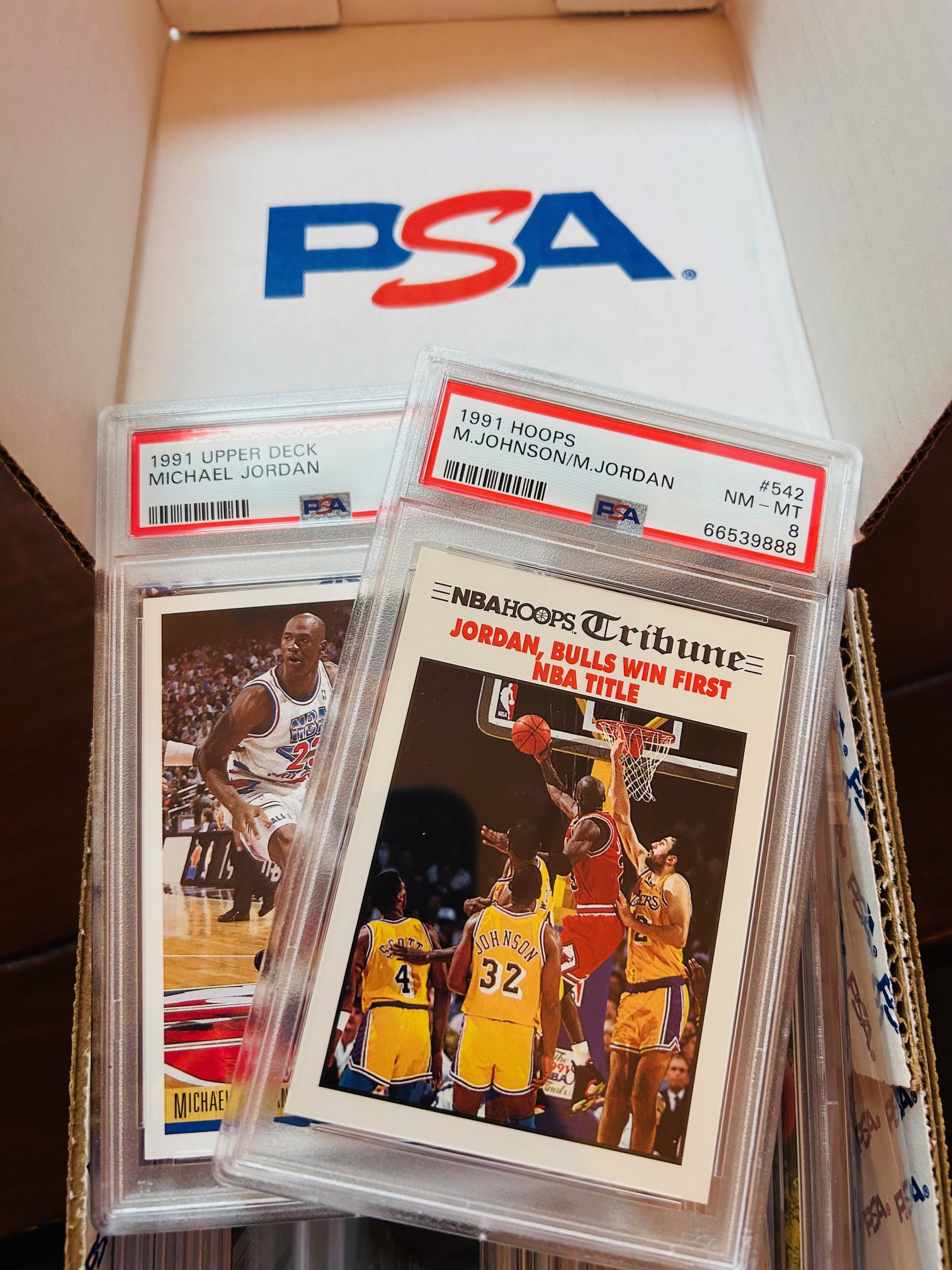
Selling a Michael Jordan card can look perfectly rational. Prices are high, the profit may be substantial and there is always the comforting idea that another copy can be bought later. That works with many cards, especially common base issues that appear constantly on eBay and at major auctions. It becomes much less convincing once the card is a scarce 1990s insert, an important autograph or simply an unusually attractive copy that took years to find.
I suspect plenty of collectors regret selling their best Jordan cards, even when the original sale produced a healthy return. The regret begins when they try to replace them. The same card may still exist, but the next copy has weaker centering, a scratched surface, a different holder or a price that has moved far beyond the money received from the sale. Collectors often talk about a checklist number as though every example were interchangeable. Anyone who has spent time comparing Jordan cards knows that they are not.
PSA, Beckett And The Copies Hidden Behind The Population Numbers
The PSA population report is an obvious place to start, although it can also create a false sense of availability. A card might have a respectable number of PSA 9s or PSA 10s, but that does not reveal how many owners are willing to sell, how often clean examples reach public auctions or how many copies have the eye appeal a serious collector actually wants. A population of one hundred does not mean one hundred cards are circulating. A large part of that supply may sit in collections for years.
Beckett makes the comparison even more complicated. A BGS 9.5 with strong subgrades, excellent centering and a clean surface can behave differently from another BGS 9.5 carrying the same overall grade. It may also appeal to a different buyer than a PSA 10. This is especially noticeable with premium Jordan cards from the 1990s, where foil, delicate surfaces and printing defects make attractive examples difficult to find. The label gives the market a starting point, but the card inside the holder still decides whether someone will chase it.
This is why the latest sale alone tells very little. The important question is not only what the card is worth today, but how many comparable copies can realistically be bought. There are expensive Jordan cards that appear regularly and less famous cards that become almost invisible for long periods. Selling the first type is a transaction. Selling the second can close a door.
Twenty-Three Signed Rookie Packs Inside Goodwin Champions
Upper Deck has now given collectors another reminder of how differently the Jordan market is managed. The company placed only 23 Michael Jordan-signed 1986–87 Fleer rookie packs into Goodwin Champions. The number naturally fits Jordan, but the more interesting detail is what Upper Deck did not do. It did not create hundreds of colour parallels, repeated autograph versions or a large checklist designed to satisfy every level of demand. It created 23 pieces for an international market that has been chasing Jordan for decades.
The packs combine two parts of the hobby that already carry enormous weight: Jordan’s autograph and the 1986–87 Fleer rookie-card era. It is also a clever construction because the collector is not simply chasing another signed photograph placed on cardboard. The pack itself belongs to the mythology surrounding the Jordan rookie, and the signature turns it into something Upper Deck can present as a new object without making the autograph feel ordinary.
This controlled release is possible because Upper Deck remains Jordan’s exclusive licensed autograph partner. The arrangement gives the company a level of control that Topps, Panini and other manufacturers do not have with him. New licensed Jordan autographs therefore arrive according to Upper Deck’s schedule and in quantities Upper Deck chooses. That does not make every Jordan autograph automatically rare, and there are already many Upper Deck-signed cards and memorabilia pieces in circulation, but it prevents the kind of uncontrolled annual supply seen with numerous active players.
Upper Deck Has Been Protecting More Than A Signature
The exclusivity also affects confidence. Collectors know where a modern licensed Jordan signature should come from, which matters in a market filled with private signings, third-party authentication and endless arguments about provenance. Upper Deck’s relationship with Jordan has become part of the product itself. Buyers are not only paying for the autograph; they are paying for the recognised chain behind it.
This does not mean Upper Deck is operating a museum or protecting collectors out of generosity. It is a commercial relationship, and scarcity makes the products more desirable. The 23 Goodwin rookie packs are marketing at an extremely high level. They encourage people to open a product that contains many other cards because one of those almost impossible Jordan pieces could be inside. Still, the strategy works because Upper Deck understands that Jordan cannot be treated like an ordinary autograph subject. Producing too much would damage the very market that makes each new release important.
LeBron James Is The Obvious Comparison, But Not The Same Market
LeBron James belongs in the article because he is the only modern basketball player with a convincing claim to the same long-term conversation. His career has the championships, the scoring record, the longevity and a generation of collectors who watched him from his rookie season into his forties. His best Upper Deck rookie cards, Exquisite material and important autographs already occupy the top end of basketball collecting.
The difference is that Jordan’s post-career market has been tested for more than two decades. Children who never watched the Bulls dynasty still know the shoes, the number 23 and the silhouette. They may discover the cards through sneakers, documentaries, fashion or the endless Jordan-versus-LeBron debate rather than through memories of the 1998 Finals. That cultural machinery keeps producing new Jordan collectors even though his playing career ended long ago.
LeBron may experience the same effect after retirement, and his market could become stronger once his career is viewed as a completed object rather than an ongoing argument. But Jordan has already survived that transition. His cards went through the end of the Bulls, the Washington years, retirement, the rise of Kobe Bryant and LeBron, the pandemic boom and the correction that followed. Collectors continued to return to him through all of it.
The Cards Worth Selling And The Ones That Become Regrets
There is no reason to turn every Jordan card into a sacred object. Selling common cards, duplicates or pieces that no longer fit the collection can finance something better. Moving twenty replaceable cards into one difficult insert or one strong autograph may be the most sensible decision a Jordan collector can make. The problem begins when the rare card is sold only because its current price looks tempting.
A collector may receive a good offer for a beautifully centred rookie, a scarce insert or a premium BGS copy and assume the market will provide another opportunity. It often does, but not necessarily the same opportunity. The next card may be technically identical and still feel inferior. By then the money from the original sale may have gone elsewhere, while the replacement carries a larger price and none of the history the original copy had in the collection.
Jordan cards are not immune to corrections, and not every purchase will outperform other assets. The market has overpaid for some of them, particularly during periods when almost anything inside a high-grade holder attracted speculation. But the question behind a sale is not limited to whether the price could fall next year. It is whether that particular card is replaceable at all. Upper Deck can create 23 new signed rookie packs and make the entire hobby look again, but it cannot recreate the exact Jordan card someone owned for twenty years and decided, perhaps too casually, to let go.