
Michael Jordan is one of the biggest names in sports cards, but his card market is not one clean market. The 1986 Fleer rookie card, the 1986 Fleer sticker, rare 1990s inserts, Upper Deck autographs, game-used cards and important high-grade copies live in a completely different world than ordinary late 80s and 90s base cards.
Beginners search Michael Jordan, see an older card, see a PSA slab, maybe even see Bulls red and some nice 90s design, and the card suddenly feels more important than the market thinks it is.
Raw Jordan cards from that period can sit around one to nine euros. Not fake cards. Not necessarily ugly cards. Just ordinary Jordan cards from sets that were printed in huge numbers. Even PSA-graded examples can still be cheap. A 1989 Hoops All-Star Michael Jordan #21 in PSA 9 was sitting around 40 euros. PSA 9 is a strong grade. The card is clean. The player is Jordan. The card is from 1989. Buyers still were not exactly fighting over it.
Junk Wax Is The Problem
Late 80s and 90s basketball cards came from a completely different production environment. Topps, Hoops, Fleer, SkyBox and Upper Deck were everywhere. Packs were everywhere. Sets were everywhere. Jordan cards were everywhere.
Some of these names barely matter in modern basketball cards anymore, at least not in the same way collectors talk about Panini Prizm, modern Topps Chrome, Fanatics, National Treasures or Flawless. But during Jordan’s prime collecting years, they helped flood the market with product. Those cards are still sitting in binders, old boxes, card shops, childhood collections and eBay listings.
That is why so many normal Jordan cards from that era stay cheap. The market has had decades to understand the supply. A card can be from Michael Jordan’s playing years, have a good photo, sit in a PSA holder and still not be something collectors chase hard.
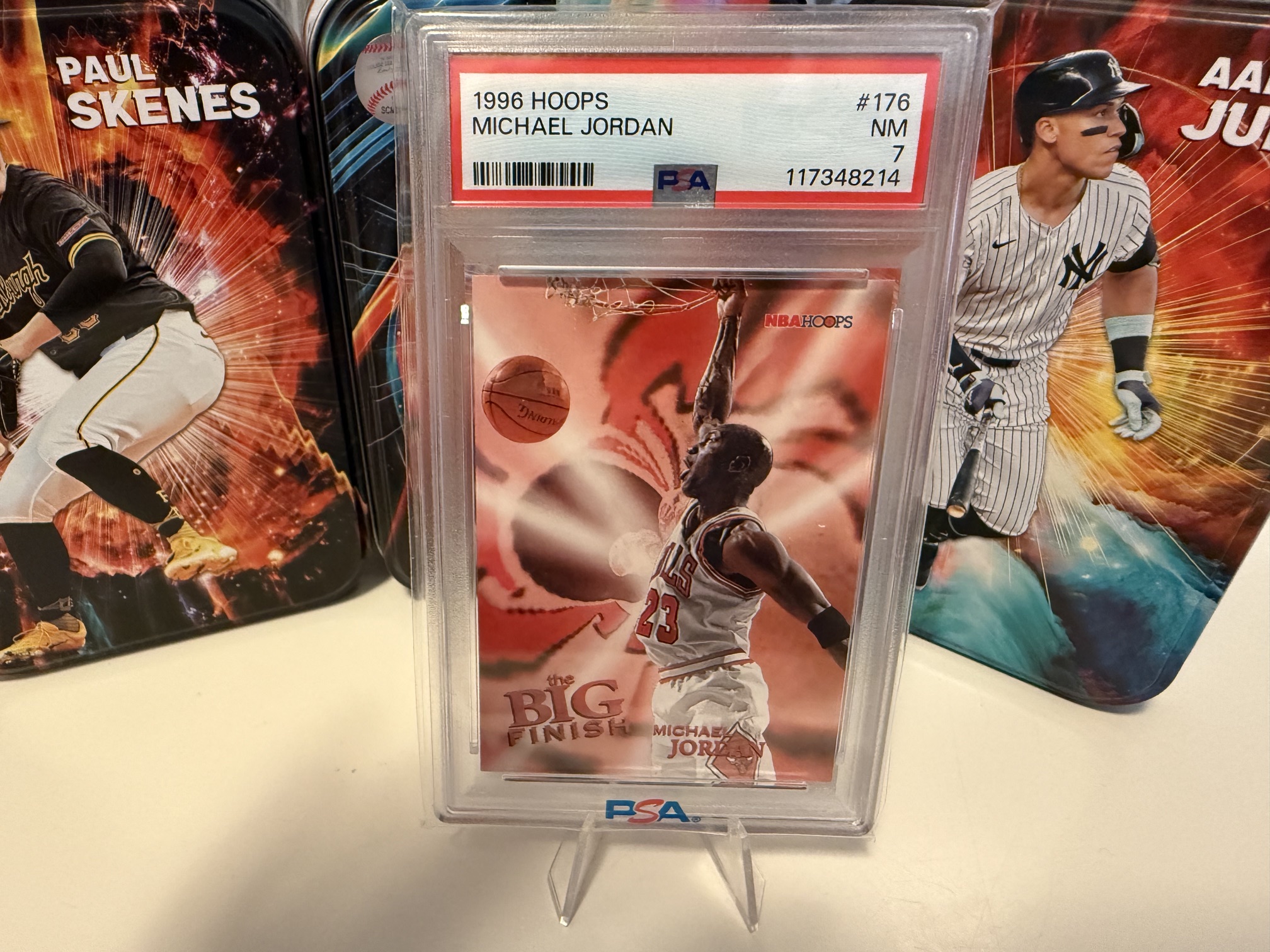
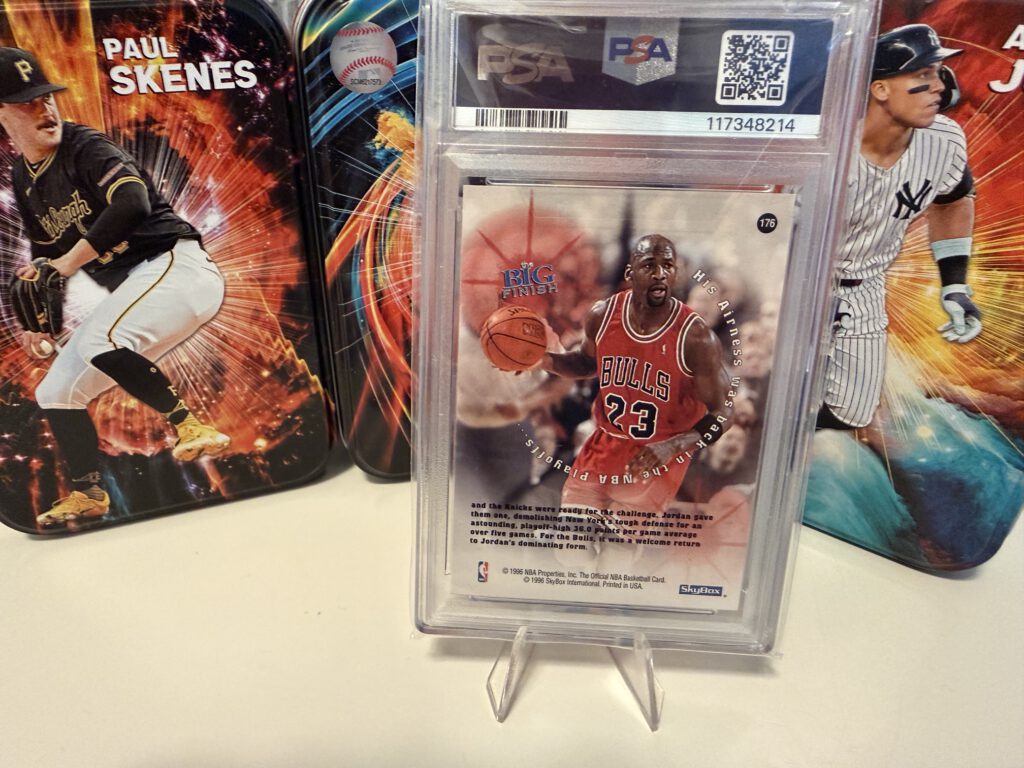
I saw a 1996 Hoops Michael Jordan #176 in PSA 7 around the 20 euro level. Nearly 30 years old, graded, Jordan on the front, and still basically a cheap card. That is not strange once you understand how much of this material exists.
The 90s Design Still Works
The 1996 Hoops card I photographed has a great 90s look. Jordan is cut out in front of this loud graphic background, almost batik, almost pixel, almost early digital sports design. “The Big Finish” across the card. Big effects. Strange color choices. Not subtle at all.
A lot of modern base cards feel too clean, too template-driven, too produced for the next parallel. Some cheap 90s Jordan cards have more personality, even if the market price is low. I still like owning them because the design and era are interesting, not because I think every one of them is secretly undervalued.
The Two-Dollar Topps Jordan
I also photographed a raw 1992 Topps NBA All-Star Michael Jordan #115 for this article. No PSA slab, no auction drama, no big investment thesis. I found it on eBay for two dollars, and it came in a magnetic holder.
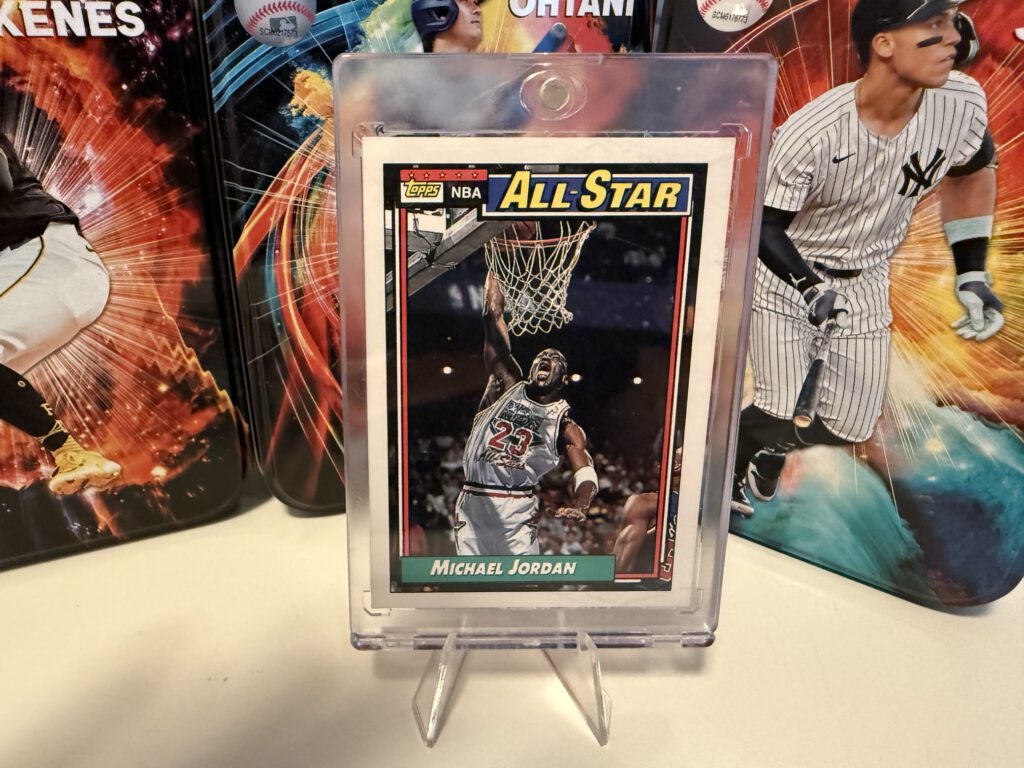
The card has the early 90s Topps feel, the All-Star theme, the Jordan name, the retro basketball-card look. It is exactly the kind of card that feels fun to own if you like the era. The price also shows where it sits. Two dollars is not a hidden treasure price. It is a normal market price for a card that exists in large supply.
For two dollars, I would rather own that than a pile of modern base cards I do not care about. But I would not put it in the same conversation as the Jordan cards that drive serious auction results.
The Metal Universe Exception
The confusing part is that some cards from the same general period became monsters.
SkyBox is a good example. A normal SkyBox Jordan can be cheap. But a 1997-98 SkyBox Metal Universe Michael Jordan #23 in PSA 10 sold at Goldin for $4,080. Same player, same broad 90s era, PSA holder again, but the market treats it completely differently.
Metal Universe has real hobby status. The design is instantly recognizable, the set matters, condition matters, collectors chase it, and PSA 10 changes the equation. This is not the same lane as a common Hoops or Topps Jordan.
Upper Deck creates a similar problem. A normal Upper Deck Jordan base card can sit cheap for years. A real Upper Deck Authenticated Jordan autograph is a completely different object. The manufacturer name alone does not decide much. The exact product does.
“Michael Jordan card value” is almost too broad as a question. Which Jordan? Which set? Which year? Which grade? Which population? Which buyer pool? A one-euro raw Jordan and a four-figure Metal Universe PSA 10 can appear next to each other in search results, but they are not really competing with each other.
Printed Signatures And Fake Autograph Confusion
Jordan also has a lot of misleading material around him. Not only fake PSA slabs, which I have already written about. There are also cards with printed signatures, facsimile autographs or autograph-style designs that can confuse inexperienced buyers.
Jordan is exactly the kind of name where people want to believe. They see a signature shape on the card, see a low price, maybe read the title too fast, and suddenly it feels like maybe there is an overlooked autograph sitting there. If the signature is part of the printed design, there is no live ink. No autograph authentication. No hidden Upper Deck-level bargain.
Real Michael Jordan autographs are a different lane. Upper Deck is still the cleanest lane for me because of Jordan’s long relationship with Upper Deck Authenticated. That does not mean every non-UDA Jordan autograph is automatically fake, but it does mean the story has to be much stronger.
Fake Slabs Make The Expensive Side Riskier
The cheap Jordan cards are mostly about supply. The expensive Jordan cards bring another problem: trust.
Once a Jordan card becomes expensive enough, the slab itself becomes part of the target. Fake holders, copied certification numbers, weak photos, strange sellers, labels that do not look right. I have already written about fake PSA slabs, and Jordan is one of the most obvious names where this matters.
A 20 euro Jordan card is usually not where the biggest danger sits. The real risk grows when the card is expensive enough for somebody to build a convincing listing around it. Buyers have to check the card, holder, label, certification number, seller history, price and images together.
With Jordan, the market is big enough that both things can be true at the same time: tons of cheap common cards, and serious high-end cards that attract serious risk.
Cheap Jordan Cards Still Have A Place
I still like cheap 90s Jordan cards when the design works. The 1992 Topps All-Star card for two dollars makes sense to me as a collector object. The 1996 Hoops design makes sense too. Not everything has to be a grail, and not every card needs to justify itself with a future auction result.
The gap inside the Jordan market is massive. A raw Topps Jordan for a few dollars, a PSA 9 Hoops All-Star around 40 euros, and a Metal Universe PSA 10 at more than $4,000 are different categories using the same player. Buyers need to understand that before they start thinking every older Jordan card is valuable.