
Every few months somebody asks for unpopular opinions about sports cards. The answers are always entertaining because most of them are not unpopular anymore. Buy singles. Collect what you love. PSA is overrated. Modern is junk. Breakers are ruining the hobby. We have repeated those lines so often that they have become part of the hobby’s language, and sometimes I wonder whether people still believe them or simply know they will receive approval for saying them. The debate looks lively, but much of it has become strangely predictable.
I do not think the hobby has become worse. I think it has become obsessed with the wrong conversations. People argue endlessly about PSA versus Beckett, whether wax is gambling, whether modern cards will collapse and whether influencers have too much power. None of those questions has one clean answer, which is precisely why they never disappear. PSA deserves its position because the market decided that PSA matters. Beckett can still produce a slab I would rather own for certain 1990s cards because strong subgrades and better eye appeal can tell me more than a single number on a red label. Both things can be true, but the hobby increasingly behaves as if every discussion needs a winner.
Grading Became A Market Before It Became A Standard
Grading was supposed to make condition easier to understand. Instead, it created another market around the card. Collectors now buy the grade, the holder, the population report and the resale premium along with the player. That does not make grading useless. A valuable vintage card or a scarce modern autograph often benefits enormously from professional authentication and condition assessment. But we have reached the point where almost every card is treated as incomplete until it has been sealed inside plastic.
The strange part is that many collectors know the system is inconsistent and still accept it completely. They complain about overgraded cards, undergraded cards, cracked slabs and resubmissions, then pay a huge premium for the next PSA 10. Beckett is criticised for losing market share but still matters whenever collectors start discussing subgrades on delicate premium issues. SGC has loyal supporters. TAG attracts people who want more transparency. Nobody trusts the system entirely, yet almost everybody participates because the resale market has made opting out increasingly difficult.
That is not really a grading problem. It is a dependence problem. We have allowed third-party labels to become part of the identity of the card, and now many collectors struggle to separate the object from the market structure around it.
Modern Cards Are Not Dead, Most Of Them Are Just Forgettable
The same confusion appears whenever somebody declares modern cards dead. If modern cards were dead, major releases would not sell out, breakers would not fill rooms and collectors would not pay thousands for Paul Skenes, Victor Wembanyama or Shohei Ohtani. Modern cards are alive. Most modern products simply will not become historically important, which is a completely different argument.
Collectors often compare the greatest survivors from the past with average products being released today. That is an unfair comparison because history has already removed most of the forgettable material. Nobody talks about the hundreds of unimportant basketball and baseball cards that surrounded the famous releases of the 1980s and 1990s. We remember 1986 Fleer because Michael Jordan happened. We remember the great inserts because collectors selected them over time. Modern cards have not yet had that filtering process.
There is also a tendency to call everything Junk Wax 2.0 simply because manufacturers produce too many parallels. The criticism is understandable. A card numbered to 99 can appear scarce until you realise there are twenty similar versions in the same product and another twenty in the next one. Still, overproduction does not mean every modern card is worthless. It means the hierarchy will become more brutal. A few cards will matter, many will not, and collectors will spend years pretending they knew the difference from the beginning.
Scarcity Is Not A Number Printed On The Back
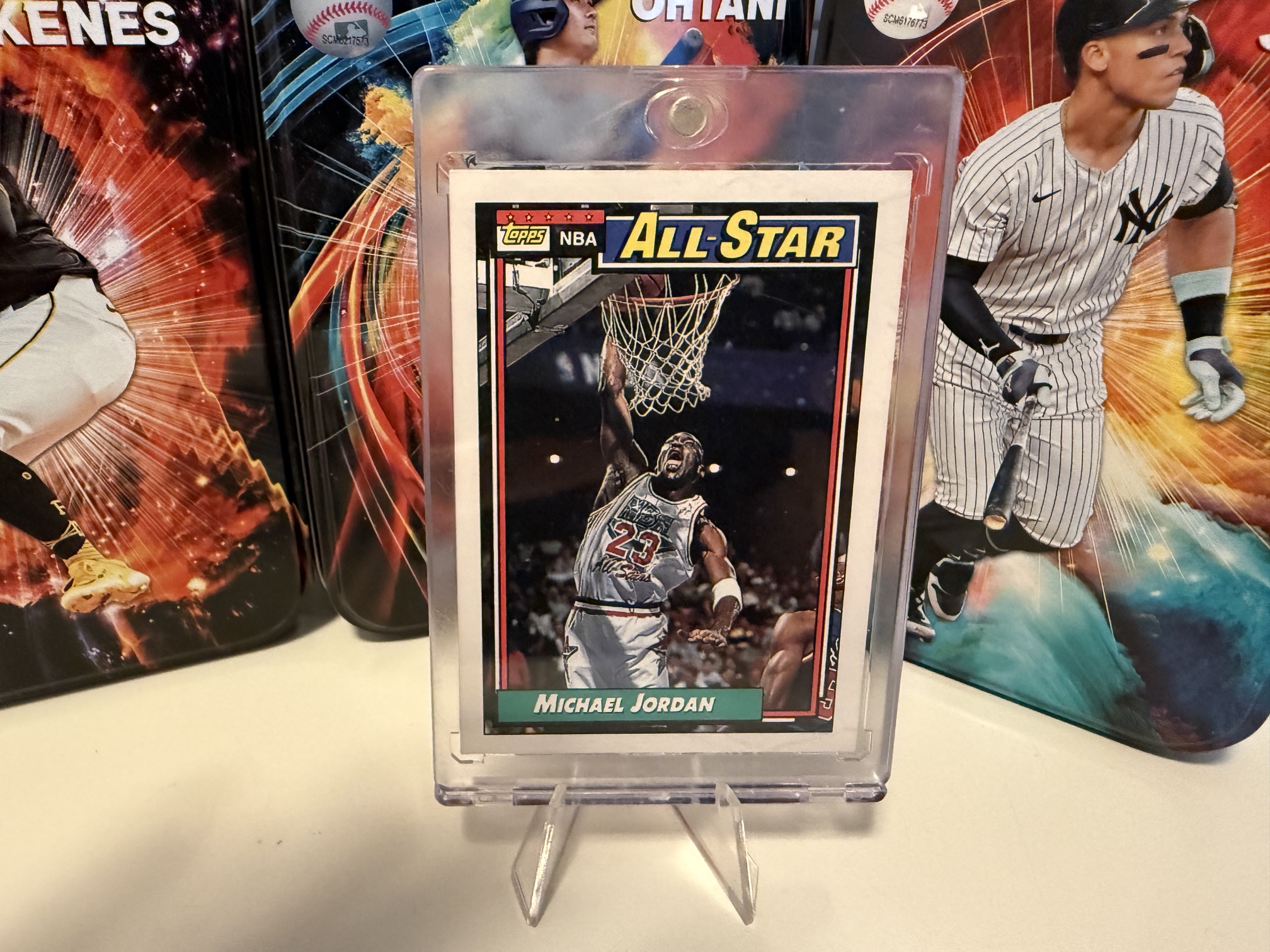
Michael Jordan is probably the clearest example of how poorly the hobby sometimes understands scarcity. Collectors complain that Michael Jordan autographs are expensive, but the prices did not appear by accident. Upper Deck has controlled the licensed Jordan autograph market for years, and it has generally resisted the temptation to flood the hobby with endless new signatures. The recent placement of only twenty-three signed Fleer Rookie Packs inside Goodwin Champions fits that strategy perfectly. Twenty-three objects in a global market built around the most collected basketball player ever.
That is real scarcity because the supply is controlled before the card reaches the market. It is very different from printing ten colours of the same rookie, adding serial numbers and asking collectors to treat each version as historically important. Upper Deck understands that Jordan does not need more supply. The scarcity itself has become part of the product.
The irony is that collectors regularly demand lower production while becoming angry when products are difficult to obtain. They criticise companies for printing too much and then complain when the chase is almost impossible. The hobby wants scarcity, access and low prices at the same time, which is not how scarcity works.
Breakers Did Not Create The Speculation, They Industrialised It
Breakers receive a large share of the blame for what happened to the hobby, and some of that criticism is deserved. They consume enormous quantities of product, turn opening cards into continuous entertainment and help separate the price of wax from the expected value inside it. But breakers did not invent speculation. Collectors were chasing rookies, buying sealed cases and gambling on future stars long before livestreams existed.
What changed is scale. Breaking industrialised the emotional part of opening wax. A collector no longer needs to buy the whole box. He can buy one team, one player or one serial-numbered slot and watch somebody else open the product. That makes expensive releases feel accessible, but it also allows the market to absorb far more product than ordinary collectors could ever buy alone.
I understand why people dislike it. The relationship between manufacturers, distributors, breakers and influencers often feels too close. Products appear impossible to obtain at retail while large breakers seem to have endless supply. Prices are then supported by entertainment rather than by the actual cards. But blaming breakers alone lets the rest of the market escape too easily. The system exists because collectors continue paying for it.
Buy Singles Is Good Advice, But It Is Not The Whole Hobby
“Buy singles” may be the most repeated advice in sports cards, and mathematically it is difficult to argue against. Anyone who wants a specific card will usually save money by purchasing it directly. Opening boxes is almost always an inefficient route to a particular player or insert. Still, buying singles and opening wax are not the same activity.
Wax is entertainment. It contains uncertainty, anticipation and the possibility of pulling something you would never buy outright. That does not make it financially sensible, but not every part of a hobby has to be financially sensible. People spend money on golf, concerts, restaurants and travel without calculating resale value afterward. Sports cards became strange when collectors started demanding that every enjoyable activity also function as an investment.
The problem begins when entertainment is marketed as an asset class. A collector buying one box for fun understands the risk. A buyer taking on debt because a breaker says the product contains generational upside is doing something else entirely. The packaging looks the same, but the motivation has changed.
The Hobby Says “Collect What You Love” And Then Checks Comps
The phrase “collect what you love” appears everywhere, usually directly beside a discussion about market value. That contradiction is probably unavoidable. Collectors care about the objects, but they also care about what those objects are worth. Pretending otherwise is not more authentic. A person can love a card and still know the latest sale. He can build a personal collection and still avoid overpaying.
What bothers me is not that people check comps. It is that comps have started replacing judgment. A recent sale becomes the answer to every question, even when the card is rarely traded, the condition differs or the transaction took place during an unusual market moment. One public sale suddenly defines value, while eye appeal, scarcity and the actual desire to own the card become secondary.
This is how collectors slowly outsource their taste. They wait for auction results, influencers, grading companies and social-media reactions to tell them whether a card matters. Then everybody chases the same players, the same parallels and the same slabs, and the hobby wonders why collections have begun to look identical.
Vintage Collectors And Modern Collectors Need Each Other
Vintage collectors often speak as though they escaped speculation, which is not entirely true. Vintage has its own hype cycles, manipulated prices and obsession with grades. Modern collectors sometimes dismiss vintage as boring because the designs are simpler and the players belong to another era. Both positions miss the obvious connection between the two markets.
Every vintage card was once modern. Every modern star is trying to become history. The difficult part is that most will fail. A vintage collector benefits from decades of information because careers are complete and the market has already selected its icons. A modern collector accepts more uncertainty but also participates while the story is still being written.
I would not want a hobby with only one of them. Vintage gives collecting depth. Modern keeps it alive.
The Real Problem Is That Too Many Collections Are Built By The Same Voices
The strongest change in the hobby is not grading, breaking, Whatnot or parallel production. It is the amount of influence collectors have handed to other people. YouTubers decide which products matter. Large social accounts decide which inserts are suddenly cool. Breakers create demand around releases most collectors would never have noticed. Auction headlines make one athlete appear investable while another disappears from attention.
This does not mean influencers control everything or that collectors have no independent judgment. It means the market now reacts much faster to a small number of repeated opinions. A card can become desirable within days because the same message appears across several platforms. Six months later, the attention moves elsewhere and the buyers who arrived last discover that enthusiasm is not the same thing as long-term demand.
The best collections I have seen were built by people who ignored most of that noise. They collected one obscure team, one era, Olympic memorabilia, ticket stubs, tennis autographs, regional baseball cards or players the broader hobby had forgotten. Those collections were interesting because they reflected a person rather than an algorithm.
The hobby does not need everyone to agree on PSA, wax, vintage, breakers or investment. It needs more collectors willing to decide what matters before somebody else tells them.