
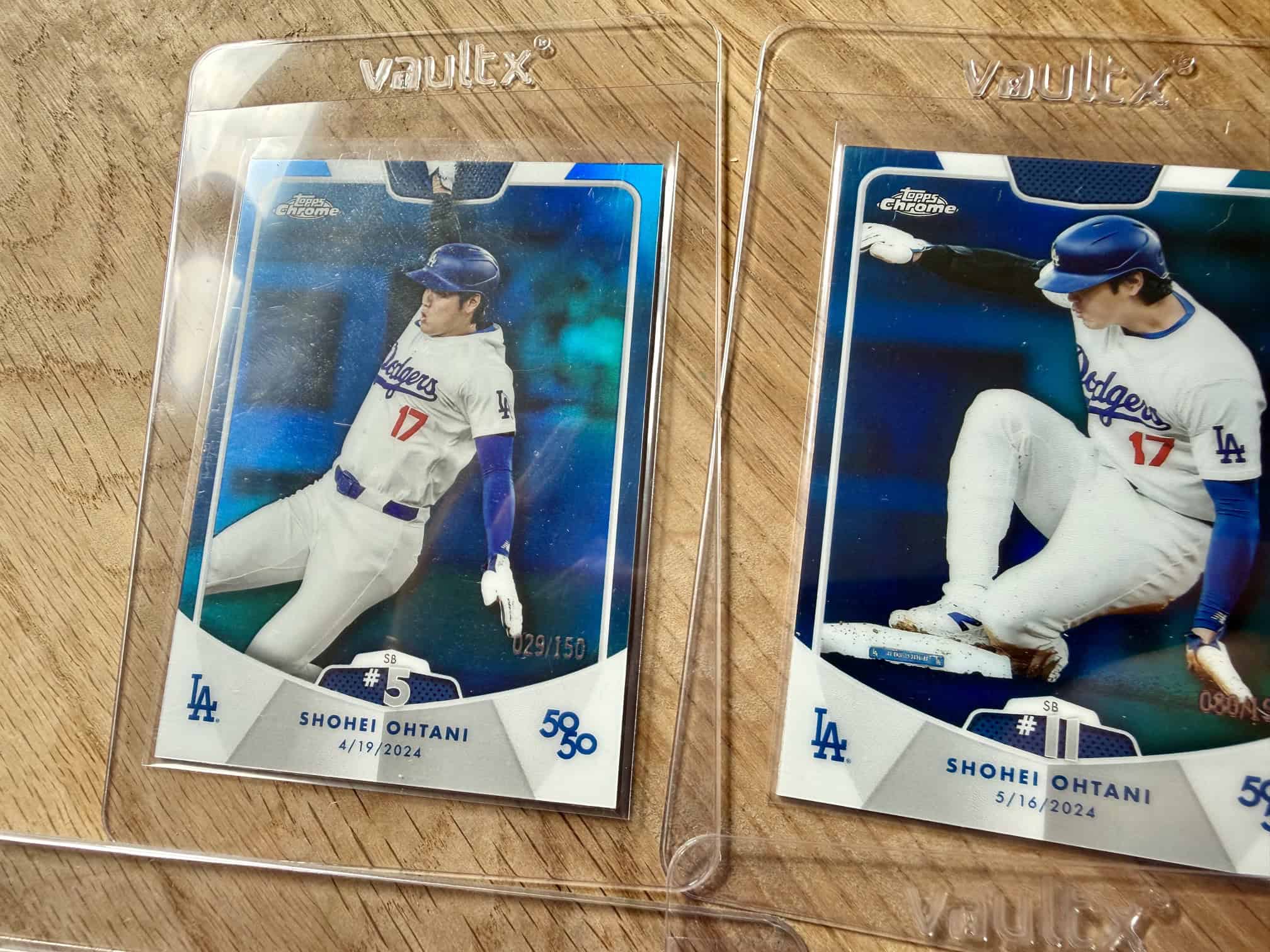
I sent six Shohei Ohtani cards from the 2024 Topps 50/50 set to PSA in September. Three Blue Refractors /150, two Green Refractors /99 and one Chrome Refractor. I had bought the cards at prices where grading looked attractive, and when I started checking PSA 10 sales I thought the six could potentially be worth somewhere between $4,500 and $6,000 if the grades went my way.
I had made a fairly basic mistake. I was looking at Ohtani 50/50 PSA 10 prices and paying too much attention to the parallel. A Blue /150 was a Blue /150, a Green /99 was a Green /99, and some of the prices looked fantastic. The set doesn’t really work like that. Every card represents a particular home run or stolen base from Ohtani’s 2024 season, and the market can put very different prices on two cards that otherwise look almost identical on paper.
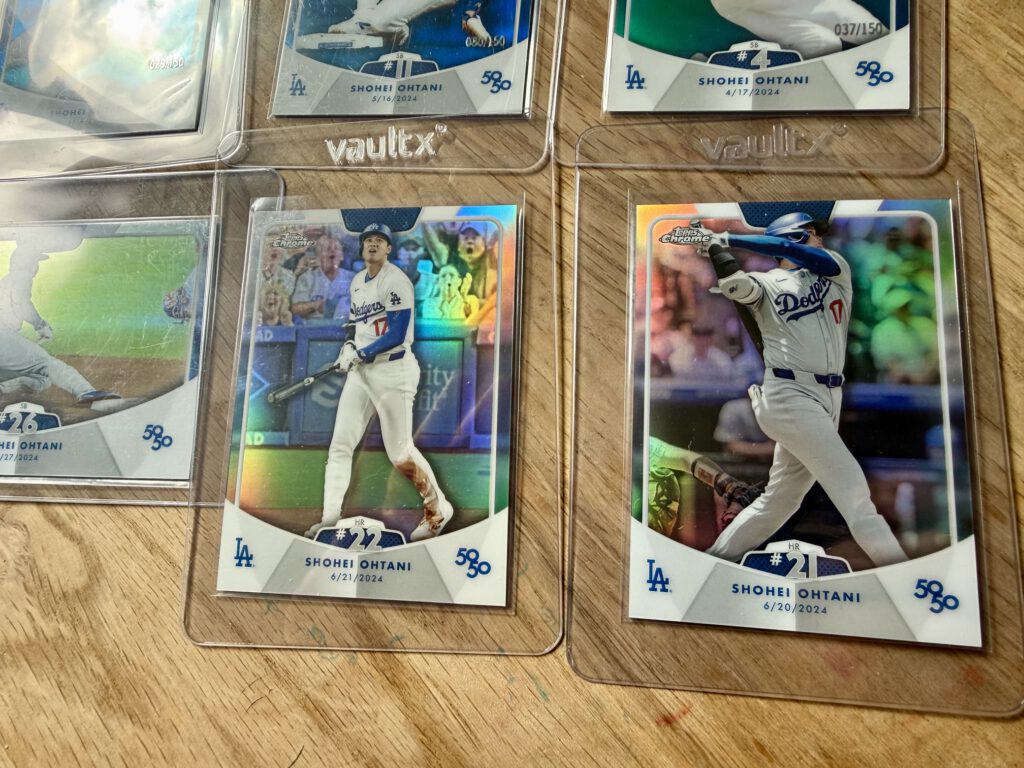
These are the six currently at PSA:
| Card | Moment | Parallel | PSA 10 reference* |
|---|---|---|---|
| #54 | SB24 | Blue /150 | ~$220 |
| #9 | SB5 | Blue /150 | ~$158 |
| #8 | SB4 | Green /99 | ~$275 |
| #37 | HR21 | Chrome Refractor | No reliable direct comp |
| #58 | SB26 | Green /99 | ~$188 |
| #23 | SB11 | Blue /150 | ~$300 older reference |
*Price references checked in September 2026. These are thinly traded cards and shouldn’t be read as fixed market values.
I was comparing my cards with the wrong cards
HR50 was the most obvious problem with my first calculation. The Blue /150 PSA 10 of Ohtani’s 50th home run has been valued at more than $3,000. I own Blue /150 cards as well, so it is tempting to look at a sale like that and start imagining what a good PSA submission could produce.
Except my Blues are SB24, SB5 and SB11.
Once I went through the actual checklist, I couldn’t justify using HR50 as a meaningful comparison anymore. The serial number may be identical, but the reason somebody wants the card isn’t. Ohtani‘s 50th home run has an importance inside this particular set that stolen base number five simply doesn’t have.
I think I underestimated this when buying the cards. Modern collecting makes it very easy to start with the serial number. I see Green /99, I know only 99 exist, and immediately that feels more interesting than an unnumbered card. With the 50/50 set I should have spent more time looking at the number on the front as well as the number on the back.
It gets less straightforward once you move away from HR50, though. A Blue /150 #12 PSA 10 sold through Fanatics Collect for $1,770 at the end of August. A #86 Blue /150 PSA 10 sold for $1,000 in June. Neither of those is the HR50 card, while the available PSA 10 reference for my #54 SB24 is only around $220.
I tried to find enough sales to understand exactly why that gap exists and there simply aren’t enough. These aren’t cards trading several times a week. Sometimes there is one relevant PSA 10 sale and then very little for months, so that transaction ends up carrying far more weight than it would in a liquid market.
The strangest one among my six may be #23. An older PSA 10 reference is around $300, but a raw #23 Blue /150 sold for $330 in July. If mine comes back a 10, I’m not going to price it from the older $300 sale. I’d rather start higher and see whether there is a buyer.
This is where I think price guides become dangerous with cards like these. Not because the data is necessarily wrong. There just isn’t much data.
My $6,000 estimate is gone
After separating the actual cards I own from the biggest cards in the set, I would currently put the six at roughly $1,900 to $2,100 combined if all six come back PSA 10.
That is obviously a big correction from $4,500 to $6,000, but I’d rather correct the number now than keep using sales that don’t belong in the calculation. I don’t own HR50, SB50 or one of the obvious milestone cards. I own SB4, SB5, SB11, SB24, SB26 and HR21.
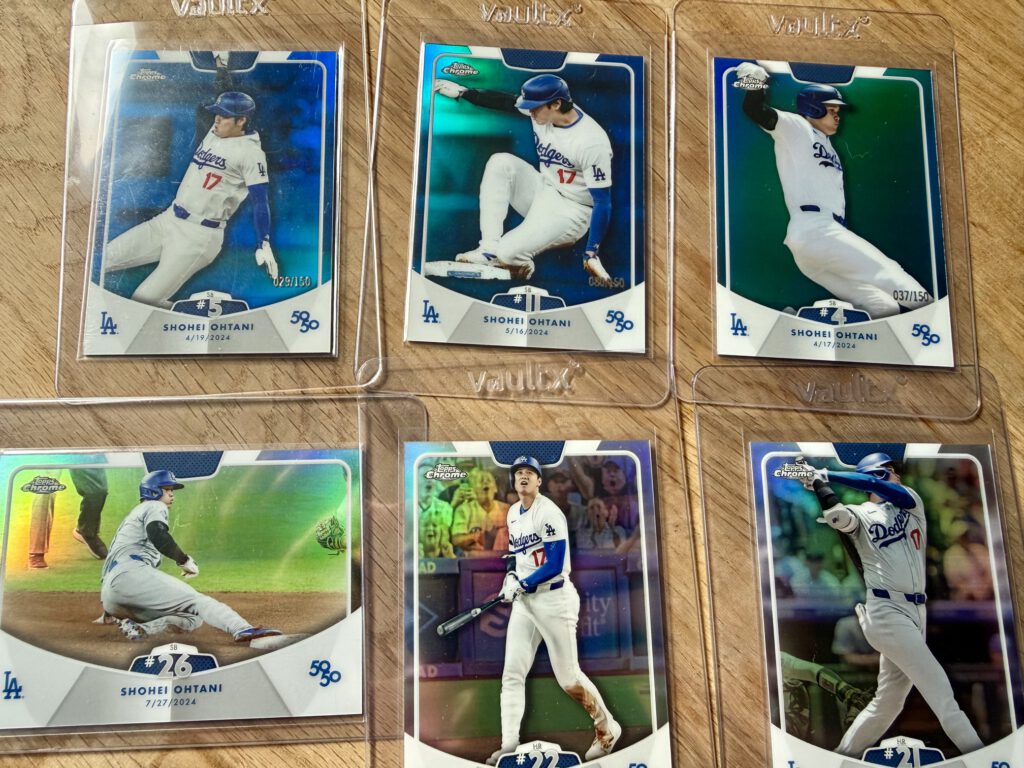
The whole submission consists of ten cards and cost me €534.89. I wouldn’t spend more than €50 per card grading most of the Ohtanis I own. I have roughly 200 of them, and putting every inexpensive insert into a PSA holder would make very little financial sense. A PSA 9 on a cheap modern card can leave you wondering why you paid for grading in the first place.
The numbered 50/50 cards were different enough for me to send them. There are only 99 copies of each Green and 150 of each Blue, I like the set, and PSA 10 prices gave me enough room to justify the cost. The Chrome Refractor #37 is the one unnumbered card in the group and probably the card for which I most need a 10.
I also like the fact that the set is tied so closely to one season. There are already an enormous number of Ohtani cards and there will be many more. Another random Ohtani /99 can appear in almost any future Topps product. These cards at least document individual moments from the 50/50 season, which gives me a reason to own them beyond the color of the parallel.
I wouldn’t assume that this makes every card in the set a great investment. The current prices already suggest otherwise. Collectors are separating the major moments from the rest, and I expect that to continue.
What I’ll do when PSA sends them back
If the cards come back as 10s, I won’t simply take the number displayed by SportsCardsPro and list them there. I’ll check sales for the exact card again, particularly because the market has already moved considerably on some 50/50 parallels.
For #23, I would start above the older PSA 10 comp because of the more recent $330 raw sale. With the Greens and the other Blues, I’ll look at what has actually sold by the time the slabs arrive rather than deciding on the prices now. I don’t need to sell all six together, either.
PSA 9s will be a different calculation. I paid enough for grading that I don’t want to pretend a disappointing grade is a successful investment just because the card now sits in a PSA holder. Depending on the card and the gap between PSA 9 and raw, selling and putting the money somewhere else may make more sense.
The interesting part for me is that I started this submission thinking mainly about Ohtani plus scarcity. /99 was better than /150, PSA 10 was better than raw, and the rest looked fairly easy to calculate. Going through the actual sales made that approach look much too crude for this set.
I still don’t know what the six cards are worth because I don’t have the grades. But at least I stopped pretending that an HR50 Blue /150 tells me what my SB5 Blue /150 is worth.