
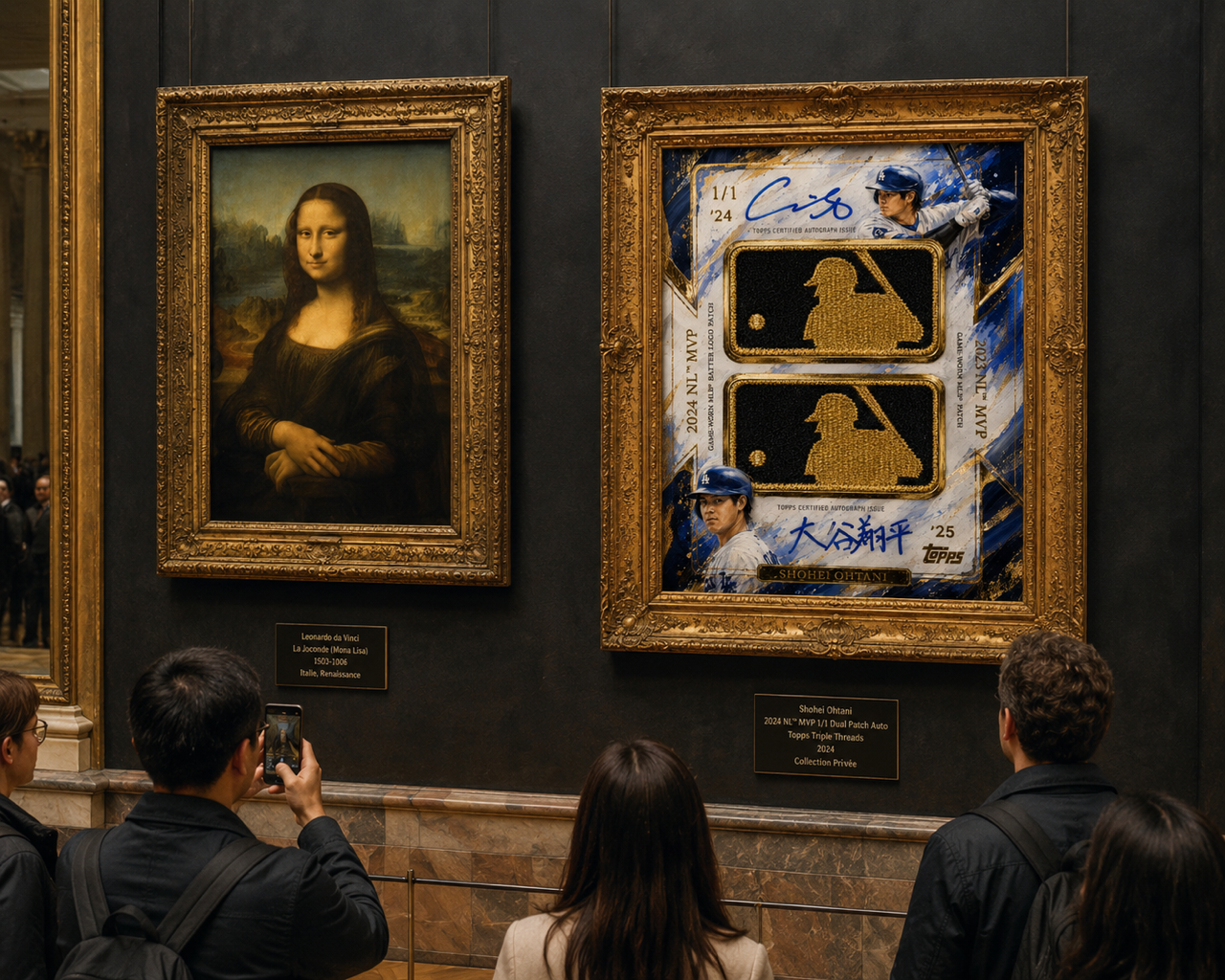
The biggest chase in 2026 Topps Chrome Baseball has finally been pulled, although “pulled” is almost the wrong word because the collector did not find the actual card. He found a redemption promising the one-of-one Shohei Ohtani Dual Gold Logoman Autograph, featuring two game-worn gold MLB patches and two Ohtani signatures: one in English and one in Japanese Kanji. The patches came from games played on September 7, 2025, and April 12, 2026, connecting two award-winning seasons in a single card. Topps had announced the card before release, collectors knew exactly what they were chasing, and many of us tried to find it. I opened Topps Chrome myself and, unsurprisingly, did not come close.
The redemption was found in a hobby box purchased through Boca Sports Cards in Florida and was reportedly sold almost immediately for $11 million to a group of collectors that includes Kevin O’Leary, Matthew Allen and Paul Warshaw. That makes it one of the most expensive sports-card transactions ever reported, even though the physical card has not yet been delivered to its first owner. The buyer paid eight figures for Topps’ promise that the finished object will eventually exist.
I keep returning to that detail because it says more about the current card market than the price alone. Eleven million dollars did not buy a finished card that could be inspected under a loupe, checked for surface damage, compared with Topps’ preview image or placed immediately in a display case. It bought a redemption card and the right to receive the final object later. The patches exist, the signatures are planned and Topps has defined what the card will become, but the version sold for $11 million is still, in practical terms, a claim ticket.
A Manufactured Card With The Price Of A Masterpiece
I joked that this card should eventually hang in the Louvre next to the Mona Lisa, and the comparison becomes less ridiculous once a newly manufactured sports card changes hands for $11 million. Nobody is seriously claiming that a Topps card has the cultural importance of Leonardo da Vinci, but markets do not price objects according to cultural importance alone. They price desire, scarcity, status and the financial power of the people competing to own them. There is now enough money at the highest end of sports collecting that a one-of-one card can be treated more like a trophy asset than a traditional collectible.
That remains strange to me because Topps designed the object, selected the patches, created the concept and decided there would be exactly one. It is not an accidental survivor from a century ago, nor an object that became rare because most examples were lost or destroyed. Its scarcity was created at the factory. That does not make it fake, and the game-worn patches give it a direct connection to Ohtani’s career, but it does make the valuation more difficult to understand than the price of a historic jersey or an established vintage card. Topps can manufacture scarcity; it cannot manufacture a century of history. The market has nevertheless decided that the right combination of Ohtani, Kanji, English autograph, gold patches and one-of-one numbering is already worth more than almost every sports card ever produced.
We have seen the process accelerating. An Ohtani Gold Logoman autograph sold for $3 million, an Ohtani–Aaron Judge dual Gold Logoman autograph reached $2.16 million, and an Ohtani World Baseball Classic jersey sold for more than $1.5 million. The new $11 million transaction does not emerge from nowhere, but it moves the scale into another category.
The Redemption May Be More Important Than The Finished Card
The seller’s decision is easy to understand. There is a romantic version of this story in which the collector waits patiently, receives the completed card, keeps it for twenty years and watches Ohtani’s legacy continue to grow. There is also the version in which Topps takes months to produce it, the final design disappoints somebody, the signature placement looks imperfect or the market simply cools while everyone waits. Eleven million dollars removes all of those uncertainties from the seller’s side.
The buyer is purchasing a different kind of certainty. There will only be one card, the entire hobby knows it exists and the public chase has already given it a history before production is complete. The redemption itself documented the moment the chase ended. Once the card is made, the object may look spectacular, but it will never again have the same mystery it possessed while still hiding somewhere inside Topps Chrome.
That may be why the sale does not feel like an ordinary flip. The collector did not merely sell cardboard. He sold the conclusion to the largest chase of the product, while the attention was still concentrated on that exact moment. Waiting for the physical card might have improved the photographs, but it would also have introduced time, and hype is often most valuable before it has time to become familiar.
PSA Has Eleven Million Reasons To Show How Large The Market Has Become
At the same time, PSA is dealing with a backlog that stood at approximately 11 million cards in its July 14 update, after reaching about 12 million at the end of June. PSA temporarily stopped accepting Value Bulk, Value, Value Plus and Value Max submissions because the company could not continue taking in cards at the same rate without making the existing queue worse. Its own target is to reduce the backlog to five million before reopening those levels.
The two stories belong together. At the top, one unproduced Ohtani card sells for $11 million. Beneath it, millions of ordinary cards are waiting to be authenticated and graded because collectors increasingly believe a slab is necessary to protect, price or sell almost everything they own. The market is not only booming around a handful of trophy cards. It has created an industrial process around cardboard at every level.
I have cards waiting for grading myself, and the PSA closure changes the calculation. Sending them through the remaining PSA tiers is difficult to justify when the cards are worth a few hundred dollars rather than several thousand. Beckett becomes more attractive simply because it is available, protects the cards and allows me to decide later whether I want to keep them, sell them or perhaps cross them to PSA once the cheaper services return. That is not necessarily a declaration that Beckett is better. It is a practical reaction to a market in which the dominant grading company has more cards waiting than many collectors could have imagined a few years ago.
A Bubble Can Continue For A Very Long Time
Calling the entire market a bubble is tempting, particularly when a redemption sells for the price of several houses. But “bubble” is often used too casually. A market can contain absurd prices without collapsing completely. Some modern one-of-ones may fall sharply, while Ohtani continues to become more important. PSA may reopen its Value tiers and immediately receive another wave of submissions from collectors who have been waiting. Beckett, SGC and CGC may benefit in the meantime. None of that requires the whole hobby to disappear.
The more uncomfortable question is what buyers are now paying for. The Ohtani card contains real game-used material and two real signatures, but most of its $11 million valuation comes from the story constructed around those elements: the only one, the biggest chase, the first buyer, the public bounty, the dual language and the idea that Ohtani may eventually stand beside the most important athletes in baseball history. The card does not merely represent his achievements. It represents the market’s confidence that his future legacy will justify today’s price.
Perhaps it will. Ohtani is already producing a collector base that reaches Japan and the United States simultaneously, and very few athletes have ever created that combination of sporting achievement, international demand and cultural visibility. But paying $11 million before the card has even been manufactured shows how far the hobby has moved away from simply collecting players. At this level, buyers are purchasing narrative, position and ownership of the object everyone else has been told is the most important.
When the finished card finally appears, I still think somebody should photograph it beside the Mona Lisa. Not because the two objects belong in the same artistic category, but because the image would capture something remarkable about the present market: an industrially produced baseball card, designed in advance to be scarce, can now command the kind of price once reserved for objects that had already survived history.