
For more than two decades, Wesley Gretah and Eric Pace have dedicated themselves to one of the most demanding fields in sports memorabilia: authenticating Michael Jordan autographs. By studying thousands of genuine and non-genuine signatures, they have developed an exceptional ability to recognize the subtle characteristics that separate authentic Jordan signatures from convincing forgeries.
Their expertise has earned G.O.A.T. Authentics a strong reputation among collectors, dealers, and major auction houses. While their opinions do not always align with those of the industry’s largest authentication companies, Gretah and Pace have built their reputation on one principle: following the evidence rather than the certificate. In recent years, they have also expanded their work to include signatures from icons such as Wayne Gretzky and Tom Brady.
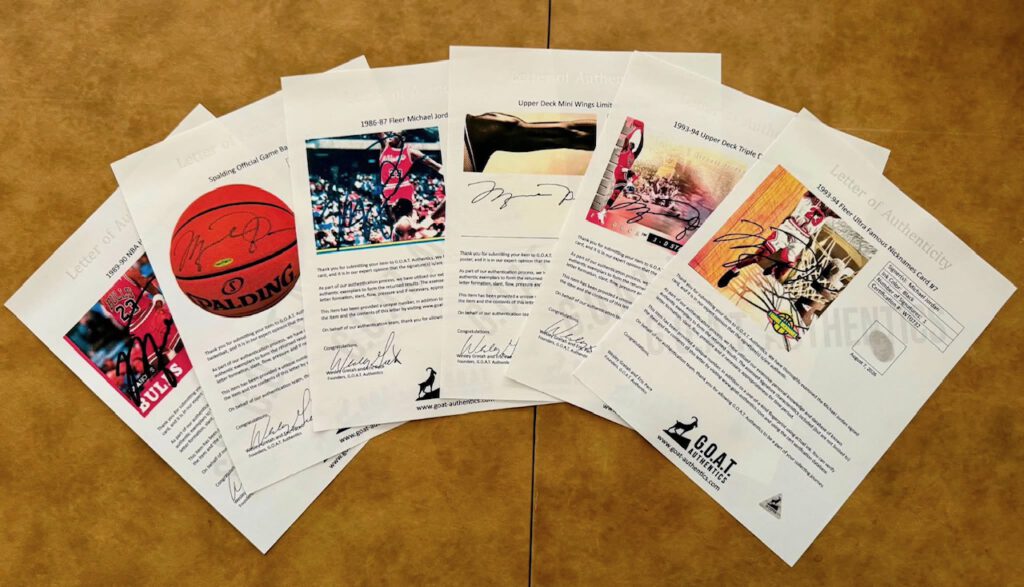
In this interview, Wesley Gretah discusses how he became an expert in Michael Jordan’s signature, why no single letter can authenticate an autograph, the future of sports memorabilia, and why authenticity will matter more than ever in the age of artificial intelligence.
How does one become an expert in Michael Jordan’s signature?
There isn’t a shortcut. It takes years of studying authentic signatures, understanding how Jordan signed throughout different periods of his career, and handling an enormous number of genuine examples. I’ve spent decades immersed in Michael Jordan memorabilia, comparing authentic and non-authentic signatures side by side. I started collecting Michael Jordan memorabilia at about 10 years old. Over time begin to recognize habits that are incredibly difficult to fake, things like rhythm, speed, spacing, pen lifts, pressure, and consistency. It’s pattern recognition built through thousands of observations, not memorizing one version of his autograph.
When did you first realize that a Michael Jordan autograph—despite having a certificate—was likely not signed by Jordan himself?
At a young age, I assumed that if an autograph had a certificate from a company, it was authentic. That changed when I started seeing signatures from Upper Deck. You begin to notice those signatures with the mom and pop shop certificate didn’t align with Jordan’s natural writing characteristics. Instead of assuming the autograph must be genuine because of the paperwork, I focused on the signature itself. Eventually, I submitted some of my own items to the bigger companies, 20 plus years ago, and got the results I expected, not authentic. The fire just grew from there.
When should red flags go up? Is it the distinctive “M” in Michael? How do you assess a signature?
No single letter authenticates or disproves an autograph. The “M” gets a lot of attention, but it’s only one piece of a much larger picture. I look at how every part of the signature flows together: the speed, proportions, spacing, line quality, natural variation, pen pressure, and how one letter transitions into the next, canvas and possibly the situation while signing. Genuine signatures have a natural rhythm. Simulated signatures often appear hesitant, overly deliberate, or mechanically consistent. Authentication is about evaluating the entire signature, not isolated characteristics.
Do you use forensic methods like PSA and Beckett?
My approach is based on comparative analysis and years of specialization along with items such as loops and certain light sources. I study known authentic exemplars, signing periods, provenance when available, and the writing characteristics of the signature itself. Companies like PSA and Beckett have their own methodologies, and I respect the work they do. My evaluations come from specializing in a very narrow area rather than trying to authenticate every athlete.
How do you explain that major grading companies sometimes reach different conclusions?
Authentication isn’t an exact science, and reasonable experts can disagree. Large authentication companies evaluate millions of signatures across thousands of athletes. My focus is much narrower. At G.O.A.T. Authentics, we specialize in only a handful of athletes, allowing us to study them in exceptional depth. That specialization sometimes leads us to conclusions that differ from broader authentication companies. Ultimately, every opinion should stand on the evidence supporting it.
You’ve helped stop auctions because you questioned an autograph. Do you ever feel sorry for the owners?
Absolutely. Most owners are acting in good faith. They often purchased the item believing it was authentic, sometimes years earlier, and may have invested significant money. My goal has never been to embarrass collectors or reduce the value of their collections. It’s to protect the integrity of the hobby and help prevent future buyers from making expensive mistakes. If an item turns out not to be authentic, the unfortunate reality is that someone was likely misled before the current owner ever acquired it.

Where do you see the sports memorabilia market in 20 to 30 years?
I think truly exceptional pieces will continue to appreciate over the long term. Scarcity matters. Historical significance matters. Provenance matters. As younger generations who grew up collecting become wealthier, demand for iconic athletes should remain strong. That said, not everything will increase in value. The market will likely become more selective, rewarding genuine rarity and quality while becoming less forgiving of common items or questionable authenticity. Authentication will only become more important as values rise.
Where should collectors look for worthwhile opportunities?
The best opportunities usually come from knowledge rather than location. Every marketplace can contain both bargains and overpriced items. Many treasures can be had at estate collections, long-held private collections, or items with strong provenance that others may overlook. The key is doing your homework before buying.
How important is the purchase price for long-term investing?
Absolutely. Your purchase price has a tremendous impact on your long-term return. Buyer premiums, taxes, and other costs all raise your effective investment. That’s why discipline is so important. Sometimes the best investment decision is simply passing on an item that’s become too expensive. Patience often produces better returns than chasing the hottest auction.
Will AI make authentic signatures harder to identify?
Without question. Artificial intelligence and advanced printing technologies are becoming increasingly sophisticated. They may eventually produce signatures that appear convincing to many collectors. However, authentication is about much more than visual similarity. We examine natural handwriting characteristics, ink behavior, writing rhythm, provenance, and the circumstances surrounding the signature. Technology will continue to evolve, but so will authentication methods. It’s likely to become an ongoing race between those creating sophisticated forgeries and those working to detect them.
What advice would you give collectors investing in athletes like Shohei Ohtani, Michael Jordan, Tom Brady, LeBron James, or Kobe Bryant?
First, buy quality over quantity. I’d rather own one exceptional piece than ten average ones. Second, focus on authenticity and provenance, those become increasingly important as values rise. Finally, collect athletes and pieces you genuinely enjoy. If the market goes through ups and downs, you’ll still own something meaningful. The best collections are built with patience, knowledge, and passion.