
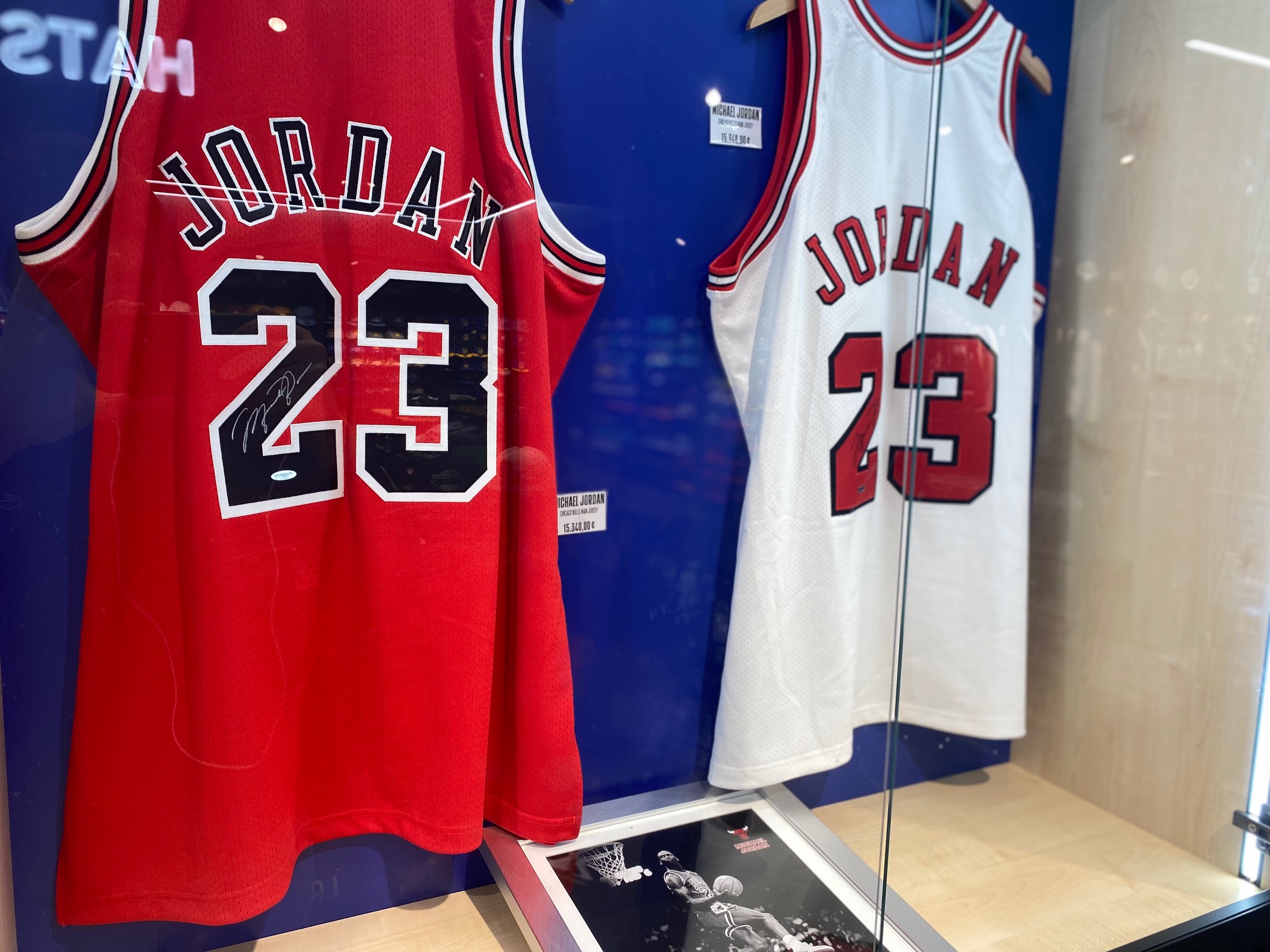
Sports autographs are one of the most personal parts of collecting. A signed basketball, jersey, rookie card, photo, or pair of shoes can feel very different from a regular collectible.
That is also why fake autographs are such a big problem in sports memorabilia.
Few athletes are forged as often as Michael Jordan.
Why Michael Jordan Autographs Are So Heavily Faked
Michael Jordan memorabilia sits near the top of the sports collectibles market. Signed jerseys, basketballs, shoes, photos, cards, game-used memorabilia, and rare autograph cards can sell for serious money.
That makes Jordan an obvious target for forgers.
His autograph is also tricky because it can look simple at first glance. In the 1990s, Jordan often used a style that can be roughly described as an “M” squiggle and a “J” squiggle. That makes many people think the signature is easy to copy.
It is not.
A real Jordan autograph has small habits in the strokes, loops, spacing, pressure, and flow. Forgers often copy the overall shape, but they usually miss some of the details.
A fake autograph that slips through authentication can suddenly become worth thousands or even tens of thousands of dollars. That is why the incentive to forge Jordan is so high.
The Sports Memorabilia Boom Made the Problem Worse
Sports memorabilia has become much more valuable over the last several years. Collectors are no longer only spending big money on rookie cards. Game-used jerseys, signed helmets, photo-matched memorabilia, autographed shoes, and authenticated signatures have become major categories inside the hobby.
Some historic memorabilia pieces have sold for millions of dollars at major auctions. As values rise, the incentive for fraud rises with them.
Modern fake memorabilia can include forged signatures, fake holograms, counterfeit certificates, copied authentication stickers, fake serial databases, and autopen signatures.
Many scammers study real memorabilia carefully. They do not only fake the autograph. They try to fake the whole package around it.
Upper Deck and Michael Jordan Signatures
Upper Deck has dominated the market for authenticated Michael Jordan signatures for years. Upper Deck Authenticated items are important because they are usually connected to witnessed signings, serial-numbered holograms, and Upper Deck’s own authentication system.
That does not mean every non-Upper Deck Jordan autograph is fake. Real in-person Jordan autographs do exist.
But if a Jordan autograph does not come from Upper Deck, it needs closer inspection. PSA, Beckett, JSA, and other authenticators can also be relevant, but the signature itself still needs to make sense.
A COA alone is not enough.
Why Authentication Is Difficult
Authentication companies like PSA, Beckett, and JSA spend a lot of time reviewing signatures and memorabilia. Upper Deck has built one of the strongest systems in the Jordan market through witnessed signings, serial-numbered holograms, and authentication records.
But no system is perfect.
Collectors have seen fake holograms, copied labels, counterfeit certificates, and forged items with convincing-looking paperwork. Fraudsters often imitate the appearance of real authentication systems closely enough to fool inexperienced buyers.
Even experienced collectors can struggle with high-quality fakes.
That is why Jordan autograph authentication is difficult. The signature itself must be examined, but the item, the COA, the hologram, the seller, the source, and the story behind the piece all matter too.
Can Fake Memorabilia Reach Major Auction Houses?
Many collectors assume that expensive memorabilia sold through a major auction house must automatically be authentic.
Major auction companies usually perform reviews and rely on authentication experts. But the volume of memorabilia in the market is huge, and mistakes can happen.
If a fake item successfully passes authentication, the value can increase massively almost overnight.
This is especially dangerous with Michael Jordan because demand is strong across almost every category: jerseys, basketballs, shoes, cards, photos, and game-used items.
Collectors should not assume that an item is safe only because it appears in a major auction listing.
Research still matters.
Key Areas in a Michael Jordan Autograph
When checking a Michael Jordan autograph, it helps to break the signature into parts.
The main areas to study are:
- the “M” stroke in Michael
- the figure-eight loop at the end of the “M”
- the small peaks in the middle of Michael
- the “J” stroke in Jordan
- the figure-eight loop at the end of the “J”
- the “D” loop or ending stroke in Jordan
Jordan’s signature has variations. It can change depending on the year, the item, the pen, the surface, and how quickly he signed.
But even with variation, the same basic habits often appear.
A forger may get one or two parts right. The problem is usually that other parts are wrong.
The “M” in Michael
The “M” is one of the first things to study.
In many genuine Jordan signatures, the “M” has a natural angle and length. The final downstroke of the “M” should not look strangely shortened or forced.
A common problem in forged examples is abnormal foreshortening of the ending downstroke of the “M” in Michael. The forger gets the general look, but the stroke does not finish naturally.
Other warning signs can include an unnatural slant, a flat ending loop, an overdrawn loop, a stiff movement, or pressure that looks too even.
The “M” should not look like someone slowly drew it from a reference image.
The Figure-Eight Loop After the “M”
The figure-eight movement at the end of the “M” is another important area.
In genuine examples, this loop often connects the “M” to the rest of Michael in a natural way. It can vary, but it should still look like part of the same signing motion.
In forged examples, this area is often wrong. The loop may look too flat, too pointed, too large, or badly connected to the rest of the name.
Some forgers understand that the loop should be there, but they do not execute it correctly.
That same mistake can also appear in the “J” in Jordan.
The Middle of “Michael”
The middle part of Michael is easy to overlook.
Collectors often look at the small peaks that make up parts of the “I,” “C,” “H,” and “L” in Michael. These peaks can help show whether the signature has the right rhythm.
One common warning sign is incorrect placement of the “twin peaks” in the middle of Michael. In some questionable examples, the peaks sit too close to the “M.” That changes the spacing and makes the whole signature feel compressed.
This is a subtle point, but it matters.
A fake Jordan autograph can look close from a distance and still be wrong in the middle details.
The “J” in Jordan
The “J” in Jordan is another major area.
Some real Jordan autographs have a wide or loose “J” loop, especially in later or rushed examples. A strange-looking “J” does not automatically mean the autograph is fake.
The question is whether the rest of the signature supports it.
If the “J” has the same kind of incorrect figure-eight execution as the “M,” that becomes more concerning. If the “M,” the middle of Michael, and the “J” all show problems, the autograph becomes much harder to trust.
The “D” Loop in Jordan
The ending of Jordan is also important.
One warning sign is an abnormal overextension of the circular “D” loop or ending stroke in Jordan. In questionable examples, the end of the name can look too stretched, too deliberate, or disconnected from the natural flow of the rest of the signature.
Again, one unusual feature does not prove everything.
But if the “M,” figure-eight loops, middle peaks, “J,” and “D” ending all show problems, the autograph should be treated with caution.
Repeated Mistakes Are a Major Red Flag
One questionable autograph is one thing. Multiple items with the same mistakes are another.
This is where many professional forgeries can be identified.
A forger may practice one Jordan style and repeat it across different items. The signatures may look convincing at first, but when compared side by side, the same wrong stroke patterns appear again and again.
Examples of repeated red flags include the same shortened “M” downstroke, the same misplaced middle peaks, the same incorrect figure-eight loop after the “M,” the same incorrect figure-eight movement in the “J,” and the same overextended “D” loop in Jordan.
If two or more items show the same abnormal patterns, that can suggest they were signed by the same person.
That person may not be Michael Jordan.
Side-by-Side Comparisons
Side-by-side comparison is one of the most useful tools when checking a Jordan autograph.
Start with a known genuine example. Upper Deck examples are often used because many are tied to witnessed signings and serial-numbered authentication.
Then compare the questionable autograph part by part.
Do not just ask whether the overall shape looks similar. Look at the “M,” the loop after the “M,” the middle peaks, the “J,” and the ending of Jordan.
If you are comparing several questionable items, look for repeated mistakes.
For example, if two baseball bats both show the same shortened “M,” the same misplaced peaks in Michael, the same flawed figure-eight connection, and the same overextended “D” loop, that is a serious warning sign.
The issue is not only that each autograph looks off.
The issue is that they look off in the same way.
Why Some Real Jordan Autographs Look Strange
Not every unusual Jordan autograph is fake.
Jordan’s autograph changed over time. His 1990s signatures, Upper Deck signatures, in-person autographs, rushed signatures, and later lazy signatures can all look different.
The item also matters. A basketball is harder to sign than a flat photo. A shoe, jersey, card, or glossy surface can change the way the pen moves.
This is why authentication is difficult.
A real Jordan autograph can have an unusual feature. But the full signature still needs to show natural Jordan movement.
Why In-Person Autographs Still Matter
Because authentication has become complicated, many collectors still like in-person autographs.
Watching the athlete sign the item removes a lot of uncertainty. It also gives the collector a personal connection to the piece.
Real in-person Michael Jordan autographs do exist on the open market. But they are not automatically safe just because a seller claims the item was signed in person.
The same checks still apply: signature structure, item history, seller reputation, authentication, and price.
How To Check Before Buying
Before buying a Michael Jordan autograph, check the basics:
- compare it with known authentic examples
- study the “M” in Michael
- check the figure-eight loop after the “M”
- look at the middle peaks in Michael
- study the “J” in Jordan
- check the ending loop or stroke in Jordan
- verify the COA or hologram
- check the serial number in the official database
- check the seller
- review the item’s history
- compare the price with normal market value
If the price looks too good, be careful.
A real Jordan autograph is expensive for a reason. A cheap one may have a problem.
The Future of Authentication
As sports memorabilia values continue rising, authentication will likely become even more important.
Collectors may see more advanced hologram security, stronger digital verification systems, better database tracking, enhanced photo matching, AI-assisted authentication, and layered anti-counterfeit technology.
That will help, but it will not remove the need for collector knowledge.
Fraudsters adapt. Collectors have to adapt too.
Buyer Beware Still Applies
Michael Jordan autographs are heavily forged because the demand is high and the money is real.
The signature can look simple, but the details matter. The “M,” the figure-eight loops, the middle of Michael, the “J,” and the ending of Jordan all need to be studied together.
Upper Deck examples remain an important reference point, but real in-person autographs also exist. PSA, Beckett, JSA, and other authenticators can help, but a COA should never replace basic research.
The safest approach is to compare carefully, verify authentication, study multiple known examples, and avoid rushing into expensive purchases.
With Jordan autographs, the small details are often where the truth is.