
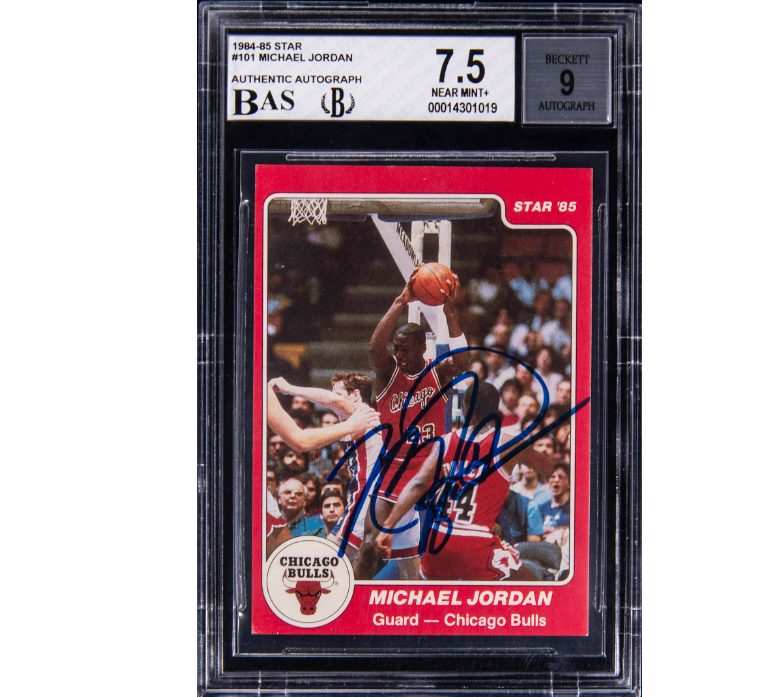
A rare 1984–85 Star Co. rookie card of Michael Jordan is currently up for auction at Goldin. After just one week, bidding has already climbed past $120,000, and with the buyer’s premium factored in, the price now sits at roughly $147,000. The steady stream of bids – well over 70 so far – underscores how aggressively collectors are chasing this particular piece.
While many fans instinctively point to the 1986–87 Fleer card as Jordan’s “true” rookie, seasoned collectors take a broader view. Early Michael Jordan cards – especially those from his rookie period – have become increasingly difficult to find.
Star Co. cards are unique. In the 1980s, they were not sold nationwide through traditional retail channels but were instead distributed regionally – often in arenas or stadiums before or after games, through fan shops, or via local vendors. This unconventional distribution model is a key reason why availability is so limited today. Without a broad retail rollout and with relatively small print runs, far fewer cards entered circulation compared to later sets like the 1986–87 Fleer release.
Another factor is that these card sets were largely overlooked from the late 1980s through the 1990s and into the early 2000s. Questions around licensing and their limited availability – why they weren’t more widely accessible, even within the United States – made them less appealing to collectors for many years. That perception has now shifted completely: what was once seen as a weakness has become a defining strength, driven by their scarcity and limited supply.
A Card That Predates the Iconic 1986-87 Fleer
What truly sets the 1984–85 Star Co. Michael Jordan rookie card apart is its scarcity. Estimates suggest a print run of only around 3,000 copies, a fraction of what was produced for later releases. In a market where population reports and grading counts matter, that level of rarity is a major driver of value – especially when the card surfaces in strong condition.
This particular example is strong for its grade. Graded 7.5 (Near Mint+) by Beckett Authentication Services, it shows solid subgrades across the board and, more importantly, features a clean, authenticated autograph graded a 9. That signature alone pushes the card into a different tier—less a collectible, more a centerpiece.
For comparison, the 1986 Fleer Jordan card exists in far greater numbers, with tens of thousands of copies produced and graded over time. In contrast, the Star Co. version remains significantly harder to find – particularly in higher grades.
The Michael Jordan Rookie Card Hunt
It should also be noted that Jordan cards are particularly susceptible to counterfeits. Increasingly, reprints are appearing on the market that come very close to the original rookie cards, especially because printing technology has improved significantly over the past 40 years.
This is also where one of the key distinctions lies: cards from the 1980s are typically not as perfectly printed as modern reproductions, simply because the technology at the time wasn’t as advanced. Ironically, that imperfection is what helps identify authentic cards today.
In this case, the goal is not to look for perfection, but to detect originality.
Image source: Goldin