
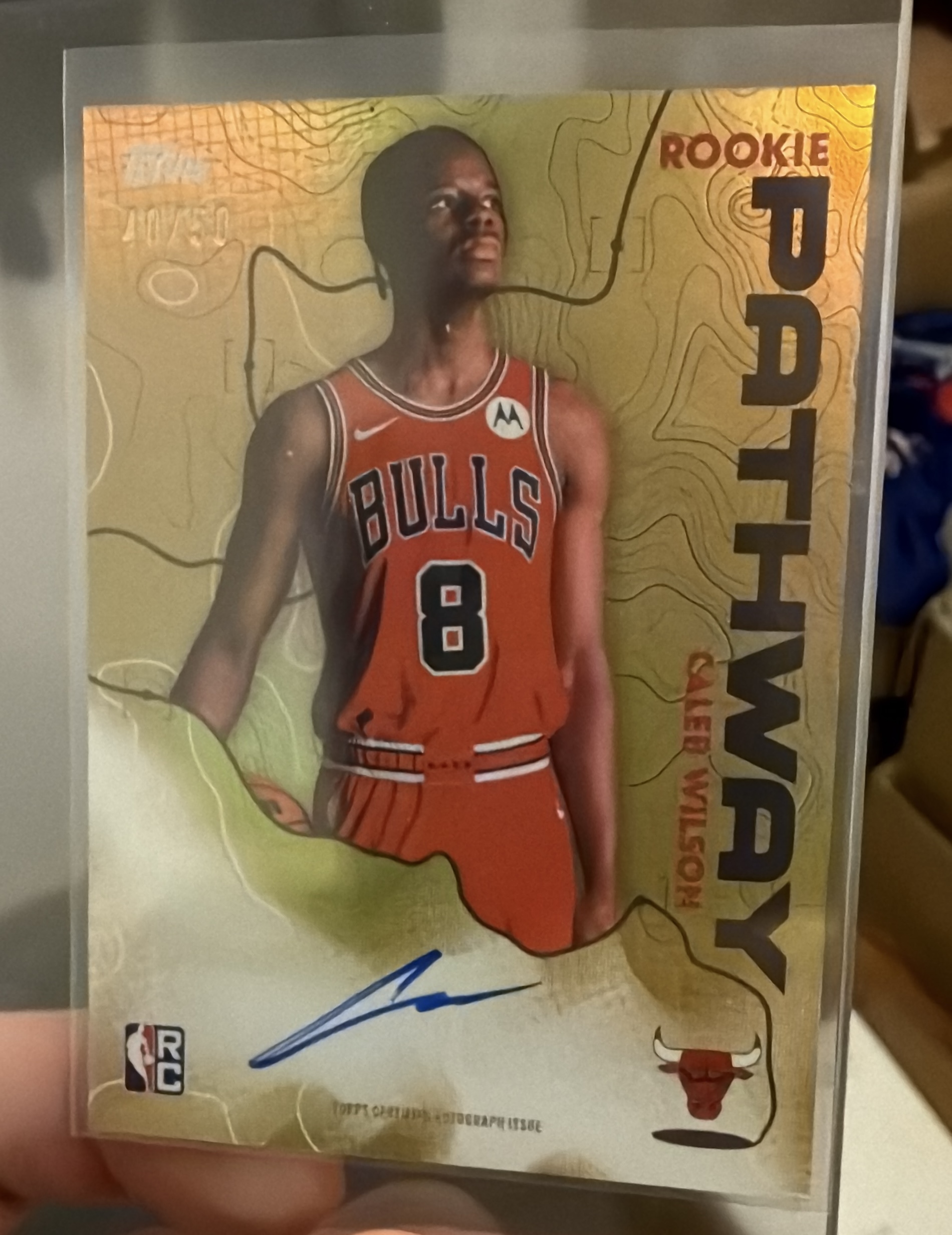
I have to admit something about myself as a sports card collector. I am a box chaser. The players I pull from hobby boxes have an almost ridiculous influence on who I suddenly become interested in. A player I barely followed yesterday can become the subject of hours of research simply because I pulled one of his cards. I start looking at his performances, his potential, his weaknesses and, inevitably, the prices collectors are already paying for his autographs.
That is exactly what happened when I opened two hobby boxes of 2026/27 Topps Flagship Basketball. I had looked at the rookie class, written a few names on a piece of paper and hoped for something involving Cooper Flagg or Victor Wembanyama. An autograph from Steph Curry, Anthony Edwards or Jalen Brunson would have been more than welcome, too.
Instead, I pulled a Caleb Wilson Rookie Pathway Gold Autograph numbered 40/50 from 2026/27 Topps Flagship Basketball. The card features an on-card signature, Wilson in his Chicago Bulls uniform and a gold-colored design. Only 50 copies of this numbered parallel exist. While other Caleb Wilson rookie autographs have already attracted substantial bids, I have not yet established a reliable completed-sale price for this exact Rookie Pathway card. An actual on-card autograph, not a sticker, from the new NBA rookie class.
Wilson had not been particularly high on my personal chase list. Within a few hours of pulling the card, however, I had developed a considerable interest in the fourth overall pick of the 2026 NBA Draft.
Caleb Wilson: The Fourth Pick in the 2026 NBA Draft
Caleb Wilson entered the NBA after an impressive freshman season with the North Carolina Tar Heels. He averaged 19.8 points and 9.4 rebounds while shooting 57.8 percent from the field before a hand fracture ended his college season early.
He was selected fourth overall by the Chicago Bulls. AJ Dybantsa went first to the Washington Wizards, attracting the attention that naturally follows a number one pick.
I find Wilson’s draft position appealing from a collector’s perspective. Fourth overall is hardly an overlooked prospect, but it does place him outside the immediate spotlight surrounding the first selection. That does not necessarily make his cards undervalued, although it creates an interesting comparison between the expectations surrounding different members of the same rookie class.
Wilson combines size, athleticism and defensive versatility with efficient scoring around the basket. His shooting and offensive creation still need development, but he has the physical tools to influence games in several ways.
During my research, I also encountered comparisons with Michael Jordan. I think those are premature and not particularly useful. Wilson is a different type of player, and the standard Jordan established is almost impossible to meet. I am much more interested in whether Wilson can become an elite NBA forward in his own right.
His college performances suggest that the potential is there. The prices collectors were already paying for his cards suggest that plenty of people agree.
Caleb Wilson’s Most Expensive Cards Before the NBA Draft
On June 23, 2026, Sports Illustrated published an article examining the five biggest Caleb Wilson trading card sales ahead of the NBA Draft. I knew that high-end prospect cards could command substantial prices, but I had not expected Wilson’s market to be this strong before his NBA debut. The most expensive card was a 2025 Bowman U Now 1/1 Foilfractor #42, which sold for $5,500. It commemorates Wilson becoming the first North Carolina freshman to score at least 20 points in six consecutive games.
A 2025 Topps Chrome McDonald’s All-Americans Billboard Ink Superfractor Autograph 1/1 sold for $5,100. Personally, that is the card I would most like to own from the list. A one-of-one Superfractor with an autograph combines two features that have long appealed to high-end collectors. Another Bowman U Now Foilfractor 1/1, card #70, commemorating his 23-point performance against Duke, reached $5,000. A 2025/26 Bowman Basketball 1st Bowman Platinum 1/1 also sold for $5,000, while a 2025/26 Bowman 1st Basketball Red Autograph /5 achieved $4,000 on eBay. These are not representative prices for ordinary Caleb Wilson cards. Four were one-of-ones, and the fifth was limited to five copies. They represent the top end of his early collecting market. But they also demonstrate that collectors were prepared to spend thousands of dollars on Wilson before he had played a single NBA game. That made me curious about how the market would value his new NBA rookie autographs.
What Is My Caleb Wilson Rookie Pathway Gold Auto /50 Worth?
This was the question I started asking almost immediately after pulling my card. The challenge is that the 2026/27 Topps Flagship Basketball product has only just been released, and reliable sales data for specific low-numbered parallels is still limited. I found several Caleb Wilson autograph cards attracting substantial attention on eBay.
One example was a 1981–82 Topps Basketball Rookie Autographs Gold Rainbow /50, numbered 41/50, which had reached $1,225 with 51 bids on November 11. Another, a Level Up Signatures Gold Rainbow /50, numbered 07/50, had attracted 28 bids and reached $690. Both cards feature Wilson’s autograph and are limited to 50 copies, but neither is the Rookie Pathway card I pulled. Their designs, insert sets and collector demand may differ significantly, so they cannot establish the value of my card.
An unnumbered 1981–82 Topps Rookie Autograph was also shown as sold for $485 on November 5, although the listing accepted offers and the final transaction price may have been lower. These examples suggest that collectors are already paying considerable attention to Wilson’s first NBA-season autographs. But they do not justify assigning a four-figure valuation to my Rookie Pathway Gold /50. As of November 11, 2026, I have not verified a completed sale of this exact card. I would rather acknowledge that uncertainty than publish an estimated value without a reliable comparison.
For now, I am considering whether to submit the card to PSA. Its condition will matter, and a PSA 10 could make it more desirable. But before spending money on grading, I want to see what collectors actually pay for the Rookie Pathway Gold /50 once more copies reach the secondary market.
Are Caleb Wilson Rookie Cards Worth Buying in 2026?
With 2026/27 Topps Flagship Basketball now available, collectors can pursue Wilson’s NBA-season cards rather than relying exclusively on college and prospect releases. His regular Flagship rookie card is #259, while the product also includes numbered parallels, inserts and autograph sets. My Gold Pathway /50 is only one of several limited Wilson autograph options. That is an important distinction. Modern basketball products can contain numerous parallels and autograph variations, so a card numbered to 50 is not automatically among the rarest collectibles of a particular player.
I generally prefer low-numbered autographs to ordinary base cards, especially when the signature is directly on the card. But scarcity alone is not enough. The design, the product, the player’s development and the demand from collectors all influence the long-term appeal of a card. Wilson’s early market is already expensive. The five major college-card sales show that collectors identified his potential long before the NBA Draft, and the first auctions for his NBA rookie autographs suggest that interest has continued. I see enough in Wilson’s game to understand the enthusiasm. His athleticism and defensive versatility give him a strong foundation, while his offensive development will determine whether he becomes a very good NBA player or something considerably more significant.
What I am not prepared to do is treat every numbered Wilson card as an automatic investment opportunity. I have seen enough prospect hype in this hobby to know how quickly expectations can change. For the moment, I would rather follow the first completed sales of his NBA rookie autographs and watch how he develops on the court than start buying every parallel I can find.
My own card has already given me a reason to pay much closer attention to the Chicago Bulls. I will be watching the auction of card 41/50 especially carefully. Its final price could help me decide whether my 40/50 belongs in a PSA submission, on the secondary market or in my personal collection for the next few years.
As a final bit of research, I took a look at how previous NBA rookie classes have developed over the years.
| Player (Draft position) | Card | Sale | Date |
|---|---|---|---|
| Ja Morant (#2, 2019) | 2019/20 Crown Royale Rookie Autographs Gold /10, BGS 9.5 | $3.774 | March 2022 |
| Ja Morant (#2, 2019) | Same card, lower grade | $1.170 | December2023 |
| Ja Morant (#2, 2019) | Crown Royale Rookie Autographs Gold /10, ungraded | $999,99 | April 2026 |
| Tyrese Haliburton (#12, 2020) | 2020/21 Revolution Rookie Autographs, PSA 10 | $300 | October 2022 |
| Tyrese Haliburton (#12, 2020) | Same card, other number | $191,25 | January 2026 |
| Scottie Barnes (#4, 2021) | 2021 Panini Eminence Peerless Gold Rookie Patch Auto /5 | $990 | February 2026 |
As always, the real question is what happens next. If Caleb Wilson can build on his early performances and eventually become the face of the Chicago Bulls franchise, we might be watching a new NBA star at the very beginning of his career. And owning one of his early rookie autographs could turn out to be something special.
But we have seen how unpredictable these stories can be. Just think about Zion Williamson or Ja Morant. Both entered the league with enormous expectations, and both have shown extraordinary talent. Yet injuries, setbacks and circumstances beyond basketball have complicated their careers and affected how collectors view their cards. The comparisons are not perfect, but they remind us that potential and long-term success are two very different things.
In the sports card market, a relatively small number of players capture a disproportionate share of the biggest prices. In many ways, it is a winner-takes-most market, and predicting those winners early is incredibly difficult. But I would add one thing: Between a $1 trading card and a multimillion-dollar sale, there are countless fascinating price points. Not every player needs to become Michael Jordan, and not every card needs to become a six-figure collectible to make collecting worthwhile. There is plenty of room in between for great players, memorable cards and purchases that turn out to be surprisingly rewarding.