
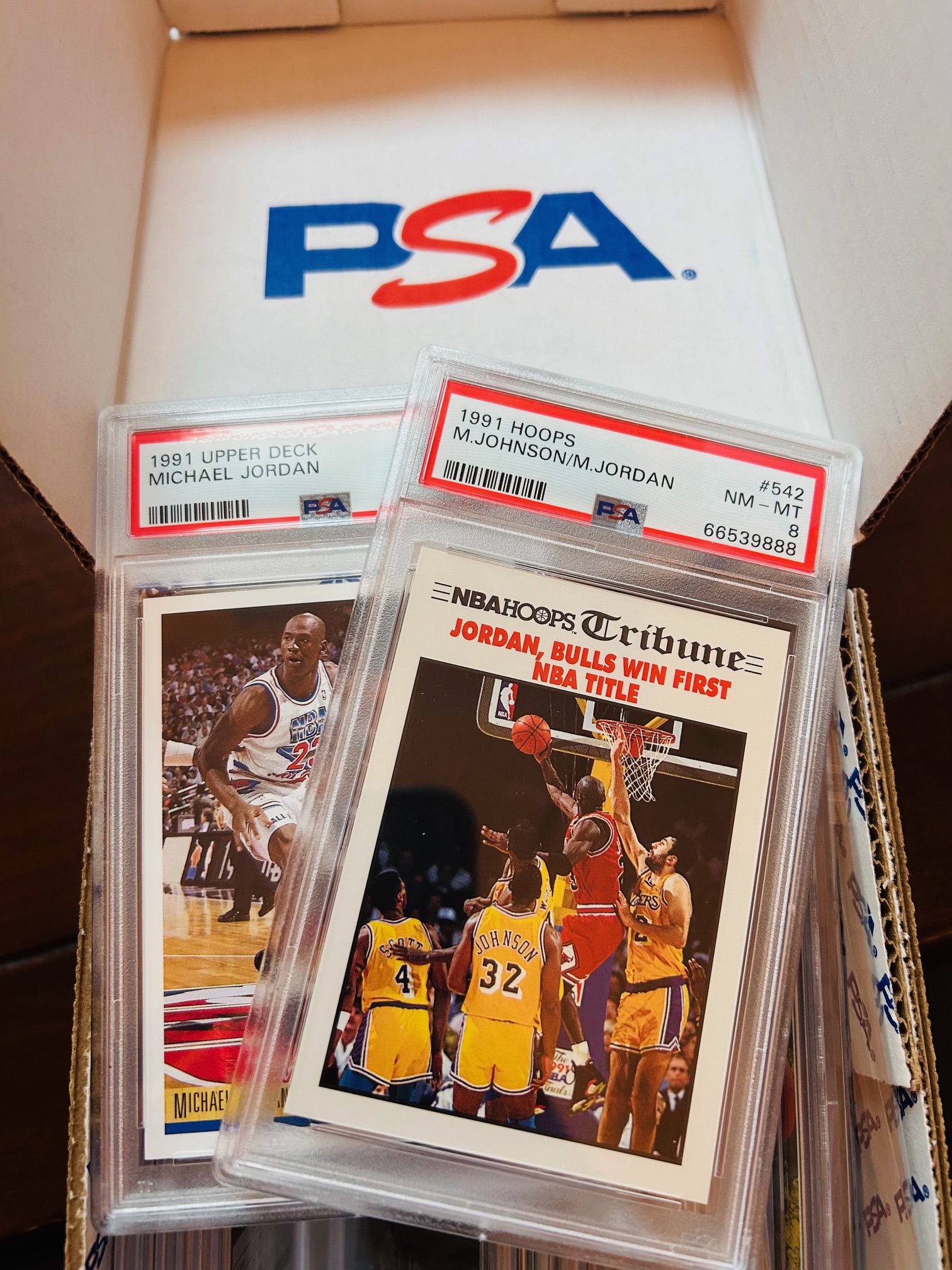
There is an unwritten rule in sports card investing that many collectors, myself included, sometimes tend to forget: until you actually sell a card, you have not generated any sales revenue. What you have done is commit capital to an asset that you hope to sell at a profit sometime in the future.
There is nothing inherently wrong with that. However, depending on how much money you spend on cards and how long it takes to sell them, sports card investing can quickly turn into a serious cash flow problem. And the better your collection looks on paper, the easier it can be to overlook this problem.
How Much Money Is Actually Tied Up in Your Sports Cards?
Let’s look at a hypothetical example that is not too far removed from my own collecting experience.
You have spent $1,000 on Whatnot breaks and another $2,000 on boxes purchased directly from Topps and individual cards on the secondary market.
You have even pulled a few bangers. In my case, these include a Munetaka Murakami Gold Rookie Autograph /50, a Caleb Wilson Gold Autograph /50 and several numbered Shohei Ohtani refractors.
Naturally, you want to send your most promising cards to PSA. You also include some lower-end cards where you believe there is a little margin to be made through grading.
Let’s assume you submit 30 cards at an average grading cost of $46.20 per card, equivalent to €42. This is a hypothetical blended cost across different grading tiers, rather than a specific PSA service price.
| Expense | Amount |
|---|---|
| Whatnot breaks | $1,000 |
| Boxes and individual cards | $2,000 |
| PSA grading: 30 × $46.20 | $1,386 |
| Total capital invested | $4,386 |
Assumed exchange rate: €1 = $1.10, rounded from the ECB reference rate of $1.0975 on November 26, 2026. Shipping, insurance, potential PSA upcharges and other expenses are excluded.
For comparison, PSA’s European pricing page currently lists its introductory Standard service at €49.99 per card, with a maximum insured value of €900. Submitting all 30 cards at that rate would increase the total investment to approximately $4,650.
Before you have sold a single card, you have already committed at least $4,386 in our example.
Your Collection Is Worth $7,000. Congratulations. Now What?
Let’s assume your grading results are reasonably good. I will deliberately leave my own recent grading results out of this hypothetical example, because my gem rate on the numbered Ohtani refractors I purchased was frankly terrible. None of them received a PSA 10.
In our example, however, things go reasonably well. Based on recent comparable sales, you estimate that your cards are now worth $7,000.
On paper, you have made a fantastic investment. But what happens once you account for selling costs?
| Financial metric | Amount |
|---|---|
| Estimated collection value | $7,000 |
| Total capital invested | $4,386 |
| Unrealized profit before selling costs | $2,614 |
| Gross unrealized return | 59.6% |
| Estimated selling costs (13%) | $910 |
| Potential net sales proceeds | $6,090 |
| Potential profit after selling costs | $1,704 |
| Potential return after selling costs | 38.9% |
| Actual sales revenue | $0 |
For simplicity, I assume selling costs of 13% throughout this article. This is broadly comparable to eBay’s published US trading card fee of 13.25%, although actual costs vary depending on the marketplace, seller location, account type and additional charges.
Even without a market correction, selling costs reduce our potential profit by more than a third. And while a return of almost 39% after marketplace fees still sounds impressive, your bank account tells a very different story.
You have spent $4,386, and none of that money has returned to you.
The Cash Flow Problem Nobody Talks About
What makes sports card investing particularly challenging is the amount of time that can pass between the initial investment and the eventual sale.
You purchase a box, pull a redemption, wait several months for the autograph to arrive, send the card to PSA and then wait again. Once the card returns, you might decide that the offseason is not the right time to sell and hold it until Opening Day.
Before you know it, almost a year has passed.
Throughout that period, your money is tied up in a collectible that generates no income simply by being in your possession.
Of course, unrealized profits also exist in the stock market. The fundamental difference is liquidity. Publicly traded shares in large companies can generally be sold quickly at observable market prices. A low-numbered sports card might take weeks or months to sell at a price you are willing to accept.
And while you are waiting, there is always another interesting release, another promising rookie and another Whatnot break.
That is how a profitable-looking collection can gradually become a liquidity problem.
However, having capital tied up in collectibles is not necessarily a financial problem. If you have sufficient savings, a stable income and invest exclusively with money you can afford to lose or leave untouched for years, you may be perfectly comfortable holding your cards.
The problem begins when you depend on future card sales to finance your current spending or when you continually commit fresh capital without recovering previous investments.
In my opinion, money needed for everyday expenses or financial emergencies should never be tied up in speculative collectibles.
What Happens When the Market Turns?
Let’s assume selling costs of 13% and examine what happens if the estimated value of our $7,000 collection declines before we manage to sell it.
| Market scenario | Gross collection value | Net sales proceeds | Profit or loss | Return |
|---|---|---|---|---|
| No correction | $7,000 | $6,090 | +$1,704 | +38.9% |
| Market declines 10% | $6,300 | $5,481 | +$1,095 | +25.0% |
| Market declines 20% | $5,600 | $4,872 | +$486 | +11.1% |
| Market declines 30% | $4,900 | $4,263 | −$123 | −2.8% |
| Market declines 40% | $4,200 | $3,654 | −$732 | −16.7% |
| Market declines 50% | $3,500 | $3,045 | −$1,341 | −30.6% |
The calculation excludes additional expenses and assumes that all cards can be sold at their estimated market values.
What initially looked like an investment with a gross return of almost 60% turns into a loss following a market correction of approximately 28%.
And that assumes you can actually sell every card.
Anyone who has spent time selling sports cards knows that a recent comparable sale does not guarantee that another buyer will pay the same price tomorrow.
What If You Cannot Sell Your Entire Collection?
This is where things become particularly interesting. Even if market prices remain stable, you might struggle to find buyers for parts of your collection.
Let’s assume you manage to sell cards representing only 80% of your estimated collection value.
| Scenario | Gross sales | Net cash recovered | Cash surplus or shortfall | Remaining inventory value |
|---|---|---|---|---|
| Sell 100% | $7,000 | $6,090 | +$1,704 | $0 |
| Sell 80% | $5,600 | $4,872 | +$486 | $1,400 |
| Sell 60% | $4,200 | $3,654 | −$732 | $2,800 |
| Sell 40% | $2,800 | $2,436 | −$1,950 | $4,200 |
| Sell 20% | $1,400 | $1,218 | −$3,168 | $5,600 |
The percentages refer to the estimated value of the collection, not the number of cards. Remaining inventory values are estimates before selling costs.
Selling only 60% of the collection leaves you $732 short of recovering your original expenditure, even though you still own cards theoretically worth $2,800. That is not necessarily an investment loss. It is a cash recovery shortfall. The remaining cards still have potential value, but they have not generated liquidity. Now imagine that the market declines by 20% and you can sell only 80% of your collection at the revised prices.
| Financial metric | Amount |
|---|---|
| Original estimated collection value | $7,000 |
| Collection value after 20% correction | $5,600 |
| Gross sales at 80% sell-through by value | $4,480 |
| Net sales proceeds after fees | $3,897.60 |
| Original capital invested | $4,386 |
| Capital still to recover | $488.40 |
| Remaining estimated inventory value | $1,120 |
This combination of declining prices and limited liquidity is what concerns me most. The market does not necessarily need to collapse for an investor to experience financial pressure.
The Hidden Cost of Waiting
There is another expense that rarely appears in sports card collection trackers: the opportunity cost of capital. If I commit $4,386 to sports cards for an entire year, I cannot use that money elsewhere during that period. Assuming an illustrative alternative annual return of 5%, the opportunity cost amounts to approximately $219.
| Holding period | Illustrative opportunity cost |
|---|---|
| 3 months | $55 |
| 6 months | $110 |
| 12 months | $219 |
| 24 months | $450 |
Calculated using a hypothetical 5% effective annual return with compounding. The alternative return is not guaranteed.
After one year, our potential profit of $1,704 would therefore represent an economic gain of approximately $1,485 relative to that alternative investment. For collectors financing purchases through interest-bearing credit, the situation can become considerably worse. Financing costs are actual expenses, not merely hypothetical opportunity costs. This is also why redemption waiting times and lengthy grading processes matter from an investment perspective. Time is not free.
You Are Investing in Human Beings
Your investment thesis often depends on the performance and health of an individual athlete.
Imagine investing heavily in a promising rookie who subsequently suffers a career-threatening injury. The entire investment thesis could change overnight, and finding buyers for that player’s cards might become considerably more difficult.
A player can also lose his starting position, fail to live up to expectations or simply become less relevant to collectors. This is one reason why I increasingly distinguish between investing in established legends and speculating on active players. Established careers and historical achievements can provide a more stable foundation for collector demand, although cards of retired athletes are certainly not immune to market corrections.
When a substantial portion of your collection is concentrated in one or two active players, you are exposed to both market risk and individual career risk.
How Much Do You Actually Need to Sell to Break Even?
With $4,386 invested and assumed selling costs of 13%, you would need to generate approximately $5,041 in gross sales just to recover your initial expenditure.
That represents roughly 72% of your estimated $7,000 collection value.
One metric I find particularly useful is what I call the cash recovery rate: the percentage of my original expenditure that I have recovered through actual net sales proceeds.
Cash Recovery Rate = Net Cash Recovered ÷ Capital Invested × 100
| Gross sales generated | Net proceeds | Capital still to recover | Cash recovery rate |
|---|---|---|---|
| $1,000 | $870 | $3,516 | 19.8% |
| $2,000 | $1,740 | $2,646 | 39.7% |
| $3,000 | $2,610 | $1,776 | 59.5% |
| $4,000 | $3,480 | $906 | 79.3% |
| $5,041 | $4,386 | $0 | 100% |
| $7,000 | $6,090 | $0 | 138.9% |
Recovering my original expenditure does not mean that every individual card has been profitable. But it does mean that I have released the capital I initially committed to the collection.
And unlike estimated collection values, this metric is based on actual transactions and cash flows.
Sports Card Investors Should Think More Like Businesses
If a retailer spends thousands of dollars purchasing inventory but struggles to sell it, the company has a working capital problem. Even a business with attractive potential profit margins can run into financial difficulties if its inventory does not generate cash quickly enough.
I see no reason why sports card investors should think fundamentally differently. The questions I increasingly ask myself are not just how much a card could be worth in five or ten years, but how much capital I have tied up in my collection, how quickly I can liquidate parts of it and how much additional money I am willing to commit before recovering some of my previous investments.
That does not mean I want to sell every valuable card immediately. Some cards I genuinely want to hold for years. But there is a considerable difference between deliberately holding a long-term investment and accumulating inventory because selling it would mean accepting a disappointing price. My recent experience selling lower-end cards through COMC has made this distinction particularly clear to me. Owning hundreds of cards with theoretical market values is one thing. Finding hundreds of buyers is another.
Cash Flow Matters More Than Collection Value
I still enjoy opening boxes, participating in breaks, identifying promising rookies and sending cards to PSA. I also believe there are genuine investment opportunities in the sports card market.
However, successful sports card investing requires more than identifying the right players and pulling valuable cards. It requires capital management, patience and, perhaps most importantly, the discipline to sell. A collection worth $20,000 might look impressive. But if you have spent $15,000 building it, you need to generate approximately $17,241 in gross sales at a 13% selling fee just to recover your initial expenditure.
That means you need to realize more than 86% of your estimated collection value before you have recovered your original investment. There is nothing wrong with holding cards for the long term, provided you can afford to do so. But if you depend on selling those cards to finance your everyday life or your next investment, the estimated value of your collection becomes considerably less important than your ability to turn it into cash. Ultimately, paper profits don’t pay your bills. Cash does.
Disclaimer: All financial calculations are illustrative. This article reflects my personal collecting experience and opinions and does not constitute financial advice.