
A few years ago, the logic when buying a signed piece of memorabilia was fairly simple. There was a sticker with a number on the object, you entered that number on the authenticator’s website and, if the correct name appeared, the whole thing at least felt reasonably safe.
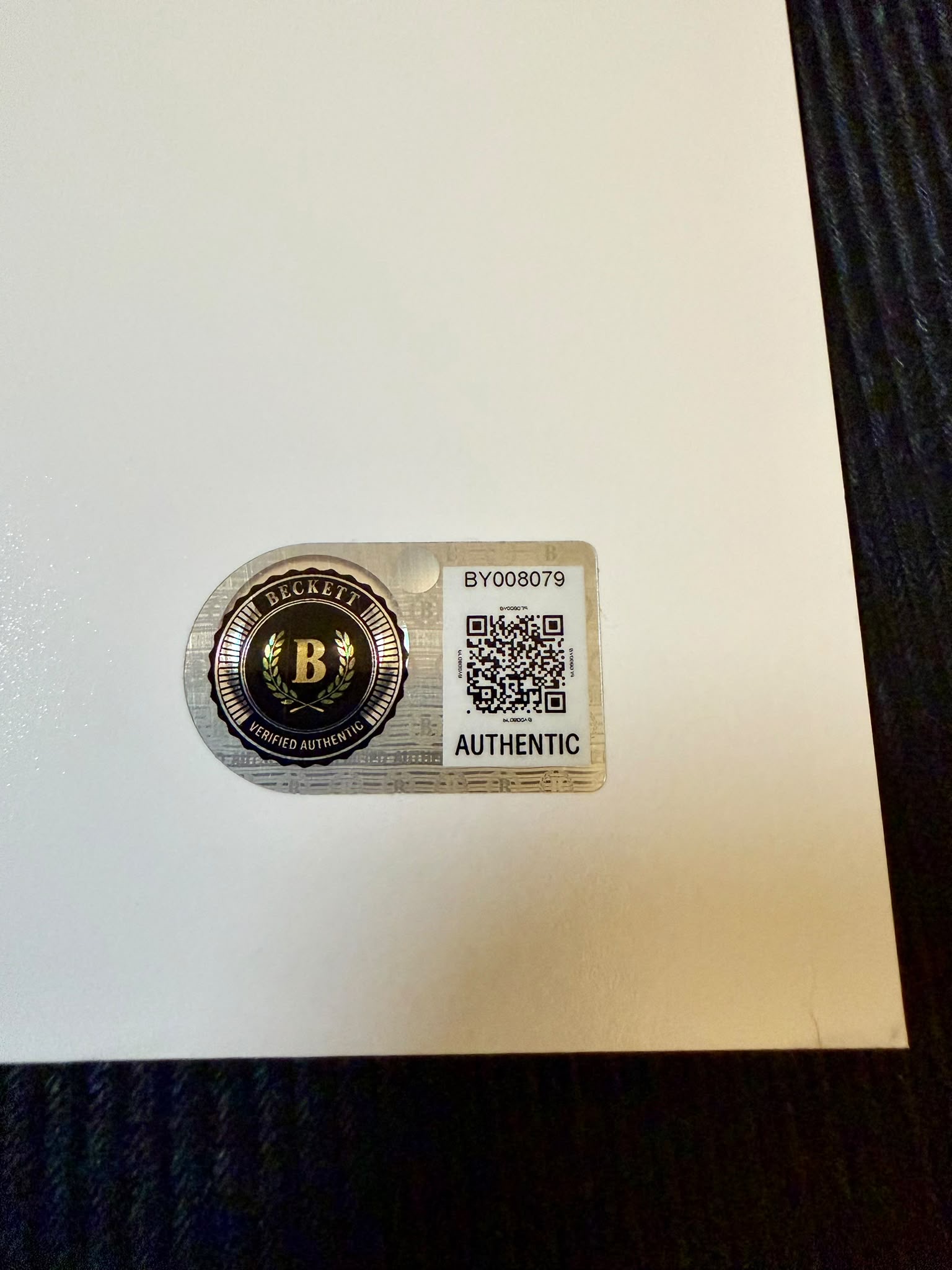
Beckett Authentication Services is revising its security system for autographs. The new Authentication Stickers and Letters of Authenticity are supposed to include holographic metallic material and hidden UV patterns, among other things. Additional security features have also been added, while the certification can still be checked via QR code or Certification Number in the Beckett database.
Some of the changes had actually started becoming visible before the wider relaunch. Images of new Beckett Witnessed stickers appeared online during the summer. One documented example showed a larger holographic label and a QR code leading through a new verification process rather than simply opening the familiar Beckett certificate lookup. The system checked whether the certificate existed and also used an image of the sticker as part of the verification process.
The timing has become even more interesting because Beckett’s digital infrastructure has been going through a much bigger rebuild. Beckett.com, Beckett Authentication Services and other digital services have been unavailable during the work. On October 2, Beckett finally provided another piece of information about why the downtime had become so extensive. During planned work to modernize its legacy IT systems, the company says it detected what it calls “suspicious technical activity” and took its platforms offline as a precaution.
Beckett brought in outside security experts and started a forensic investigation. According to the company, that investigation has so far found no evidence that sensitive customer information was affected. Beckett also says its core certification records, grading records and historical population databases remain intact and uncompromised.
When a company reports suspicious activity, the first question is normally whether customer data was stolen. Names, addresses, email addresses, payment information. Beckett has actually dealt with that kind of problem before. A separate breach reported in November 2025 exposed names, usernames, email addresses, phone numbers and physical addresses.
One of its most important assets is the enormous amount of authentication information it has accumulated over the years. Somewhere inside that infrastructure are the records connecting certification numbers with authenticated signatures and memorabilia, from young prospects most collectors have barely heard of to Michael Jordan, Tom Brady and other superstars whose autographs can be worth thousands or tens of thousands of dollars.
Beckett itself describes how its experts use a database of autograph exemplars when examining signatures. Once an autograph passes authentication, the certification number connects the physical item with Beckett’s online records. For items with a full LOA, Beckett can also include an exact image of the item that was examined.
I have no idea whether anyone involved in the suspicious activity was interested in any of that. Beckett says its certification and historical databases were not compromised, and there is currently no evidence to say otherwise. But the incident raises an interesting question about authentication companies that goes well beyond customer email addresses: how valuable is the database itself?
At first glance, the new stickers sound like a relatively small product update. For the memorabilia market, I find them more interesting because Beckett is responding to a problem that will inevitably become bigger as prices rise. We spend a lot of time talking about fake autographs. But there is a second level: what happens when not only the signature is forged, but also the trust that is supposed to sell it?
A Certification Number can be copied. A QR code can be copied. If I know the number of a genuine Beckett, PSA or other certified item, a database search can be completely correct even though the object I am holding is not the object the authenticator examined. PSA itself warns buyers about exactly this fundamental problem: even successful Cert Verification does not eliminate the risk because genuine certification numbers from public sources can be used for counterfeits.
That is the point at which the small sticker suddenly becomes quite important.
The COA Is Becoming a Security Product
Fanatics Authentic already works with numbered holograms that can then be verified online. PSA combines tamper-evident labels with database entries and offers additional security features with its LOAs. Current PSA LOAs can, for example, include a high-resolution image of the actual object that was examined. This image can then also be displayed during online verification.
I like that much more than a database that, after I enter a number, simply tells me that at some point a Michael Jordan autograph was authenticated under that number.
Beckett is now also moving more clearly in this direction. Holographic material and a hidden UV pattern obviously do not prevent counterfeiting. But they increase the effort required. A counterfeiter no longer only has to copy a number and the appearance of an ordinary sticker. The more physical features are connected to a digital record and, ideally, to an image of the specific object, the harder it becomes to convincingly reproduce the entire authentication chain.
Whatever you think of an individual third-party investigation, the method itself illustrates the weakness perfectly. A counterfeiter doesn’t necessarily have to break Beckett’s database. The easier route can be to copy enough of what the buyer expects to see that the authentication looks convincing.
This is exactly where I see the next competition in the autograph authentication market. PSA, Beckett and Fanatics ultimately sell trust. Whether a company has carried out ten million or one hundred million certifications does little to help the buyer if the visible security system can easily be copied. The sticker is not a side issue in their business. It is the physical connection between the object in my hand and the data record of the company that claims to have examined that object. With a $100 autograph, the problem is annoying. With a five-figure Michael Jordan autograph, things already look very different.
What About Older Memorabilia?
This is where it becomes more complicated for me, because the market does not consist only of new Fanatics signings and memorabilia submitted to Beckett in 2026.
I have already written about Michael Jordan autographs and Upper Deck. Upper Deck is something completely different with Jordan than a normal third-party authenticator because its long-standing relationship with Jordan is itself part of the provenance. At the same time, there are large quantities of older signed memorabilia with security systems from a time when a sticker, a serial number and a paper COA seemed completely sufficient.
And that is why I would not claim that we are currently seeing the end of fake COAs. What could change instead is what buyers expect from new high-priced memorabilia. A number in a database may at some point no longer be perceived as a particularly impressive security feature if other providers photograph the specific object, use tamper-evident materials, incorporate physical security features and connect everything digitally.
With older pieces, provenance may actually become even more important as a result. Who sold it? When was it authenticated? Are there invoices, old auction images or photographs of the specific object? Does the sticker actually match the generation that was being used at the time? With expensive autographs, I would not rely solely on the fact that some number in some database produces a result anyway.
Upper Deck is an interesting special case here. There are no audited public financial figures that allow a meaningful comparison of the privately held company with PSA or Fanatics, and estimates of Upper Deck’s revenue circulating online should be treated accordingly.
PSA gives us a better documented indication of the amount of money now being invested in collectibles infrastructure. In May 2026, PSA announced a new infrastructure investment of $200 million, in addition to more than $100 million that it said had been invested since 2021. That does not tell us how much of it is being spent specifically on authentication security, but it gives an idea of the scale this business has reached.
For Beckett, the current rebuild now brings the physical and digital sides of authentication together in a way I find quite interesting. The company is modernizing legacy IT systems while introducing more sophisticated physical authentication features. At the same time, an unexpected security investigation has forced Beckett to publicly reassure collectors that its certification, grading and historical population data remain intact.
Perhaps in ten years we will look at simple numbered COA stickers in much the same way we look at some older grading holders today: not automatically as wrong, but as a security system from an earlier generation. With a modern autograph, however, I would now want to see more than a QR code telling me that the number exists.