
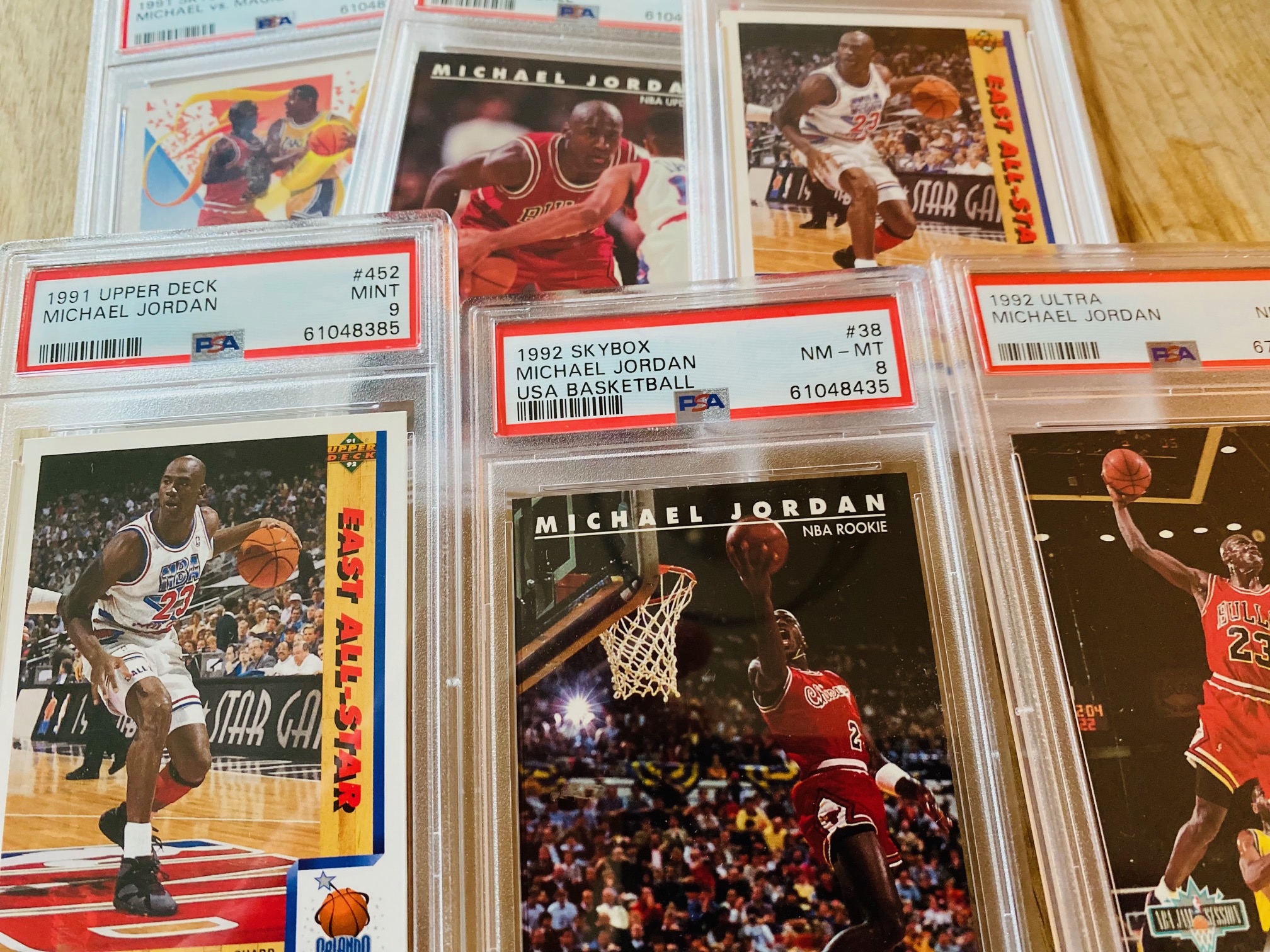
For a long time, grading was a fairly easy calculation for me. Look at the card, look at the raw value, think about what a PSA 9 or PSA 10 might be worth and decide whether the grading fee makes sense. There was obviously always a risk involved, but at Value prices you could afford to take that risk with a fairly large number of cards.
PSA had built a backlog that at one point reportedly exceeded 12 million cards. That number is almost difficult to comprehend, and for sports card collectors there is an additional frustration: a huge part of the grading boom is TCG, especially Pokémon. People are grading Pokémon cards that might only be worth a few dollars raw because the economics can change completely if that card receives a PSA 10.
I understand why they do it. Sports card collectors aren’t really doing anything fundamentally different. But PSA doesn’t separate my baseball card from somebody else’s Pokémon card when it comes to grading capacity. Millions of TCG submissions therefore become our problem as well. And now I have around 100 cards sitting here that I would like to grade.
$80 Changes Almost Everything
There are cards where I really don’t care very much whether grading costs $40 or $80. If the card is worth several thousand dollars and a PSA 10 could add another $1,000 or $2,000, arguing about another $40 in grading costs becomes rather pointless.
Shohei Ohtani is a good example for me because I own quite a few of his cards. If I have an important Ohtani parallel, a scarce card or an autograph where the difference between raw and PSA 10 is substantial, I am not going to avoid grading simply because the current service is expensive. There is enough value involved that authentication, condition and the additional liquidity of a PSA slab can justify the expense.
But I own Ohtani inserts as well. Base cards. Refractors. Cards I really like but which are nowhere near the level where an $80 grading fee becomes irrelevant. It would make no sense to apply the same grading strategy to all of them simply because they have Shohei Ohtani’s name on the front.
This is where the current price becomes a problem. Take a card worth $200 or $300 raw. Spend $80 on grading, add shipping and eventually selling fees, and suddenly a significant percentage of the value of the card has disappeared into the process. And then it comes back as a PSA 9.
Now what?
Maybe the PSA 9 is worth a little more than the raw card. Maybe it is worth roughly the same. In some modern sets, the 9 can actually be a fairly disappointing result financially because so much of the market premium is concentrated in the PSA 10.
At lower grading prices, I can take that risk more often. At $80, I can’t.
But People Are Still Sending Cards
This is the part of the current situation that makes me wonder whether collectors are waiting for something that may not return in exactly the form they expect.
People are still submitting.
PSA has a gigantic backlog, affordable services have been restricted, grading is expensive and yet people continue to send cards. If I were running PSA, I would be paying very close attention to that. The market is effectively telling the company how much pricing power it has.
Why would PSA be in a hurry to make grading dramatically cheaper when there is still demand at $80?
I don’t think that means Value is gone forever. There are simply too many cards in this hobby that cannot economically support an $80 grading fee. If PSA completely abandoned that market, it would eventually create a huge opportunity for competitors. But I am no longer convinced that we should expect Value grading to return exactly as we knew it.
Maybe Value comes back at a higher price. Maybe there are tighter limits. Maybe turnaround times remain painful. Maybe PSA simply discovers that what collectors previously considered an expensive grading service can become the new Value service.
Pokémon Is Part of the Sports Card Grading Market Now
I find the TCG side of this fascinating because it also shows how strange the grading market has become.
People send in very inexpensive Pokémon cards hoping for a PSA 10 because the grade can be worth substantially more than the underlying raw card. You can look at that and say it is crazy, but then look at what we do with sports cards.
We buy a card. We examine the corners, edges, surface and centering. We send it across the country or even across the Atlantic. Someone gives it a number, seals it into a plastic holder and suddenly the market may value the object very differently.
And I think that is sometimes forgotten when people ask why PSA continues to dominate despite the price, the backlog and the competition. A PSA slab is not simply plastic. The grade creates a standardized product that the next buyer understands immediately. That becomes particularly powerful with a 10.
A buyer doesn’t have to study twelve photographs and wonder whether the seller has cleverly avoided showing a damaged corner. There is still no guarantee that every PSA 10 is perfect, and collectors will always debate individual grades, but a huge amount of uncertainty has already been removed from the transaction.
For an investor, that matters.
Michael Jordan Shows Why Grading Is About More Than a Number
With an expensive Jordan autograph, I am not only interested in whether a card is a 9 or a 10. I want confidence in what I am buying in the first place. The amount of money in the Jordan market makes authenticity enormously important, particularly once you move into signed cards and memorabilia.
Upper Deck matters here because of its long-standing relationship with Jordan and its position in the authenticated Jordan autograph market. If I am spending four or five figures on a Jordan autograph, provenance and authentication are not little details at the bottom of the listing. They are part of the object I am buying.
I would not say that putting a Jordan card into a PSA holder somehow makes provenance irrelevant. It doesn’t. Nor should card grading itself be confused with autograph authentication when those are separate services. I still want to know where the autograph came from, who authenticated it and what documentation exists.
A raw, expensive Michael Jordan autograph asks quite a lot from the buyer. He has to trust the seller, understand the autograph, assess the condition of the card and make sense of whatever authentication accompanies it. With an established Upper Deck-authenticated Jordan piece that is also professionally encapsulated and graded, several of those questions have already been dealt with before buyer and seller even start talking about price.
That is why I sometimes think of grading as a kind of security seal on high-end cards, even though technically that description is imperfect. It reduces friction. It gives the next buyer something familiar. And when we are talking about a Jordan autograph worth thousands of dollars, reducing uncertainty has real financial value. That is very different from paying $80 to put a $70 insert into a slab and hoping for the best.
Beckett Becomes Tempting
The PSA situation has made me look at Beckett much more seriously for my own cards. Beckett is obviously not some new alternative that appeared because PSA has a backlog. BGS has been established for decades. I like the slabs, I like the additional information from subgrades, and there is still something about a Black Label that PSA cannot really replicate.
Pokémon again gives us some extreme examples. Take the Pikachu with Grey Felt Hat. Depending on the market at the time, you can see an enormous gap between a PSA 10 and the tiny number of cards that achieve a BGS Black Label. A PSA 10 might be around $2,000 while a Black Label can potentially reach somewhere around $10,000. Then you look at a BGS 9.5 and might see something closer to $1,400. That tells you almost everything about the problem.
I cannot build my grading strategy around receiving Black Labels. They are exceptionally rare. That rarity is precisely why people pay so much for them. I have to calculate using grades that I can reasonably expect, and once I do that, PSA suddenly looks attractive again.
A Beckett slab can be beautiful. I can personally prefer it. I can think the grading is stricter. None of that helps me very much if the next buyer is prepared to pay significantly more for the same card in a PSA 10 holder.
TAG Has a Different Argument
TAG is interesting for another reason. The technology-focused approach, the detailed grading information and the idea of making the process more transparent address something collectors have complained about for years. Sending a card away and getting it back with an 8, 9 or 10 without really understanding every part of the decision can be frustrating.
But the challenge for TAG isn’t convincing me that the technology is interesting. It is convincing the person who eventually buys my card that the TAG slab deserves the same money as PSA.
A grading company can win praise from collectors and still lose the resale battle. It can offer faster turnaround times, attractive slabs and more information and still be a worse financial decision for somebody whose primary objective is maximizing the selling price.
This is why I don’t expect PSA to suddenly collapse because competitors gain market share. Beckett can gain. TAG can gain. Other companies can gain. There is plenty of grading volume to go around.
But PSA can lose submissions without losing its position as the standard.
PSA’s Real Advantage Is the Next Buyer
I used to think about grading primarily from my own perspective. Which company do I trust? Which slab do I like? How much does it cost? How long does it take?
But if the card is an investment, my preferences are only half the equation. The next buyer matters more.
If collectors consistently pay a premium for PSA 10s, sellers have a reason to submit to PSA. More cards go to PSA. More PSA cards sell. Those sales create more comps. More comps make PSA cards easier to price. Buyers become comfortable with the market because they can see what comparable PSA cards have sold for. And then the next seller looks at all that data and sends another card to PSA.
That is why PSA can frustrate collectors and still remain dominant. It doesn’t need every collector to believe that PSA has the nicest slab or even the best grading process. It needs buyers to continue paying more for PSA.
The day that changes, I become much more interested in the idea that PSA could genuinely lose its position. I don’t see that happening yet.
And for Michael Jordan in particular, this effect can become even stronger because we are dealing with a mature global collector market and, at the high end, significant amounts of money. If I eventually want to sell an important Jordan autograph, I don’t want to explain an obscure grading company to the buyer. I want as little friction in that transaction as possible.
That may not be romantic.
But this is a market.
For Now, My 100 Cards Can Wait
So I have around 100 cards I want to send for grading, and most of them are staying exactly where they are for now.
Some could justify $80. A strong Ohtani card could. A high-end autograph could. A card where authentication and buyer confidence are particularly important could. If the difference between raw and PSA 10 is large enough, I can live with the grading cost.
But I am not spending roughly $8,000 to grade 100 cards just because I eventually want them in slabs.
If PSA Value returns, I will be ready. If it returns at a significantly higher price, I will grade fewer cards and become more selective. If PSA keeps collectors waiting for too long, I will look harder at Beckett and TAG.
I don’t have any loyalty to PSA that requires me to send cards there regardless of price. What PSA has is something much more useful than my loyalty: the willingness of the next collector to pay more for its slab.
That is why I think some form of Value grading eventually comes back, but I am far less certain about the price. PSA knows the demand is there. It has watched people continue submitting despite the backlog and despite expensive service levels. It knows how strong its position in the secondary market remains.
Maybe the question isn’t really whether PSA Value comes back. Maybe we are all waiting to find out what PSA thinks “Value” is worth now.