
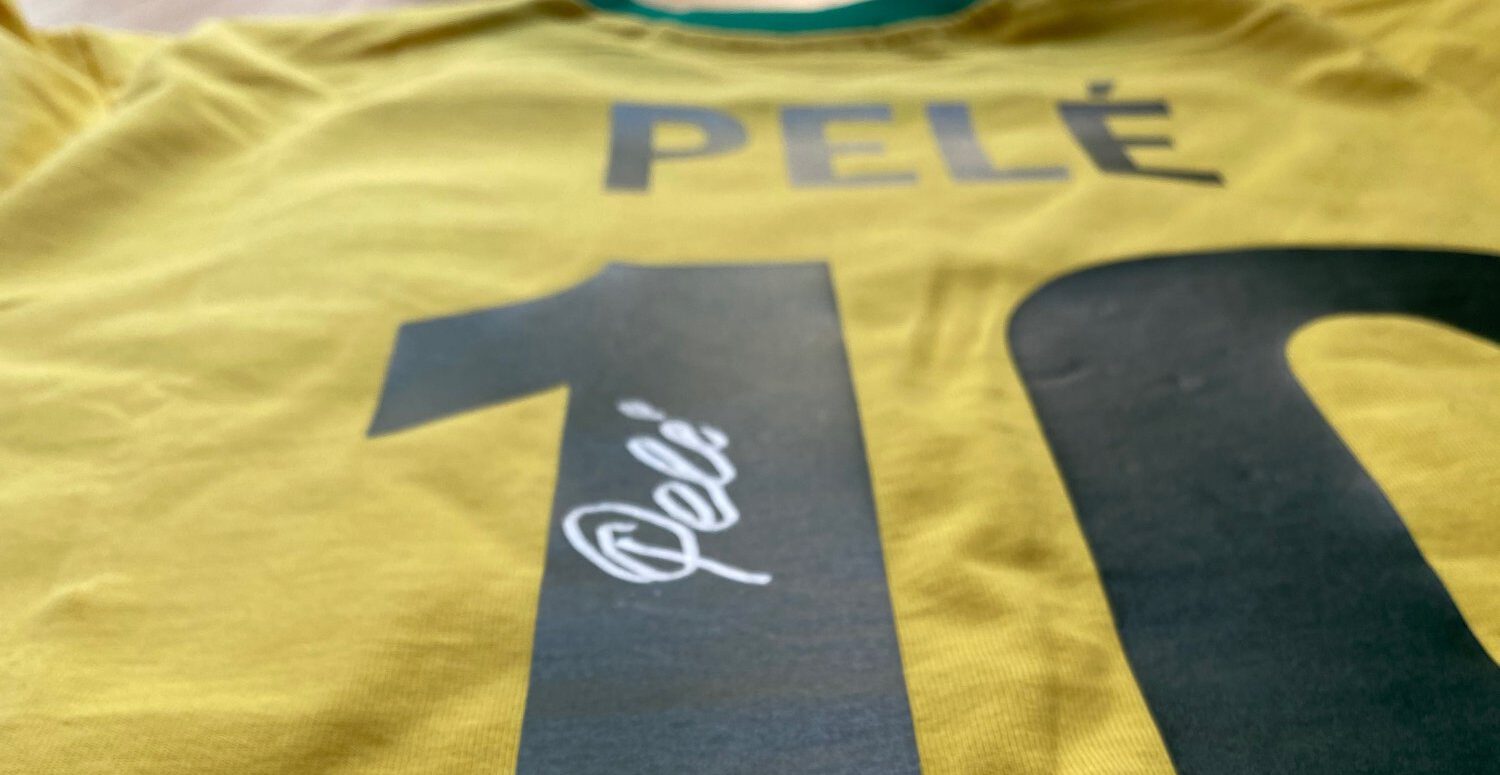
There was a time when the final whistle almost automatically led to the same scene. Two players met somewhere near the centre circle, pulled their jerseys over their heads, exchanged them with a smile and walked back to the dressing room wearing somebody else’s colours. It never felt organised. Nobody announced it. Nobody asked where the shirts would end up afterwards. Sometimes it was admiration for an opponent, sometimes respect after a difficult ninety minutes and sometimes simply because two players had known each other for years. The shirt swap belonged to soccer in the same way as the captain’s handshake or children walking onto the pitch before kick-off.
I have the feeling that this tradition is slowly disappearing, not because players suddenly stopped respecting one another, but because the shirt itself has become something completely different. Twenty or thirty years ago it was just a match-worn jersey. Today it is a commercial product with provenance, authentication and a potential auction value. The moment you realise that, the whole story suddenly looks different.
Every Match Now Produces Collectibles
Companies like MatchWornShirt have built an entire business around exactly these jerseys. Players leave the pitch, the shirts are collected, documented, authenticated and later offered to collectors through auctions. From the club’s perspective it is an elegant business model because the shirt no longer disappears into another dressing room. It becomes another asset the club can monetise, and given how much collectors are willing to pay for genuine match-worn memorabilia, it is hardly surprising that more and more clubs have embraced the idea.
What fascinates me is not that the business exists. I actually understand it completely. If supporters are willing to spend thousands of euros on a shirt worn in a Champions League match, why shouldn’t clubs participate in that market instead of letting those shirts disappear forever? Football has become an enormous industry, and memorabilia is simply another part of that industry now. The economics are obvious. Ronaldo match-worn jerseys can sell for several thousand dollars.
What has quietly changed, however, is the relationship players have with the objects they use during the match. The shirt is no longer simply theirs to exchange. It increasingly belongs to a commercial process that starts the moment the referee blows the final whistle.
It Doesn’t Stop With The Jerseys
Once you start paying attention, you notice similar things all over modern soccer. In Serie A, for example, match balls that produce goals are sometimes removed immediately because they become collectibles in their own right. The ball that made it 1–0 against a particular opponent suddenly has its own story, its own certificate and its own auction listing. Somewhere there is a collector who wants exactly that ball, not another identical one.
The same logic now applies to shirts, captain’s armbands, goalkeeper gloves and increasingly almost everything that can be connected to a specific match. Modern collecting has become incredibly sophisticated. We talk about photo-matching, provenance and authentication because those things genuinely matter, especially in an era where digital manipulation makes trust more valuable than ever. I have written about photo-matching before, and I still think it is one of the most important developments in sports memorabilia over the last decade.
But every new layer of professionalism also pushes the hobby a little further away from the spontaneity it once had.
The Bigger The Club, The Smaller The Chance Of A Shirt Swap
I also suspect this is why you still see shirt exchanges more often outside the absolute elite of world soccer. In lower divisions, or even in parts of the Bundesliga, the commercial pressure is simply different. A match-worn shirt does not automatically represent several thousand euros in auction value, so there is less reason for clubs to insist that every jersey returns to the dressing room.
At the biggest clubs, the calculation changes completely.
A Champions League shirt worn by a global superstar is no longer just a souvenir between two professionals. It has become inventory. Somebody has already thought about the certificate, the photographs, the auction page and the final hammer price before the player has even finished the post-match interview. Nobody has to forbid shirt swapping. The economics quietly discourage it all by themselves.
That is probably what I find most interesting about the whole development. Nothing dramatic has happened. There was no announcement saying that shirt swapping should stop. There was no rule change. Soccer simply became so commercially valuable that an old tradition slowly stopped making financial sense.
Maybe that is inevitable. The sport has never generated more money than it does today, and memorabilia has become a serious business instead of a niche hobby. Clubs would almost be foolish to ignore an additional source of revenue when supporters around the world are actively looking for authentic match-worn items.
I still miss the old version.
Not because auctions are a bad thing or because authenticated memorabilia is somehow less interesting. Quite the opposite. As a collector I understand exactly why this market has grown so quickly. But as a football fan, I always liked the idea that some things on the pitch belonged only to the players themselves. The shirt swap was one of those moments. It was never about money, never about scarcity and never about resale value. It was simply a gesture that said, “We shared this match.”
That feels like a small thing.
In reality, it probably says quite a lot about how modern soccer has changed.