
The Japan hype in MLB cards is real, although I would not say Shohei Ohtani created it from nothing. That would be too easy. Ichiro was already there. Hideki Matsui was already there. Japanese baseball had already sent serious stars to the United States long before Ohtani became the face of the modern hobby. But Ohtani changed the size of the room. With him, the Japanese superstar was no longer a side category for specialist collectors. Suddenly the biggest baseball card conversations in the world could revolve around a Japanese player, and once that happens, every new Japanese arrival enters a market that is already awake.
That is why Munetaka Murakami, Roki Sasaki and Yoshinobu Yamamoto feel so interesting right now. They are not arriving into the old MLB market, where the default collecting imagination was mostly American stars, Yankees prospects, Dominican sluggers and the occasional international icon. They are arriving into an MLB market that has already learned what Ohtani prices can look like. That changes everything. A Japanese player no longer has to prove that collectors should care about Japan. Ohtani already did that. Now the question is whether the next player can hold the attention.
Ohtani Did Not Start It, But He Changed The Ceiling
Ichiro changed the way many American fans looked at Japanese position players. Matsui became a Yankees and World Series name. Those careers mattered, and it would be wrong to treat the current boom as if baseball only discovered Japan in the Ohtani years. But Ohtani did something different. He made the market imagine a Japanese player as the central figure in baseball, not simply as an international star who succeeded in MLB.
That is a big distinction. Mike Trout was the American baseball ideal for years, and in another injury-free version of history his memorabilia market might look very different today. Aaron Judge still carries that traditional American superstar weight, especially with the Yankees behind him. There are always new American names coming, someone like Ben Rice gets attention because the Yankees always make people pay attention. But the emotional momentum in the hobby does not feel purely American anymore. It feels as if collectors are constantly asking what Japan is sending next.
Topps Is Already Playing Into It
You can see the shift in the cards themselves. Topps does not create Kanji cards by accident. Those variations exist because the market wants Japanese identity inside the product, not hidden behind it. The language, the design, the cultural signal — all of that becomes part of the card. It is no longer just a player from Japan on an American baseball card. The card itself starts to perform Japan as part of the appeal.
That is exactly where things become interesting for collectors. A normal rookie card is one thing. A Kanji variation of the right player in the right season can feel like it belongs to the moment more directly. Maybe that is artificial. Maybe it is smart product design. Probably both. But the market reacts to those details, and Topps clearly knows it.
The Old Geography Is Shifting
For a long time, MLB collecting had a familiar international map. American superstars, Dominican stars, Venezuelan players, Curaçao producing more talent than its population should allow, and then the Japanese names as their own category. Now it feels less balanced. Japan has become the market story. Not because Latin American talent disappeared, obviously it did not, but because the card market is not only responding to talent. It is responding to buying power, attention, media, auction results and the possibility that MLB can sell the same player to collectors in several countries at once.
That is why Yamamoto matters. That is why Sasaki matters. That is why Murakami matters even before we know exactly where his MLB career lands. The collector base is not just watching the box score. It is watching the country attached to the player.
MLB Wants Asia For A Reason
American sports have been trying to export themselves for years. The NBA in Europe, NFL games in London and Germany, all of that is part of the same logic. Baseball has a different route because Japan is not a market that needs to be taught baseball from scratch. Japan already lives baseball. That makes the expansion much cleaner.
If MLB plays major games in Tokyo, if Topps builds Japanese-language cards, if the Dodgers keep becoming the home for some of the biggest Japanese stars, then the collectibles market follows naturally. The league does not need to invent demand. It only needs to connect Japanese demand with the American card machine.
That is much more powerful than people sometimes admit.
My Murakami Redemption Made This Personal
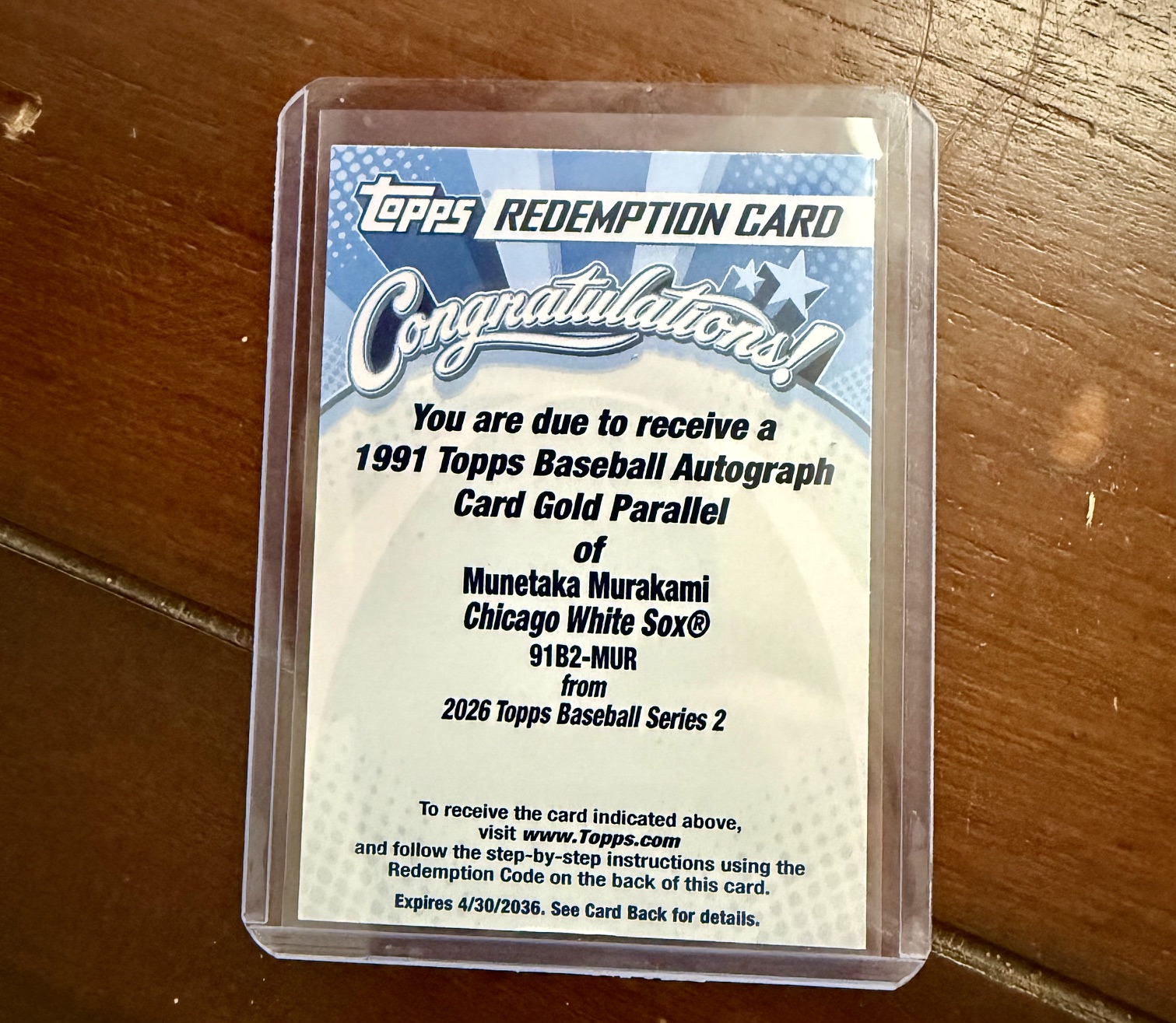
I probably feel this more strongly because I pulled the Munetaka Murakami redemption myself. Once you have one of those cards in your hand, even if it is only a redemption and not the finished card yet, the market stops being abstract. You start watching every result differently. The last sale around $75,000 suddenly does not feel like some distant headline. It affects how you think about your own card, about timing, grading, redemption delays, Rookie of the Year hype and whether this Japan wave still has years to run.
And I think it does. Not every Japanese player will become Ohtani. Most will not. That is almost the point. Ohtani is the impossible comparison. But the market no longer needs every player to become Ohtani for the Japan angle to stay hot. Murakami can be Murakami. Sasaki can be Sasaki. Yamamoto can be Yamamoto. If the collector base keeps expanding in the same direction, the entire category can grow even if only one or two of them become true all-time names.
For me, that is the important shift. The question is no longer whether Japanese stars can matter in MLB cards. That question is already gone. The question is how much of the next decade of baseball collecting will be priced through Japan.
This essay is part of Sports Memorabilia: The Ultimate Guide.