
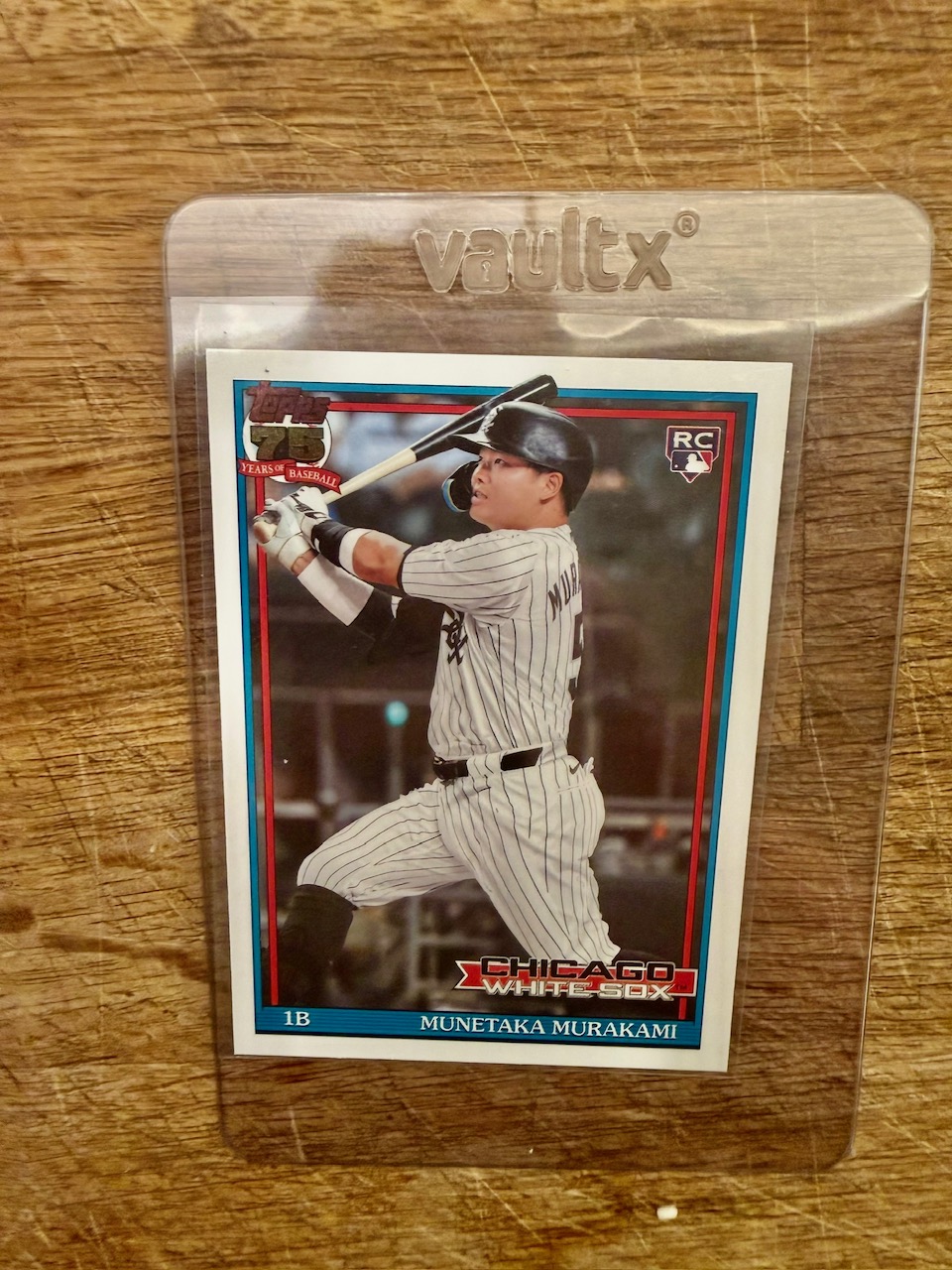
Munetaka Murakami is exactly the kind of player the baseball card market wants to believe in. Japanese star, huge power, MLB rookie season, early home runs, Rookie of the Year talk, and enough mystery around the ceiling that collectors can still argue about him. I understand the appeal immediately. I pulled the redemption from Topps Series 2 myself, the 1991 Topps Baseball Autograph Gold Parallel, card 91B2-MUR, and it is the kind of card that makes you stop thinking like a normal collector for a moment. Suddenly the question is not only what the card is worth today. It becomes what the market might decide Murakami is three months from now.
The Ohtani comparison is always going to be there because the hobby loves easy boxes. Japanese superstar comes to MLB, hits immediately, card prices move, collectors start looking for the next version. But Murakami is not Ohtani. That is probably the first thing I would keep in mind when looking at his cards. Ohtani arrived as something almost impossible for the modern hobby to price: hitter, pitcher, global figure, spectacle, mythology. Murakami is much easier to understand and maybe that is both good and bad for his card market. He is a power hitter. A serious one. The home runs are the reason people care.
The Power Is The Card Story
Murakami’s card market is built on power more than completeness. That does not make it weak, but it changes the way I look at the upside. A player who can hit 20-plus home runs early in the season immediately becomes hobby-relevant, especially when he arrives with the Japanese superstar label already attached. The market loves a simple visual story, and a Murakami home run is easier to sell than a complicated player profile. Big swing, big body, big power, big rookie cards.
But power hitters also create a different kind of risk. If the home runs slow down, the card market can lose interest quickly. A player who contributes in five different ways can survive a colder stretch better than a player whose hobby case is built mostly around slugging. That is where Murakami feels different from Ohtani. Ohtani has so many layers that even when one part of the story changes, another part keeps collectors engaged. Murakami’s early MLB card market feels more concentrated. If the power stays loud, the market stays interested. If the power cools, the conversation gets much harder.
The Age Part Is Awkward
Murakami is not a teenager and he is not a 21-year-old prospect appearing out of nowhere. He is already old enough that the hobby cannot pretend this is the beginning of a ten-year mystery in the same way it does with some younger players. That matters for cards because age is one of those things collectors talk about only when it starts to work against the price. If a player is young, everyone talks about runway. If he is older, the market starts asking how much of the breakout is already priced in.
That does not mean Murakami cards cannot run. They clearly can. The demand for Japanese stars is real, the White Sox storyline gives him a clean MLB lane, and the early power makes him very easy for collectors to understand. But I would not price him like Ohtani, and I would not pretend his cards carry the same type of safety. Murakami may have a huge rookie season and still remain a different kind of bet.
My Redemption Card Makes This Less Abstract
The strange part for me is that this is not just a market I am watching from the outside. I actually pulled one of the cards that sits inside the current Murakami conversation. The Topps Series 2 1991 Topps Baseball Autograph Gold Parallel redemption is probably limited to 50, and that immediately puts it in a different category from a regular rookie insert or base card. It is not the biggest Murakami card in existence, but it is the kind of card where timing starts to matter.
That is where the collector brain becomes annoying. Do you redeem it and wait? Do you think about grading if the card comes back clean? Do you talk to Goldin or another auction house because the market is hot now? Do you wait for Rookie of the Year momentum? Do you risk the hype cooling while the redemption process plays out? I have written about this before, but pulling the card was only the start of the problem. The harder part is deciding whether the market is still moving up or whether everyone is already staring at the same upside.
The Black Chrome Result Changes The Mood
The Black Chrome sale around $74,000 is the kind of number that makes every other Murakami card feel more dramatic than it probably should. I know my Gold Parallel is not that card. Different product, different parallel, different place in the hierarchy. Still, once a number like that enters the room, it affects how collectors look at everything around the player. Suddenly a redemption does not feel like a fun hit anymore. It feels like a decision.
That is one of the weird things about modern card markets. One massive sale can pull attention into an entire player ecosystem. Base rookies, parallels, autographs, inserts, numbered cards, redemptions. Some of them deserve the attention. Some are just getting dragged along because the name is hot. Murakami is probably somewhere in the middle right now. The power is real, the hype is real, but the market is also doing what it always does when it thinks it has found the next international baseball story.
Not Every Japanese Superstar Becomes The Same Market
The hobby wants another Ohtani because Ohtani made the Japanese superstar lane feel enormous. Before that, collectors already understood Ichiro in a different way. Japanese baseball greatness has long mattered in the card market, but Ohtani changed the ceiling. Now every major Japanese arrival gets measured against a market that may not be repeatable.
Murakami benefits from that. He also suffers from it. The demand is already waiting for him, but the comparison can become unfair very quickly. If collectors expect Ohtani-level mythology from a power-hitting first baseman, they may be asking the wrong question. Murakami does not need to become Ohtani to matter in cards. He needs the power to stay visible, the rookie season to keep its momentum, and the key cards to avoid becoming just another pile of early-hype inventory.
The Market Is Watching The Wrong And Right Things At The Same Time
What I find interesting about Murakami cards is that the market is both sharp and emotional. It knows the home run totals. It knows the rookie race. It sees the Japanese star angle. It knows the big sales. But it also wants the story to be bigger than it may actually be. That is where cards get dangerous and fun at the same time.
The Gold Parallel redemption I pulled sits right in that uncomfortable space. It could look much better if Murakami keeps hitting and the Rookie of the Year case grows. It could also look less exciting if the market moves on to the next player before the redemption is even fulfilled. That is not a normal base-card problem. That is a timing problem, and with Murakami, timing may matter almost as much as the card itself.
This essay is part of Sports Memorabilia: The Ultimate Guide.