
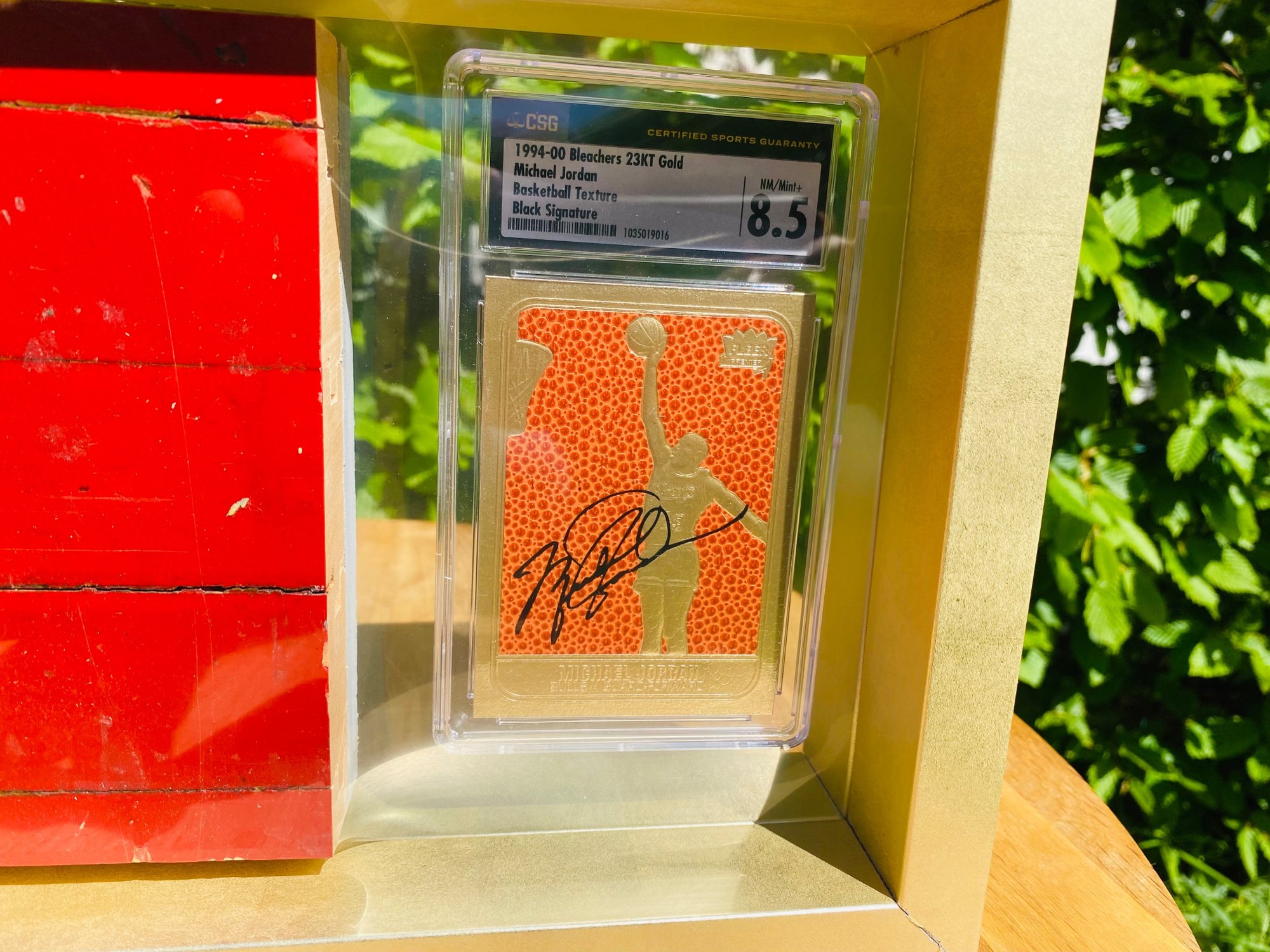
People tend to focus on the headline numbers. The $10.5 million Jordan jersey at Sotheby’s. The Dynasty Collection sneakers at $8.5 million. The 1986–87 Fleer rookie card with an autograph that reached $2.7 million. Game-worn Finals sneakers from 1998 selling for more than $2 million. The same name keeps appearing across all of them. Jordan. And in several cases, the autograph is what pushes one item far beyond a visually similar one.
Upper Deck and the Controlled Supply of Ink
Upper Deck still holds the exclusive autograph agreement with Michael Jordan. That alone sets his signed trading-card presence apart from most modern athletes. Panini and Topps dominate the current card market, but Jordan signatures do not follow the same release cycle. There is no steady stream of new licensed Jordan autographs entering circulation. Collectors deal mostly with older material. That creates a market where reference points are fixed, not constantly refreshed.
Scarcity, Demand, and Everything in Between
In discussions among collectors, the explanation usually splits into two camps. Some point to scarcity as the main driver. Others focus on sustained demand from a global collector base. In practice, both get mentioned in the same breath, especially when major auction results appear.
Price Movement Over Time
Fifteen to twenty years ago, certain signed Jordan cards could still be found around the $1,000 range. Today, comparable examples often trade in the six-figure range depending on grade, condition, rarity, and authentication. The underlying card has not changed. The market around it has.
That gap has widened gradually, not in a single jump, and most collectors who have been in the hobby for a long time have seen it unfold in real time.
Authentication as Part of the Value
As prices increased, authentication became unavoidable. Jordan’s signature has been forged for decades. Some counterfeits are easy to identify. Others are not. At higher price levels, visual inspection alone is no longer considered enough in serious transactions.
Grading companies and authentication services are now part of the structure of the market. Not an optional layer, but a standard step in most high-end deals. At the top end, authentication is often discussed alongside the item itself, because without it, liquidity drops quickly regardless of how convincing the autograph appears.
Who Is Buying These Items
A noticeable portion of buyers today grew up during the 1990s and early 2000s.
Many are now in a financial position where collecting shifts from occasional hobby purchases to high-value acquisitions. That shows up in auction rooms where bidders include long-time collectors, but also newer participants treating memorabilia as part collectible, part investment.
Comparisons With Fine Art
Jordan memorabilia is often placed in the same conversation as fine art or other established collectible markets.
Not because the objects are similar, but because the pricing logic overlaps. Scarcity, provenance, condition, historical relevance, ownership history. These are the terms that tend to appear when high-value items are evaluated.
Auction houses reinforce this framing by presenting sports memorabilia alongside other categories that traditionally sit at the top end of the collectibles market.
Where the Market Goes From Here
Demand has remained stable across multiple cycles in the broader collectibles market, including periods when other segments cooled. At the same time, future cultural relevance is not something that can be measured in advance.
For now, signed Jordan pieces remain the clearest dividing line in his memorabilia market, both in price and in how collectors talk about value.
This essay is part of Sports Memorabilia: The Ultimate Guide.