
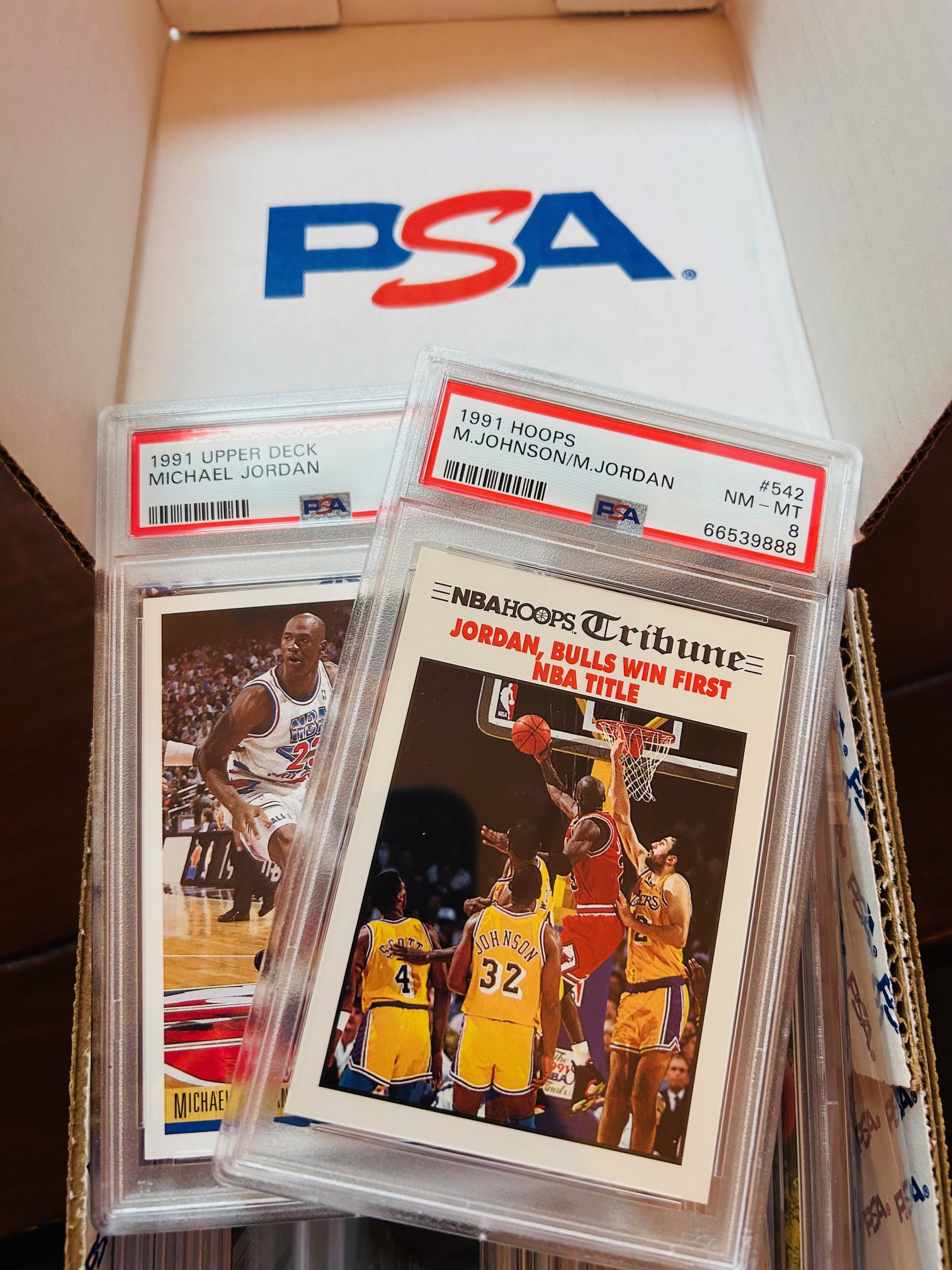
I saw this in a sports card Facebook group: PSA 9s should not be that much cheaper than PSA 10s.
Good topic. Also exactly why I still read Facebook groups. I have written before about sports card Facebook groups being messy, but this is where the real hobby talks. Not auction copy. Not dealer language. Just collectors getting annoyed because a card in a 9 holder can look great and still get treated like it failed.
I have done this too. I have looked at a PSA 9 and thought, why is this not a 10? Then you check the comp and the label is doing half the damage.
And yes, a lot of PSA 9s look great. Sometimes the 10 is cleaner. Sometimes the 10 is just the one that got the better day, the better grader, or the better luck after resubmission. People crack cards for a reason.
The Problem With PSA 9
The problem is not always the card. It is the label.
PSA 10 has clean psychology. Top grade. Easy listing. Easy comp. Easy flex. PSA 9 feels like almost. And “almost” is expensive in this hobby.
That is why a collector can look at a PSA 9 and think, “beautiful card”, while the market thinks, “not a 10.”
For personal collecting, I love 9s in the right spot. Let someone else pay the tax for the perfect label. If the card looks sharp and the price break is real, fine. Buy the card.
But if you plan to sell, the 10 usually has the cleaner exit.
Raw Cards Still Get Too Much Hope
The raw vs PSA 9 thing is even dumber.
A raw card can be scratched, dented, off-center, trimmed, wiped, pressed, whatever. But raw still lets the next buyer dream. Maybe it gems. Maybe the seller missed it. Maybe it is secretly a 10.
A PSA 9 killed the dream already.
That is why raw can sometimes price too close to a 9, or even above it. Not because raw is safer. Because raw still has fantasy left in it.
This is why the hobby loves sealed boxes too. People pay for the version of the outcome that has not disappointed them yet.
Population Makes It Messier
The PSA 10 premium makes sense when gem copies are genuinely hard. Vintage, condition-sensitive sets, low gem rates, cards with real centering issues. Fine.
But modern cards numbered to 25? That is where I slow down.
If the card is already rare, I do not want the entire price to be controlled by one grade point. Player, patch, autograph, serial number, color match, set, eye appeal, and actual demand all matter. A PSA 10 should bring more, but it should not automatically make the PSA 9 feel dead.
Especially with low-numbered cards, the object is already scarce.
The Collector Argument for PSA 9
Some collectors would rather own several strong PSA 9s than one PSA 10. I get that. If the visual gap is tiny and the price gap is huge, the 9 can make more sense in an actual collection.
This is especially true with vintage, rare autos, short prints and low-numbered cards. A PSA 7, PSA 8 or PSA 9 vintage card can still be serious. Nobody is printing more of them. Modern base cards are different. If thousands of PSA 10s exist, the PSA 9 can feel replaceable.
The problem is when the hobby treats every PSA 9 like modern base.
BGS 9.5 Is Stuck in the Middle
BGS 9.5 is another weird lane.
Some BGS 9.5s look fantastic. Some may look better than PSA 10s. But if the market wants PSA, it wants PSA. Liquidity beats a lot of arguments.
A beautiful card in the wrong holder can still sell slower. That is stupid, but not imaginary.
Same with TAG, SGC, CGC, whatever. People can argue standards all day. The resale market has its own habits.
What I Actually Think
For base modern cards with huge PSA 10 populations, I do not care much about PSA 9s. Too much supply.
For numbered autos, patches, short prints, rare parallels, low-pop cards, I am much more open to 9s. Especially if the card looks strong and the 10 premium feels ridiculous.
I do not buy the “PSA 10 or nothing” logic. Not on every card. Especially not when the 9 looks clean and the 10 premium is mostly label tax. Raw can be overpriced too, because somebody still wants to gamble on the grade.
This essay is part of Sports Cards: The Ultimate Guide.