
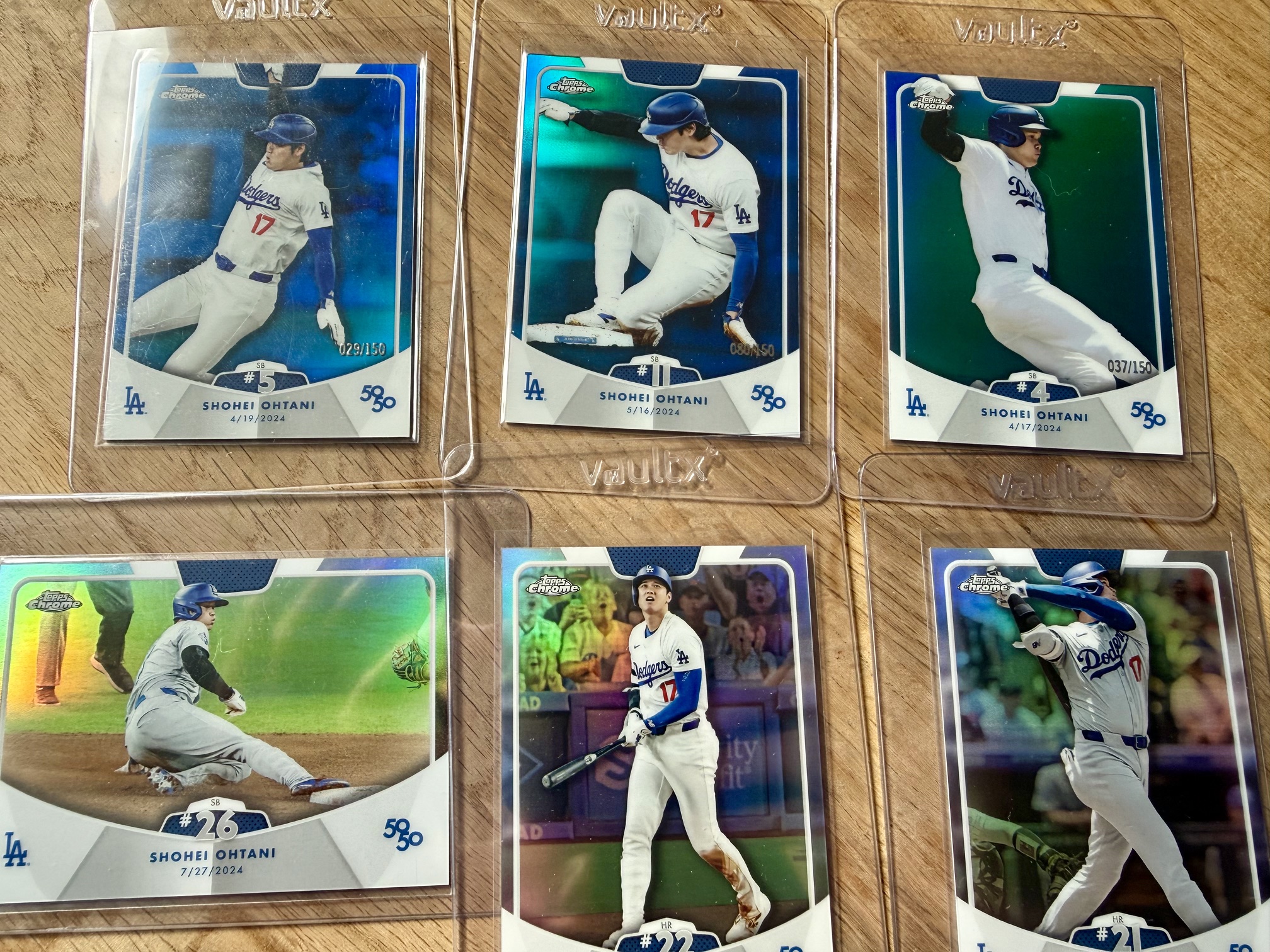
What a difference a few months make. Back in the summer of 2026, it seemed almost impossible to go wrong with Shohei Ohtani cards. Inserts such as All Aces were taking off, and every time I checked recent sales, I wondered whether I had already missed the next opportunity. Fast-forward to late November, and the situation looks rather different.
The sports card market is undergoing a serious correction. I’m feeling it in my own collection, too. There are sporting reasons for the decline, especially in baseball, but I suspect something bigger is going on. The more I look at the numbers, the more I think this correction has less to do with home runs and batting averages than with speculation and the amount of money available to chase collectibles.
The Problem With Investing in Active Superstars
Ohtani and the Dodgers missed out on a third consecutive World Series title. Ohtani also had to deal with some physical setbacks during the season. Nothing that appears to threaten his career in the long run, but enough to interrupt his rhythm.
The problem with investing in players like Ohtani is that being one of the best baseball players in the world is no longer necessarily enough. Collectors expect him to do something historic every year. Another MVP award, another World Series title, another record that sends commentators scrambling through the history books.We see much the same thing with Aaron Judge and the Yankees, whose postseason also ended earlier than fans had hoped. On a side note, I think the Yankees have a fascinating player in Ben Rice, a slugger who could eventually become one of the faces of the franchise in the post-Judge era. But that’s a topic for another article.
What exactly does Ohtani have to accomplish in 2027 to justify another doubling of his card prices? Being very good probably won’t do it. Compare that with Michael Jordan or Tom Brady. Their careers are over. Neither is going to win another championship or receive another MVP award, but collectors have the luxury of knowing exactly what these two athletes accomplished. I sometimes think of Jordan memorabilia in the same way I think of a painting by Picasso or Van Gogh. Once the creative period of an artist has ended, collectors can look at the entire body of work and decide which pieces matter most. With Jordan, new cards can still be manufactured, of course, but nobody can create another authentic rookie card from 1986 or another game-worn jersey from the 1998 NBA Finals.
From an investment perspective, that removes some uncertainty. What it doesn’t remove is market risk. And if you look at what’s happened to Tom Brady cards over the past few months, you’ll see why that distinction matters.
Ohtani Down 37%, Brady Down 38%
According to the November 17 market report from The Card Calculus, its CC2 Composite had fallen 14.5% from its September 7 peak, marking the tenth consecutive week of declining prices. The index was still up 56% since the beginning of the year.
Ohtani’s numbers are even more dramatic. His cards in the index gained 169% from the beginning of the year to late August before declining 37% from their peak. Brady’s cards followed almost exactly the same trajectory, gaining 199% before falling 38%.
| Market | Development in 2026 |
|---|---|
| CC2 Composite since September peak | −14.5% |
| CC2 Composite year to date | +56% |
| Shohei Ohtani cards before summer peak | +169% |
| Shohei Ohtani cards since summer peak | −37% |
| Shohei Ohtani cards year to date | +69% |
| Tom Brady cards before summer peak | +199% |
| Tom Brady cards since summer peak | −38% |
Source: The Card Calculus, November 17, 2026
Now, if Ohtani’s decline were primarily a consequence of his injuries, the Dodgers’ postseason disappointment or the baseball offseason, how would we explain Brady?
Brady hasn’t lost any of his seven Super Bowl rings. He hasn’t had a disappointing season. Nothing about his sporting legacy has changed since the summer, yet his cards have lost almost exactly the same percentage of their value as Ohtani’s.
That doesn’t prove the two markets are driven by the same factors, but it does make me question how much of the summer rally was really about sporting achievements and how much was about money flowing into the hobby.
Some of the individual Ohtani price increases I observed during the summer were even more extreme than the index suggests. There were cards for which prices appeared to have increased by 300% or more in a relatively short period. These weren’t always incredibly rare rookie cards or historically significant autographs, either. At some point, the prices simply became difficult to justify.
The Correction Goes Beyond Baseball
Collector Nation’s Sports Card Market Index shows that the weakness extends across several segments of the hobby.
| Market segment | October 2026 | November through Nov. 22 |
|---|---|---|
| Vintage sports cards | +0.8% | −0.3% |
| Modern sports cards | −3.6% | −3.8% |
| Cards from new releases | −7.6% | −6.3% |
| Sealed sports card boxes | +2.8% | +0.8% |
Source: Collector Nation Sports Card Market Index.
The sealed-box figures caught my attention, especially after my recent article about the economics of Whatnot breakers. While recently released singles are losing value, sealed products in this index are still appreciating.
There could be several explanations. Every time a box is opened, the supply of sealed inventory decreases. Breakers also need a constant supply of products, and as long as collectors are prepared to pay attractive prices for individual team spots, there is a commercial incentive to keep buying boxes. Whether the current resilience reflects scarcity, demand from breakers or speculation in sealed products is difficult to establish from the index alone.
The auction market offers some rather painful examples of what has happened to individual cards. At the November Fanatics Premier Auction, 17 cards purchased at earlier Premier Auctions between August and October appeared for sale again. According to The Card Calculus, 13 sold for less than their previous purchase price, with a median decline of 16%.
| Card | Previous sale | November sale | Change |
|---|---|---|---|
| 2018 Bowman Chrome Shohei Ohtani Carrying Bag Rookie, PSA 10 | $36,000 | $17,100 | −52.5% |
| 2026 Panini Prizm World Cup Lamine Yamal 1/1, PSA 8 | $204,000 | $108,000 | −47.1% |
Source: The Card Calculus – November Fanatics Premier Auction.
Baseball’s Offseason and the Threat of an MLB Lockout
Under normal circumstances, I wouldn’t be too concerned about baseball card prices declining in November. There are no spectacular home runs to watch, no nightly highlight reels and no rookie performances making collectors rush to eBay. I would normally expect interest to pick up around spring training and the start of the new season in March.
The problem is that we don’t know what kind of spring we’re going to get in 2027.
Major League Baseball’s current collective bargaining agreement expires on December 1, 2026, and the sport is facing a potential lockout. The owners want a salary cap, the players’ union doesn’t. As the Associated Press has reported, the salary cap remains a major point of disagreement between the two sides.
At the moment, it’s difficult to see where the compromise will come from.
For collectors holding significant baseball inventory, a prolonged lockout could turn the usual winter break into a much longer waiting game. A delayed season means fewer opportunities for players to generate excitement and fewer reasons for buyers to pay a premium for their cards.
It’s one thing to wait until March to sell a baseball card. It’s another to wait until March without knowing whether there will be baseball.
Sports Cards, Speculation and the Flow of Money
Even without the baseball offseason and the threat of a lockout, I think a correction was overdue. When cards double or triple in value within a few months, there has to be a point at which buyers start asking themselves what they’re actually paying for. Alternatively, they simply run out of money to keep bidding prices higher.
What I find striking about the hobby is how sentiment in one sport can influence enthusiasm in another. A spectacular sale involving a Cooper Flagg Debut Patch Autograph doesn’t necessarily make an Ohtani refractor more valuable. Yet these headline sales generate attention far beyond the individual player or sport.
Someone sells a basketball card for a healthy profit and perhaps uses part of the proceeds to buy baseball cards. Auction records encourage sellers to raise their expectations, new collectors enter the market, and suddenly everybody seems to own something that should be worth more than it was three months ago.
It works in the opposite direction, too. A collector who intended to finance their next purchase by selling another card might suddenly find themselves short of cash. The money that was circulating through the hobby during the summer is no longer circulating quite so freely.
This brings me to what I consider the biggest potential influence on the card market right now: the wider economic outlook.
Equity markets have been under pressure, and precious metals, which investors often regard as safe havens, haven’t escaped the selling either. On November 20, Kitco reported that gold had lost roughly 9.5% over the course of the week, while silver had declined by more than 15%.
Why should the sports card market be immune to this?
If somebody has lost money in their stock portfolio, is worried about their job or needs to cover higher living expenses, spending $2,000 on a rare basketball card might no longer seem like a good idea. They might even decide to sell the cards they already own.
For a market as illiquid as sports cards, having more sellers and fewer buyers at the same time can be particularly unpleasant. Unlike shares in a major listed company, you can’t necessarily sell a numbered refractor at something resembling its last recorded market price whenever you need the money.
I used to wonder whether sports memorabilia could behave countercyclically, offering some protection when traditional financial markets were struggling. Looking at what is happening in late 2026, I’m beginning to wonder whether it ever really worked that way, at least for modern sports cards.
There’s something ironic about this. Collectors have spent years arguing that sports cards deserve recognition as an alternative asset class. As more investment money and speculative capital enter the hobby, we may also be experiencing some of the less pleasant characteristics of financial markets.
The simultaneous weakness in equities, precious metals and sports cards doesn’t establish a causal relationship or a reliable long-term correlation. But it is consistent with my suspicion that the modern card market is more dependent on liquidity and investor sentiment than many collectors would like to admit.
For now, I certainly wouldn’t regard my Ohtani collection as a hedge against a decline in my stock portfolio.
My Own Sports Card Portfolio: November 2026
Enough about indices and financial markets. I’ve had two developments in my own collection over the past few days, neither of which could have come at a more awkward time.
My Ohtani PSA Submission: Great Timing, Terrible Grades
I finally received the grades from PSA. The cards were graded much faster than I had expected, which would normally be good news. Unfortunately, the grades were worse than I’d hoped.
Several of my numbered Ohtani refractors came back as PSA 8s, with one receiving a PSA 9. If you’ve ever submitted modern Chrome cards expecting a few 10s and ended up staring at a row of 8s, you probably know the feeling.
A rare numbered refractor is still a rare numbered refractor, but a good chunk of its potential resale value can disappear with those two little numbers on the label.
Here’s what my cost calculation looks like for a card purchased for $90 and submitted to PSA for $59.
| Expense | Amount |
|---|---|
| Card purchase price | $90 |
| PSA grading | $59 |
| Total invested | $149 |
| Break-even sale with a hypothetical 10% selling fee | $165.56 |
| Break-even sale with a hypothetical 15% selling fee | $175.29 |
Shipping and any other associated expenses would push those figures higher.
Based on the prices I’m currently seeing, some of these cards are hovering around my original investment before selling fees. Not exactly what I had in mind when I sent them to PSA.
I’m going to hold them for now. A PSA 8 isn’t going to turn into a PSA 10 by sitting in my collection for six months, but I’d rather see what these numbered refractors can fetch in a stronger baseball market.
There is, of course, a risk in waiting. Prices could fall further, and I have capital tied up in cards that I had originally hoped to sell at a profit. I’m comfortable accepting that risk for the time being.
My Munetaka Murakami Autograph Is Finally Coming
The Munetaka Murakami redemption card I wrote about during the summer, a gold autograph from Topps Series 2, is finally on its way to me after roughly half a year of waiting.
Naturally, it’s arriving just as the baseball offseason gets underway and the sports card market is correcting.
Great timing.
I’m looking forward to finally holding the card in my hands, but I had envisaged a slightly different market environment by the time Topps fulfilled the redemption. Unless somebody makes me an offer I find attractive, it’ll stay in my collection for the time being.
Redemptions add another layer of risk to sports card investing that I think is sometimes overlooked. You can identify an interesting player, acquire a desirable card and still end up with a disappointing financial outcome because the timing is wrong. You don’t even have much control over when your investment becomes available to sell.
My Sports Card Market Outlook for 2027
I wouldn’t be surprised if the market remains difficult over the winter, especially for modern baseball cards.
My more optimistic scenario is that geopolitical tensions ease over the coming months, financial markets stabilize and Major League Baseball reaches an agreement in time for the 2027 season. Once the sports pages are filled with stories about spectacular performances rather than labor disputes and nervous financial markets, I can imagine enthusiasm returning to the hobby quite quickly.
There is admittedly an element of hope in that forecast. I own cards whose value would benefit from exactly that scenario, so I’m hardly a disinterested observer.
What I don’t necessarily expect is a return to the kind of market we experienced during the summer of 2026, when some cards seemed to become more expensive every time they changed hands. Nor do I think every card that has fallen 30% or 40% is automatically a bargain. Some prices were simply too high in the first place. For now, my Ohtani refractors and the Murakami autograph will stay with me. I’ll continue watching completed sales over the winter rather than paying too much attention to the optimistic asking prices I still encounter on eBay. Come March, hopefully there will be some baseball to watch again. I’d quite like to have a reason to check my cards’ prices other than finding out how much more money I’ve lost.
I’m not a financial advisor. This article reflects my personal market observations and collecting decisions, not investment advice. Sports cards are speculative, illiquid assets, and their prices can fall further.