
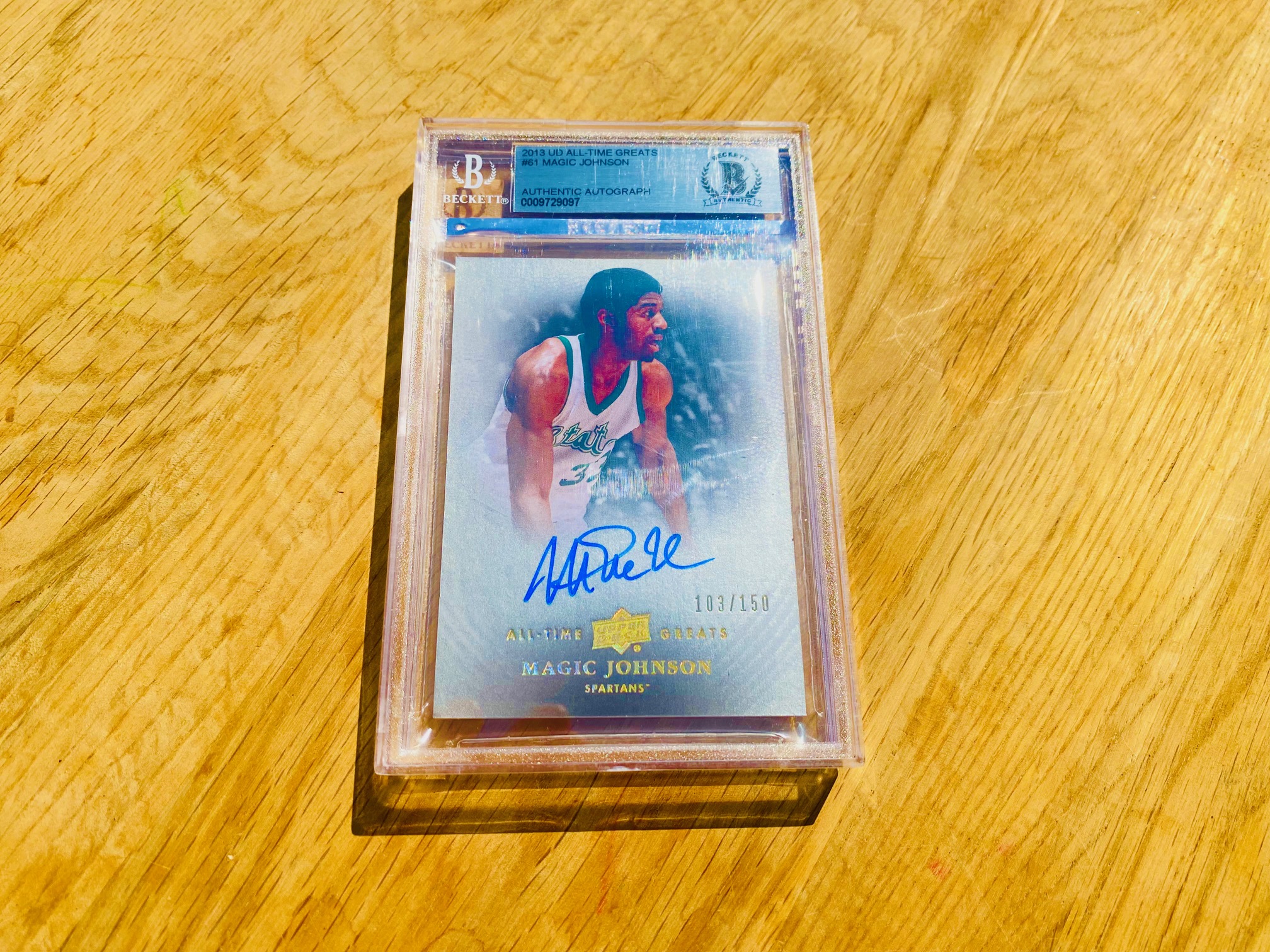
The question is not complicated. On-card autographs are better than sticker autographs. Of course they are.
That does not mean every sticker autograph is worthless. It does not mean a Messi, Brady, Mahomes or Musiala sticker auto suddenly becomes a bad card. But if we are honest, the process is worse.
With sticker autographs, the player usually signs sheets of small autograph labels. The sheets go back to Topps, Panini or another card company. Later, someone at the company takes the signed sticker and places it on a card.
That means the player may never have seen the card. He may never have touched it. He may not know which set, parallel or design his autograph ended up on.
The Player Signs a Sheet, Not the Card
This is why sticker autographs feel colder.
The player does not sit there with the finished card in front of him. He signs fields on a sticker sheet. One after another. Maybe hundreds. Maybe thousands. Then the sheet goes back into the production process.
For the company, that is efficient. For the collector, it is worse.
The card becomes a product assembled around an autograph label. The signature is real, but the connection between the athlete and the exact card is weaker.
Collectors can pretend it does not matter when the player is big enough, but it still matters. A sticker auto is not the same object as an on-card auto.
Why Companies Use Stickers
Sticker sheets are easier. Companies can send them out earlier. They do not need the finished cards ready. They do not risk damaging card corners, surfaces, foil, edges or serial-numbered cards in the signing process. They can store signed stickers and use them later. They can avoid some redemption problems.
From the manufacturer’s side, it makes sense. From the collector’s side, it explains why the card feels less special.
The Musiala Example
I have talked about my Jamal Musiala cards before. All five of them were sticker autographs.
Not because Musiala is not a great player. Not because the cards are worthless. But because he probably signed a sheet, not those exact five cards. Some employee later took the labels and placed them on the cards.
You can still like the card. You can still collect the player. You can still sell it, grade it, display it. But the ceiling is different.
If those same cards had been signed directly on-card, they would feel stronger. Simple as that.
The Visual Problem
Sticker autos often look like stickers.
Sometimes the label catches light differently. Sometimes it sits awkwardly on the card design. Sometimes the signature runs off the edge of the sticker. Sometimes the sticker is obvious even when the company tries to hide it. Panini and Topps know collectors dislike that look. They try to make the stickers clear, small, and less distracting.
An on-card signature usually sits more naturally. The ink is on the card. The signature becomes part of the object instead of a label added later.
That is why “on-card auto” is used as a selling point. Nobody proudly markets “sticker auto” unless they have to describe what the card is.
The Big-Star Problem
Sticker autographs are easier to accept with filler players. If a lower-end rookie signs a sticker sheet for a mid-level product, fine. Nobody is shocked.
But when expensive products use sticker autographs for major stars, it feels worse.
Collectors are paying premium prices, and the signature process still looks mass-produced. That is where the frustration starts. You are not just buying a cheap insert anymore. You are buying a high-end card, sometimes numbered, sometimes expensive, sometimes sold as a major hit. And then the autograph is still a little label.
There have also been enough strange autograph stories in the hobby over the years to make collectors cautious. Rumors about rushed signing sessions. Inconsistent signatures. Assistant or family-member speculation. The famous Messi/brother discussions. Some of it is proven, some of it is not, and I would be careful with hard claims.
But mass signing sheets create exactly the kind of distance where those questions start.
Sticker Autos Can Still Be Good Cards
Sticker autographs are not automatically bad cards.
A great player still matters. A rare card still matters. A strong set still matters. A low-numbered parallel still matters. If the autograph is clean and the card looks good, collectors will still care. A Messi sticker auto is still a Messi auto. A Brady sticker auto is still a Brady auto. A Musiala sticker auto can still be a good card.
But if there are two comparable versions and one is on-card, I know which one I would rather own. The on-card version is simply the better card.
For High-End, It Matters More
For some players, I can live with stickers because there may not be a better option.
But for high-end cards, I care a lot more. If a box costs serious money, if the card is supposed to be a premium hit, if the player is a major name, then a sticker autograph feels like a compromise. Maybe an understandable compromise from the manufacturer’s side, but still a compromise.
A sticker autograph can still be collectible. But an on-card autograph is the better object.