
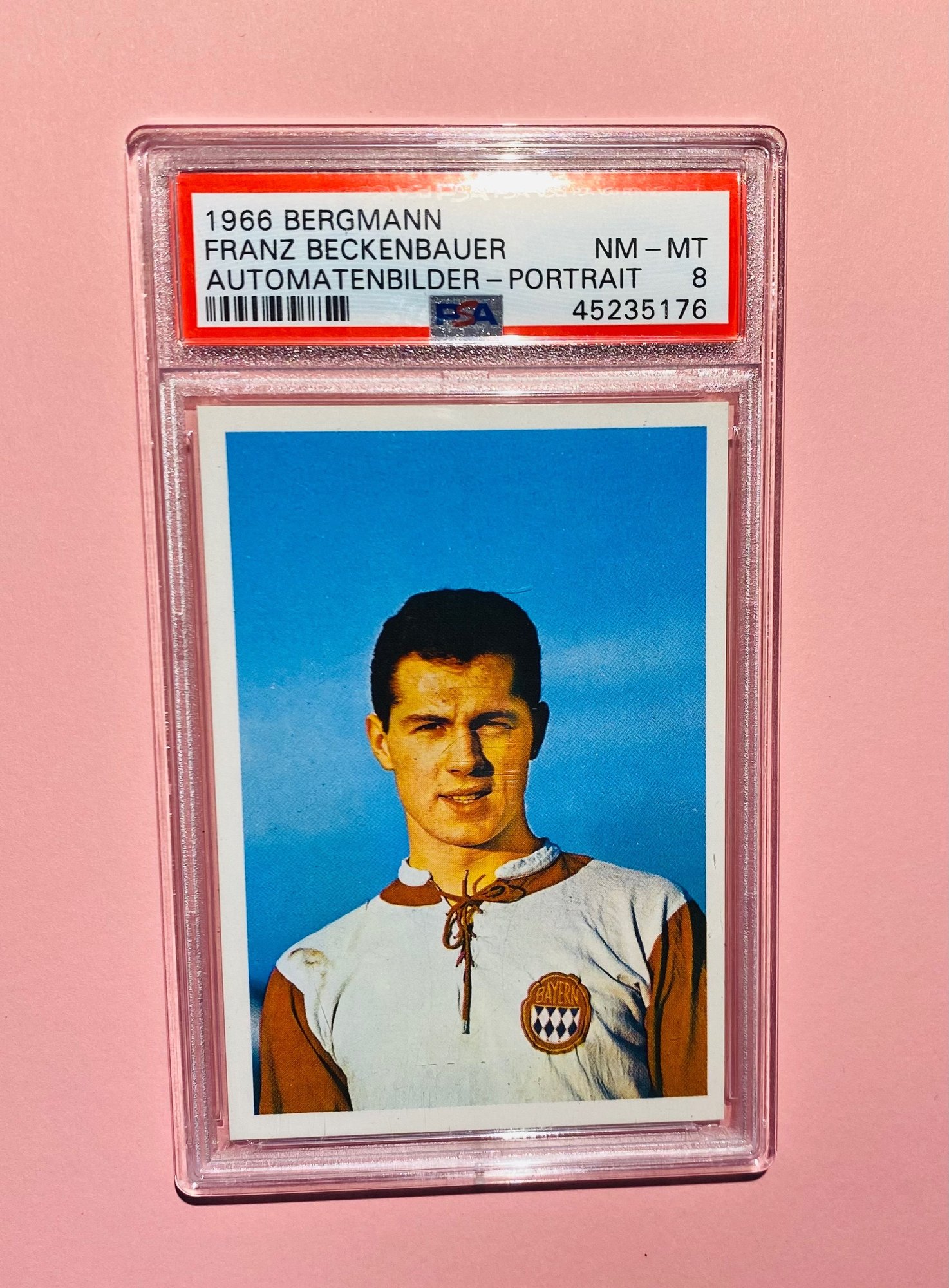
I have written about German cigarette cards before, and the story is still fascinating. Bergmann Bundesliga cards are not modern sports cards in the Topps Chrome or Panini Prizm sense. They come from a different collecting world: small vintage football images, connected to old German cigarette collecting culture, where cards and pictures were distributed very differently from today’s sealed boxes, parallels and autograph chases.
They feel older, more local, more German, and much more connected to football history than most modern products. In the last few years, some Bergmann rookie cards attracted serious attention, especially when Franz Beckenbauer entered the conversation.
The Beckenbauer Effect
Franz Beckenbauer changes the whole topic. A Bergmann Beckenbauer rookie is not just another vintage Bundesliga card. It connects to one of the most important football figures Germany has ever produced: player, captain, World Cup winner, coach, Bayern Munich, national team, German football identity.
Collectors were not only buying a small old football card. They were buying an early Beckenbauer object from a different football era. High-grade vintage cards of a player like Beckenbauer are hard to find because condition becomes a huge part of the discussion: corners, surface, centering, paper quality, print issues and storage history. A card can be historically important and still not grade high.
Bergmann Is Not a Quick-Flip Market
A Beckenbauer Bergmann card is not a Prizm rookie. You do not get the same hype cycle, the same buyer pool or the same exit speed.
A modern rookie card can explode because of a current season, a Champions League performance, a World Cup run or social media hype. Bergmann cards work differently. The collectors are more patient, the market is narrower, and the cards are harder to source in strong condition. A major sale or a fractional listing can wake up attention again, but this is not the same as chasing a current player parallel.
Some of the vintage football attention has faded again. Modern cards, current rookies, autographs, refractors, low-numbered parallels and premium releases have pulled collectors back toward newer products.
The Timeless Angle
The Beckenbauer example becomes even more interesting through fractional ownership. A Bergmann Beckenbauer rookie card listed through Timeless at around €26,000, well over $30,000, shows how seriously the market treated this card. Instead of one collector buying the whole card, people could participate in a piece of it.
Fractional ownership changes the feeling of collecting. You do not really own the card in the same emotional way. You own exposure to the asset. That can make sense financially with expensive vintage pieces, but it is not the same as holding the card, inspecting it, storing it, or placing it in your own collection.
Why Condition Drives the Price
With Bergmann cards, condition is brutal. These cards have lived for decades. They were handled, stored, traded, placed in albums, pulled out again, stacked, bent, exposed to light, humidity, smoke, and whatever else happened in old collections.
A PSA 7 or PSA 8 can look modest to someone used to modern PSA 10 culture. In vintage football, that can already be serious. The card does not need to be perfect to matter. It needs to survive well enough while still carrying the historical importance.
Raw vintage cards can be dangerous. A card may look fine in a photo but have surface issues, paper problems, trimming concerns, album damage, or other flaws that only become obvious in hand. With expensive vintage football cards, authentication and grading matter a lot.
Where the Market Stands
Bergmann Bundesliga cards are one of the more interesting corners of German football collecting. They are small, old, culturally specific, and tied to a different collecting era. When the right player appears, especially Franz Beckenbauer, the cards can become much more than nostalgic paper.
But they need the right player, the right grade, the right provenance, and the right price. A PSA 7 or PSA 8 Beckenbauer rookie can absolutely be a serious collectible. But Bergmann is not a fast market. It moves with attention, liquidity and the broader cycle between vintage and modern cards.