
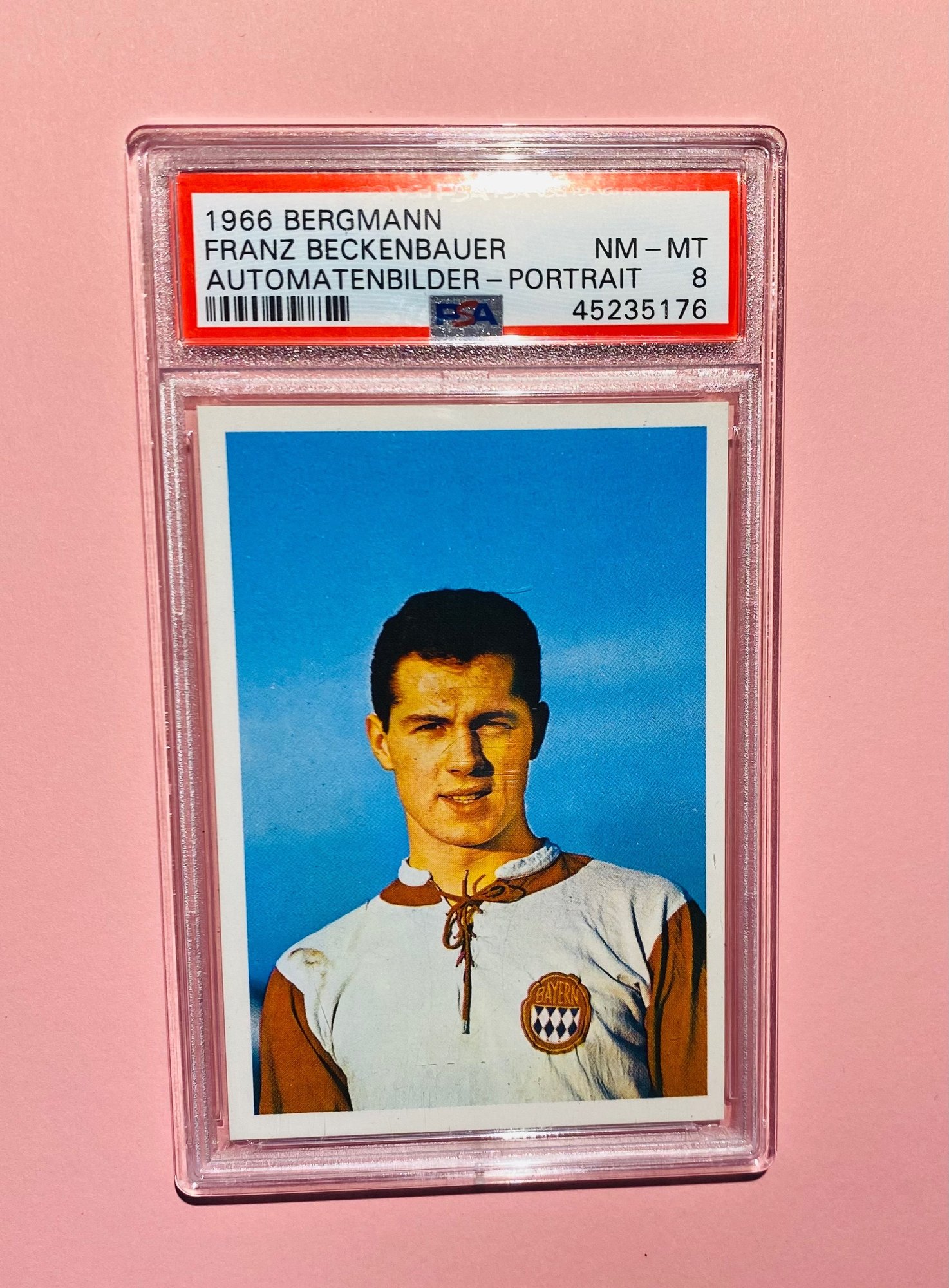
Franz Beckenbauer memorabilia is never just ordinary football memorabilia. I have already written about how Bergmann rookie cards of Beckenbauer gained real importance in the vintage football card market. Those cards became more than old paper because Beckenbauer is one of the central figures in European football history.
But with game-used memorabilia, the discussion is different. A card can be graded, slabbed and compared by population. A match-worn shirt or pair of boots needs another kind of proof. The question is not only: “Is this Beckenbauer?” The question is: “What exactly was used, when, by whom, and how clearly is that described?”
The Boots Sound Stronger
One auction example involved football boots described as game-worn by Franz Beckenbauer, used during matches for the West German national team and FC Bayern Munich in the 1970s. The catalogue estimate was listed at €3,500 to €4,500.
That price range is interesting because it is not crazy high for a player of Beckenbauer’s historical weight, but it is also not cheap. It sits in the zone where the wording has to do real work. If the boots are accepted as true 1970s game-worn Beckenbauer boots, the estimate makes sense. If the provenance is thin, the number becomes harder.
Boots are different from shirts. They touch the pitch. They show pressure, movement, wear, shape, and old leather aging. With a player like Beckenbauer, a true pair of 1970s match-worn boots is not just equipment.
Still, I would want to read carefully. Were the boots tied to a specific match? Were they photo-matched? Was there team provenance? Did they come from Beckenbauer directly, from a former player, from a club source, or from an older collection? The wording “game-worn” is powerful, but the object still depends on the paper trail behind it.
The Shirt Shows the Problem
Another example is a Germany shirt from the 1974 season described as issued / worn by Beckenbauer in an official match. The shirt reportedly came from Antonio Cabrini, who received it as a gift from Beckenbauer. The listed price was €3,500.
That is almost the same lower level as the Beckenbauer boots estimate, but the wording is softer. The description says the shirt could have been worn during the match and washed afterward, or prepared for the match but then not used.
A match-worn Beckenbauer Germany shirt from 1974 is one conversation. A match-issued or prepared shirt from that period is still interesting, but it is not the same market. Collectors should not pay match-worn money for wording that leaves the use open.
Similar price range. Different wording. Different confidence.
“Issued / Worn” Is Not Photomatched
Football memorabilia often lives in grey areas.
“Match worn” sounds clean.
“Game-used” sounds clean.
“Issued / worn” sounds close.
“Prepared for match use” sounds close.
“Could have been worn” sounds exciting.
But those descriptions do not mean the same thing.
If a shirt is photo-matched to a specific match, that is a different level of confidence. If it comes directly from a player with a strong letter, that helps. If the description itself says it may have been prepared but unused, collectors need to price that uncertainty in.
This is about reading the object properly.
The Card Market Shows the Same Pattern
The Bergmann rookie cards show how quickly Beckenbauer material can gain attention when the object is early, collectible, and tied to the right period. But even there, grade and condition decide a lot. A PSA 7 or PSA 8 Beckenbauer Bergmann card is a different object from a raw card with unclear condition.
The same logic applies to memorabilia.
A Germany shirt from 1974 lives through provenance, use, match context, player connection, and whether the wording supports “worn” or only “issued.” A pair of boots lives through wear, source, period, documentation, and ideally some kind of visual or collection history.
What I Would Want to See
For Beckenbauer game-used memorabilia, I would want the description to be precise. Who owned it before? How did it leave the player or team? Is there a signed letter? Is the item tied to Bayern, West Germany, or a specific match? Is the item photo-matched? Does the wording say match-worn, issued, prepared, or only attributed?
A pair of boots described as worn in 1970s Bayern and West Germany matches is a strong starting point. A Germany shirt from 1974 with Cabrini provenance is also interesting. But “issued / worn” and “could have been worn” leave room for uncertainty.
Why This Still Matters
A true match-worn Beckenbauer object from the right period is serious football history. A match-issued object can still be collectible. A prepared but unused shirt can still be desirable. A vintage rookie card can still be meaningful.
But each object needs to be priced for what it actually is, not for the strongest version of the story a buyer wants to believe.