
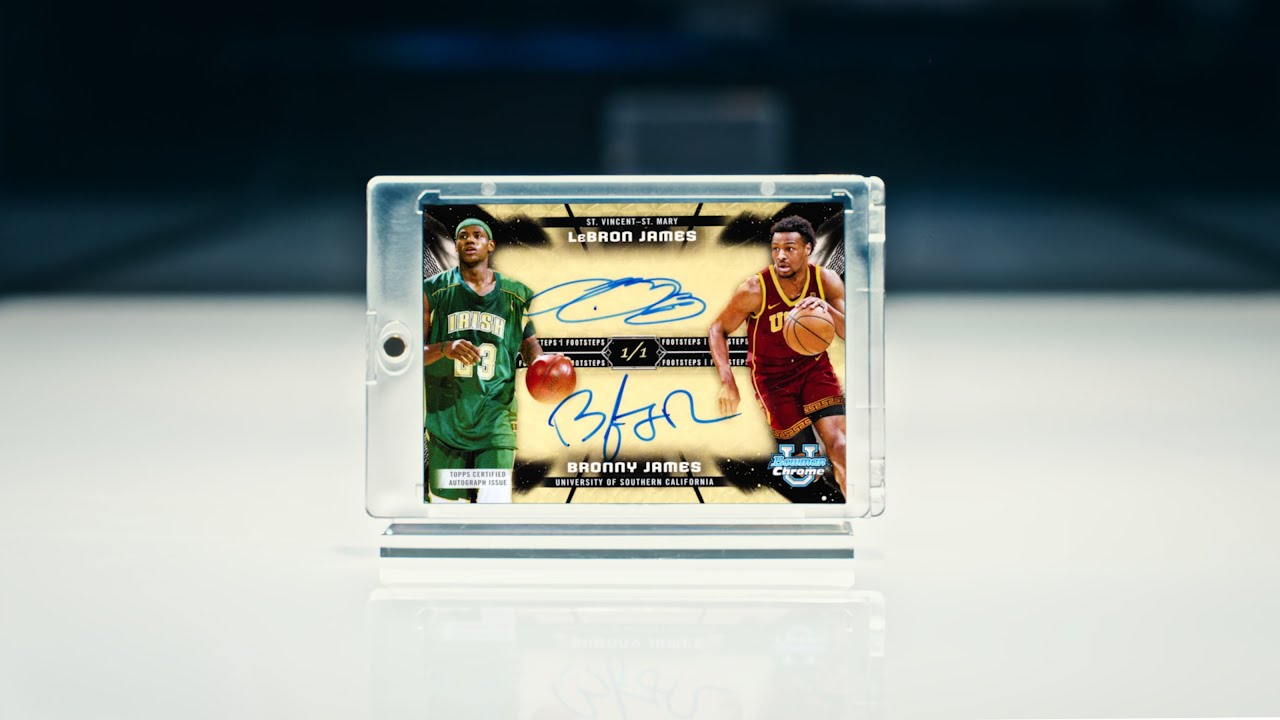
LeBron James autographs have always been among the most important signatures in the modern sports card market.
But if you look closely, his autograph has not stayed the same over time.
That is especially interesting now because new Topps cards have appeared with LeBron signatures that look noticeably different from what many collectors are used to.
There is a good Sports Illustrated piece on this topic, and I will link it in the article. The images there show very clearly how LeBron’s autograph has changed across the last two decades.
And now, with the new Topps cards, it feels like there may be another visible shift.
The Early LeBron James Signature
If you look at LeBron autographs from around 2003 and 2004, the signature had a very different look compared to today.
It was sharper.
It was quicker.
And it still looked much closer to an actual name.
The early version often had the number 23 suggested at the beginning, followed by a more readable LeBron James signature. You could still recognize more structure. It was not just a quick symbol or simplified mark.
🔥 DUAL AUTO 👑 🐍
— Goldin (@GoldinCo) September 13, 2024
This 2008-09 Upper Deck Ultimate Collection Signature Materials Combo LeBron James/Kobe Bryant Dual-Signed Relic Card (06/10) – BGS MINT 9, Beckett 10 is closing tonight in our Weekly Auction.
Open Extended Bidding starts tonight at 10pm ET ⏰
Bid now:… pic.twitter.com/ScM4BrSgGo
That early autograph fits the era very well.
Young LeBron.
Rookie cards.
Upper Deck.
Exquisite.
A player entering the league as one of the biggest prospects in basketball history.
For collectors, those early signatures are special not only because of the cards themselves, but because the autograph still feels connected to that first stage of his career.
The Number 23 Slowly Disappeared
For a while, the number 23 remained part of the visual identity of the autograph.
But around 2013 and 2014, the signature seemed to change more clearly. The 23 became less obvious, and the autograph started to move away from a more traditional name-based signature.
Instead, the signature became more about shapes.
Circles.
A quick motion.
A final mark that sometimes looked like a Z.
Over time, even that Z-like ending became less clear. Eventually, many LeBron autographs looked more like two circular movements with a line or stroke at the end.
That is not unusual for superstar athletes. The more they sign, the more their autograph often becomes simplified.
When a player has to sign thousands of cards, jerseys, photos, stickers, and memorabilia pieces, the signature naturally becomes faster.
But with LeBron, the evolution is especially noticeable because his early autographs are so important in the hobby.
The New Topps Autographs Look Different
Now the interesting part:
Some of the newer Topps LeBron autographs look different again.
The circle seems to sit lower. Above it, there is a shape that almost looks like an M. Some collectors may interpret it as a crown, which would make sense for LeBron, but visually it also looks like an M to me.
There are also two marks on the left and right side.
That makes the new version feel different from the older simplified LeBron autograph that many collectors know from recent years.
Is this just another natural evolution of his signature?
Maybe.
Could it be a special version connected to a new Topps deal or a new autograph style for certain cards?
Also possible.
I do not know for sure. But it is definitely noticeable.
And when an autograph from one of the biggest athletes in the world changes, collectors will pay attention.
Athletes Change Their Signatures More Often Than People Think
LeBron is not the only superstar whose autograph has changed over time.
Shohei Ohtani is another major example.
Early on, Ohtani used Kanji in his autograph. As a Japanese player, that made sense. Later, during his rookie years, his signature became much more elaborate and looked more like a traditional sports card autograph.
Today, his newer signatures are often much more simplified. They start with a large curved shape and then move into a form that suggests the name rather than spelling it clearly.
You can still recognize it as an Ohtani autograph, but it is not exactly readable in the traditional sense.
That is what happens with many superstar signatures. The autograph becomes less about writing the full name and more about creating a recognizable personal mark.
Why Signature Phases Matter to Collectors
Of course, autographs change over time.
That is normal. Players sign thousands of cards, stickers, jerseys, photos, balls, and memorabilia pieces over the course of a career. At some point, a signature can become faster, shorter, and less readable.
But for collectors, the interesting question is not only whether a signature changed.
The more interesting question is: in which phase of the player’s career was the card signed?
With LeBron James, the rookie years will always be the main focus. That is clear. Rookie-era cards and early autographs are special because they belong to the beginning of the story.
But later LeBron is also interesting. This is the LeBron who became one of the greatest players in basketball history. A later-career autograph from a true GOAT can still carry serious collector appeal, even if the signature looks different from the early version.
How collectors will judge these different LeBron autograph phases in 20 years is something I cannot predict. I do not have a crystal ball.
But we can already see the same kind of thing happening with other modern stars.
Cooper Flagg, for example, has already shown some changes in his signature. That is not unusual. The more a player signs, the more the autograph can develop.
And with Victor Wembanyama, it will be interesting to see whether he keeps signing the way he does now or whether his autograph also becomes shorter and faster over time.
A good counterexample is Michael Jordan.
Jordan’s signature has changed in small ways over the years, of course. No autograph stays perfectly identical forever. But the basic structure of his signature has remained remarkably consistent. You can still recognize the core of it.
That consistency, however, also makes Jordan a particularly vulnerable target for forgers. His autograph is distinctive, yes, but because its basic form has remained so stable for decades, counterfeiters have had just as much time to study it, imitate it, and gradually adapt their fakes along with the market. I have written more extensively about fake Michael Jordan autographs in a separate blog post.
That is not always the case with modern players.
And that is exactly why LeBron’s new autograph style is worth watching. It may simply be another natural stage in his signing history. Or it may become a distinct signature phase that collectors recognize later.
Why This Matters for LeBron Cards
For collectors, autograph changes are not just a small detail.
They can affect how a card feels.
A rookie-era autograph can feel different from a later-career autograph.
An early full signature may be more desirable than a simplified modern version.
A rare autograph style from a specific period can become part of the card’s appeal.
And if a player changes signatures after signing with a new manufacturer, collectors will naturally start asking questions.
Is this the new standard autograph?
Was it used only for one product?
Is it connected to a specific signing session?
Will collectors prefer the old version or the new one?
These questions matter because autographs are part of the identity of a card.
A LeBron James autograph is not just ink on cardboard. It is one of the main reasons collectors chase the card in the first place.
My Take
I do not think collectors should panic just because a superstar changes his autograph. Signatures evolve. Athletes get older. Signing habits change. Signing volume changes. Deals with manufacturers change. Sometimes a player simply chooses a new way to sign.
But in LeBron’s case, the change is worth watching. His autograph has already gone through several stages: The early sharper signature with the 23.
The more circular version with a Z-like ending. The later simplified version with two circular movements and a stroke. And now this newer Topps version that looks different again. For me, the new Topps autograph is not just a small detail. It is a new visible signature style from one of the most important athletes in the hobby. Collectors will notice that. And over time, the market may decide which version of LeBron’s autograph it values most.
As a small side note, genuine LeBron James signatures do occasionally appear on eBay at attractive prices, sometimes in the low four-figure range. But as always, caution is essential: if the piece is not in a PSA slab, or authenticated by another reputable grading company, you should be very careful.
Affiliate disclosure: This post may contain affiliate links. If you buy through these links, I may earn a small commission at no extra cost to you.