
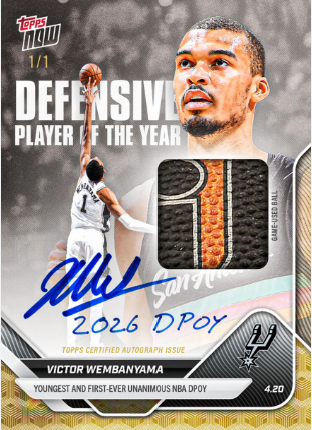
Topps Now Cards have quietly become one of the defining products for modern collectors. The concept is simple and, frankly, very clever. Capture a key sports moment and immediately turn it into a card. Whether it is Victor Wembanyama winning Defensive Player of the Year or Fernando Mendoza being selected as a first overall pick, the moment is monetized in real time.
What makes Topps Now Cards especially interesting is the transparency. The print run is published. That changes the psychology completely. Collectors are not guessing rarity. They are staring at it.
And yet the numbers tell a different story than the hype suggests.
If every buyer only purchased a single card, you could fill the Maracanã Stadium in Brazil. Of course, buyers do not stop at one. They stack orders, chasing inserts, parallels, and the dream of pulling a one of one autograph. Still, the scale is enormous.
The Chase Is the Product
Most buyers are not really buying the base card. They are buying a lottery ticket.
Topps understands this perfectly. The structure is always the same. Open edition base cards anchor the product, but the real attention sits on the parallels and inserts. Gold to 50, orange to 25, black to 10, red to 5, and the elusive one of one. Add autograph redemptions and short prints, and suddenly every purchase feels like it could be the one.
This is where Topps Now Cards thrive. Even seasoned collectors get pulled in.
Victor Wembanyama and the Shift from Hype to Legacy
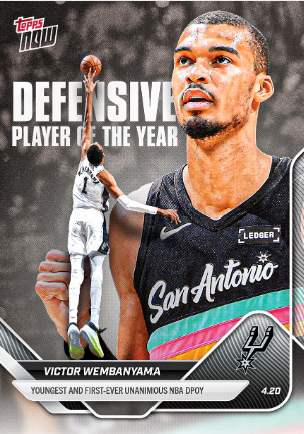
Take the example of Victor Wembanyama. His 2025 to 26 NBA Topps Now Card for Defensive Player of the Year came with a print run of 66,956.
That number feels moderate in today’s environment. It is still a massive quantity, but context matters. Wembanyama is no longer a rookie. The initial hype wave has already passed. What we are seeing now is the transition into something more sustainable, the early stages of a legacy narrative.
The market reflects that. Prices are not exploding, but they are gradually climbing. There is a growing belief that Wembanyama might actually deliver on the expectations that were placed on him. His unique physical profile and skill set already separate him from most players.
Still, becoming one of the greatest of all time requires more than production. It requires presence, narrative, and moments that define eras. That part is still unwritten.
Fernando Mendoza and the Rookie Premium
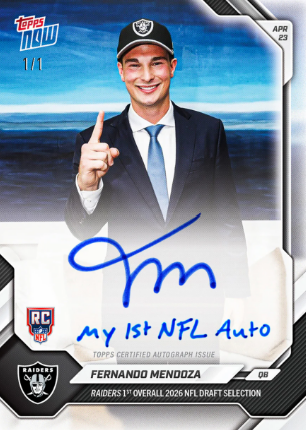
Now compare that to Fernando Mendoza. His 2026 NFL Topps Now Card came with a print run of 126,581.
That is nearly double the Wembanyama card.
The difference is the rookie factor. The RC logo carries enormous weight. It represents possibility rather than proof. Collectors are not buying what Mendoza is. They are buying what he could become.
He has been selected by the Raiders, a franchise that has not been a consistent Super Bowl contender. That matters. Situation always matters in the NFL. Meanwhile, the competition is strong. Players like Caleb Williams, Jayden Daniels, Josh Allen, and Drake Maye are all part of a crowded next generation.
The upside scenario is obvious. If Mendoza turns into the next Tom Brady, graded PSA 10 copies of these cards could skyrocket. But how likely is that outcome in today’s environment
Grading Culture and Market Reality
The collecting landscape has changed. This is not the casual market of the early 2000s.
Cards are no longer casually stored. They are sleeved immediately, often top loaded, and quickly sent for grading. High grade copies are not rare accidents anymore. They are the expectation.
That creates a different kind of supply issue. Even if the base card has a high print run, a large percentage of the population ends up in near perfect condition. Scarcity shifts from condition to true uniqueness, meaning low numbered parallels and autographs.
Junk Wax Era 2.0 or a New Model
Critics argue that we are entering a Junk Wax Era 2.0. The logic is easy to follow. There is a flood of product, constant releases, and an increasing number of one of one cards. When every set has multiple one of ones, how unique are they really
Another point of criticism is the lack of differentiation. A base card and a low numbered parallel can look nearly identical aside from the foil color and serial stamp. For some collectors, that weakens the concept of rarity.
And yet the market continues to function.
Topps Now Cards sit right in the middle of this debate. They are both a reflection of excess and a perfect execution of modern demand. Instant gratification, transparent print runs, and built in chase mechanics.
Where This Leaves Collectors
For collectors, the key is perspective.
Wembanyama cards represent a player moving from hype to legacy. The growth is slower, but potentially more stable.
Mendoza cards represent pure speculation. High print run, high risk, high reward.
Topps Now Cards are not going away. If anything, they are becoming a blueprint for how modern sports cards operate. The question is not whether they are overproduced. The question is whether collectors are comfortable with what rarity means in this new era.
Because rarity is no longer just about how many cards exist. It is about how many people believe they matter.
This essay is part of Sports Memorabilia: The Ultimate Guide.
Image Source: Topps