
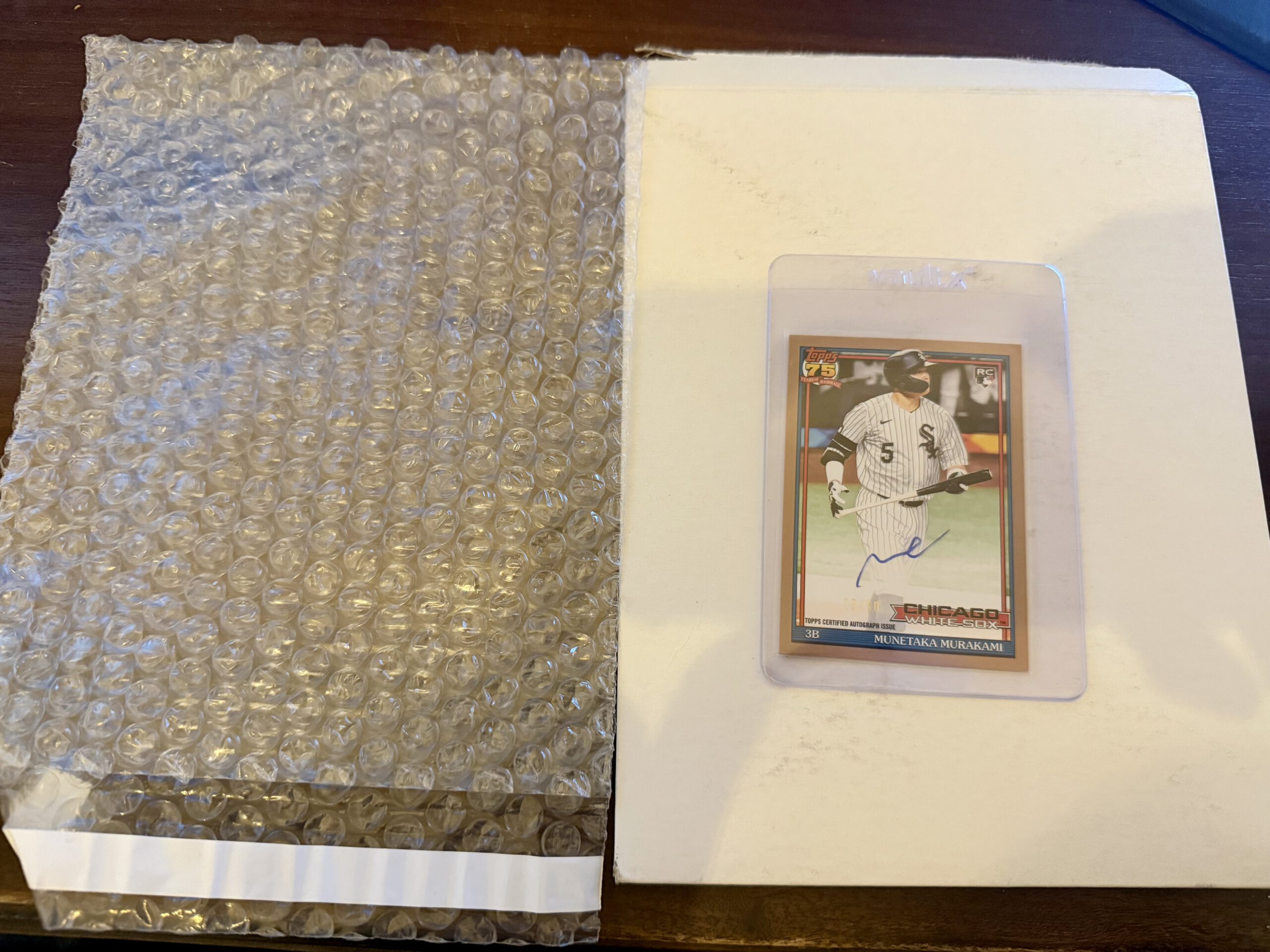
Yes! My Munetaka Murakami autograph has finally arrived. After almost six months of waiting, I finally have my 2026 Topps Series 2 1991 Gold Rookie Autograph, numbered 19/50, in my hands.
But can we talk about how Topps ships its redemption cards?
A top loader secured with a Topps seal, some bubble wrap and a cardboard envelope. Just look at the picture above. We are talking about a collectible asset potentially worth hundreds or even thousands of dollars.
Redemptions often represent some of the most valuable hits in a box. Collectors spend considerable amounts of money on these products and sometimes wait months to receive their autographs. I would expect the manufacturer to take every reasonable precaution when shipping them.
Why Can’t Topps Ship Redemption Cards Like PSA?
Compare this with how PSA ships graded cards. In my experience, PSA uses multiple layers of cardboard packaging, including boxes within boxes, even though the cards themselves are already protected by rigid plastic slabs.
My Murakami autograph arrived in a top loader wrapped in bubble wrap inside a cardboard envelope. While bubble wrap provides some protection against impacts, it offers limited protection against bending and compression.
Fortunately, I cannot identify any obvious major damage from an initial visual inspection. However, that does not necessarily mean the card is in gem mint condition. Small surface imperfections, corner damage or edge wear can significantly affect its grading result and market value.
I immediately transferred the card from its Topps-sealed top loader into a penny sleeve and a semi-rigid card holder. It is going to PSA.
My criticism is not that Topps damaged my card. It is that the company appears willing to accept a level of shipping risk that I personally would not accept when selling a card of comparable value to another collector.
The Hidden Investment Risk of Topps Redemptions
The packaging is only part of the problem. From an investment perspective, I find the financial risk associated with redemption waiting times even more interesting.
When I pulled the Murakami redemption, baseball was in season and collectors were actively buying his rookie cards. Almost six months later, I have finally received the physical card, but the market environment has changed.
According to HobbyCardIndex, which tracks 36 Murakami cards, his card market declined by 9.8% over the 30 days leading up to November 24, 2026.
Some individual cards have experienced considerably larger corrections. His 2026 Topps Chrome Sapphire Gold Autograph, also numbered to 50, sold for $2,250 on October 3 and $1,625 on November 3. That represents a decline of approximately 28% within one month.
A PSA 9 example subsequently sold for $1,325 on November 21, approximately 41% below the October transaction. However, raw and graded cards are not directly comparable. Buyers sometimes pay a premium for ungraded cards because they retain the possibility of obtaining a PSA 10.
Munetaka Murakami Gold Autograph Sales
| Card | Sale date | Condition | Sale price |
|---|---|---|---|
| 1991 Gold Autograph /50 | July 5 | Redemption | $935 |
| Tribute Gold Autograph /50 | August 23 | Raw | $1,575 |
| Tribute Gold Autograph /50 | August 25 | Raw | $902 |
| Chrome Sapphire Gold Autograph /50 | October 3 | Raw | $2,250 |
| Chrome Sapphire Gold Autograph /50 | November 3 | Raw | $1,625 |
| Chrome Sapphire Gold Autograph /50 | November 21 | PSA 9 | $1,325 |
All prices are in US dollars. Market data as of November 25, 2026, taken from Sportscards Pro.
These cards belong to different product lines and should not be treated as direct equivalents. Nevertheless, the transactions illustrate the price volatility collectors are exposed to while waiting for their redemptions.
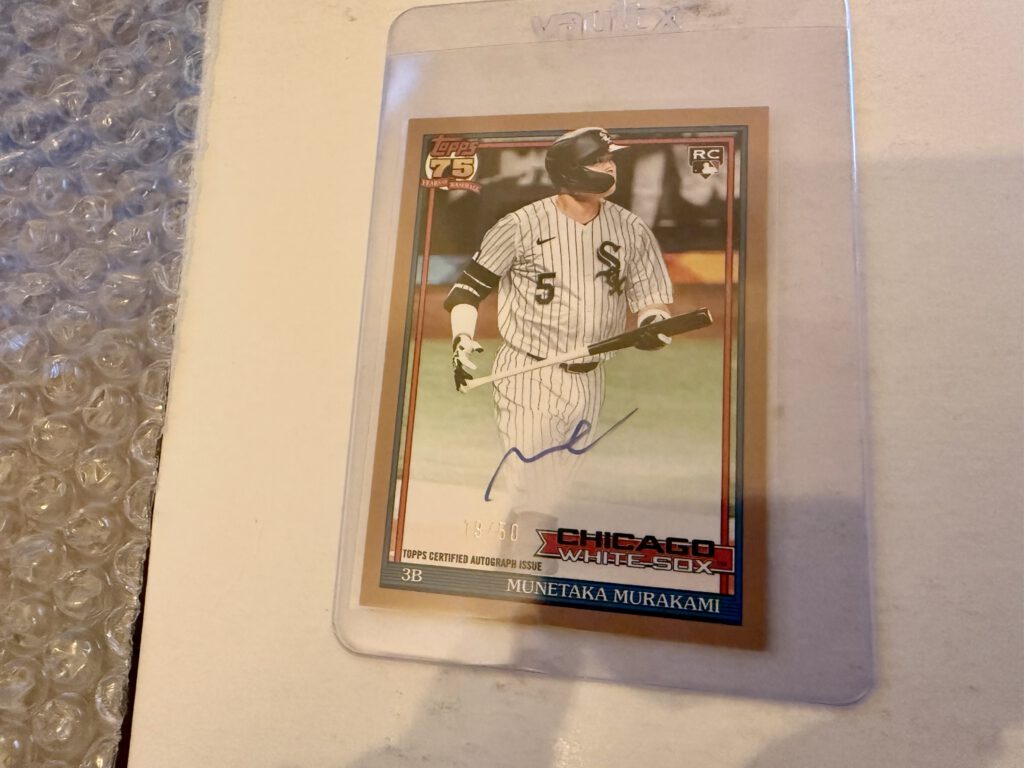
How Much Is My Munetaka Murakami Gold Rookie Autograph Worth?
I found a completed sale of my exact redemption parallel for $935 on July 5, 2026. Another seller listed the same parallel for $3,600 in August, although I could not verify a completed transaction at that price.
The July transaction provides a useful historical reference, but a single sale is not sufficient to establish a reliable market value.
Based on the available comparable sales and the recent market correction, I currently estimate the value of my ungraded card at somewhere between $650 and $950.
The card has several characteristics I generally look for as a collector: it is a numbered rookie card, features an on-card autograph and comes from a flagship Topps release. However, with only 50 copies in existence, reliable price discovery is difficult.
Will PSA Grading Make Up for the Market Correction?
After my recent experience grading several Shohei Ohtani cards, I am certainly not taking a PSA 10 for granted. None of the Ohtani numbered refractors I recently purchased raw achieved a PSA 10.
There is an important difference this time, however. My Murakami autograph came directly from the manufacturer rather than from the secondary market. That does not guarantee a high grade, but its ownership history is considerably shorter.
The Actual Cost of PSA Grading
According to PSA’s published US pricing, the following service levels are relevant to my card:
| Service | Grading fee | Maximum insured value | Estimated turnaround |
|---|---|---|---|
| Standard | $59.99 | $1,000 | 70–80 business days |
| Priority | $79.99 | $1,500 | 50–60 business days |
| Express | $199 | $2,500 | 20–30 business days |
Source: PSA, November 25, 2026. Turnaround times are estimates and exclude additional transit time.
If my Murakami receives a PSA 10 and its market value exceeds the insured value of my selected service level, I may face an additional grading charge.
As a collector based in Berlin, I also need to consider insured shipping, return shipping and potential customs-related expenses when submitting internationally. Sending several cards together can help distribute these costs across the submission.
PSA also publishes European service options, which may offer an alternative to submitting directly to the United States.
Selling Raw vs. Grading: The Economics
For the following calculation, I use $800 as an illustrative raw market value. My PSA 8, PSA 9 and PSA 10 valuations are hypothetical scenarios, informed by comparable Murakami autograph sales rather than confirmed transactions for this exact card.
A PSA 8 could sell below the raw price because the grade confirms condition limitations and removes much of the speculative grading upside that buyers may associate with an ungraded card.
I also assume selling costs of 13%, approximately reflecting the fee burden collectors might encounter on a marketplace. Actual fees depend on the platform, seller location and account conditions.
| Scenario | Sale price | Selling fees | Grading | Net proceeds |
|---|---|---|---|---|
| Sell redemption in July | $935 | $121.55 | — | $813.45 |
| Sell raw today | $800 | $104 | — | $696 |
| PSA 8 | $650 | $84.50 | $59.99 | $505.51 |
| PSA 9 | $1,000 | $130 | $59.99 | $810.01 |
| PSA 10 | $2,000 | $260 | $199 | $1,541 |
Illustrative valuations and fee assumptions. Additional shipping, insurance, taxes and acquisition costs are excluded.
The important distinction is that I am dealing with two separate investment decisions.
The first is whether I should have sold the redemption in July. The second is whether grading makes financial sense today, given the current raw value of the card.
The July sale is no longer an available alternative. My decision today must be based on the $696 I could hypothetically receive from selling the card raw.
What Is the Expected Value of Grading?
Without a reliable population report for this exact parallel, I cannot assign statistically meaningful grading probabilities. Instead, I can test different hypothetical outcomes.
| Scenario | PSA 8 | PSA 9 | PSA 10 | Expected net proceeds |
|---|---|---|---|---|
| Conservative | 40% | 50% | 10% | $761 |
| Balanced | 20% | 50% | 30% | $968 |
| Optimistic | 10% | 40% | 50% | $1,145 |
These scenarios exclude grades below PSA 8 and assume that market prices remain unchanged during grading.
Under all three assumptions, grading produces a higher expected return than selling raw today. However, only the balanced and optimistic scenarios outperform the historical redemption sale.
The conservative scenario offers an expected advantage of approximately $65 over selling raw. That is not a particularly large margin once additional shipping costs, insurance and the time value of money are considered.
For example, allocating another $40 in submission-related expenses would reduce the conservative scenario’s expected proceeds to approximately $721.
The longer I have to wait, the greater my exposure to further market movements. A renewed increase in Murakami’s popularity could work in my favor, but another correction could eliminate the expected grading premium entirely.
Should I Have Sold My Redemption Instead?
In hindsight, selling the redemption during the summer would have provided immediate liquidity and eliminated several months of uncertainty. But that does not necessarily mean it would have been the better decision.
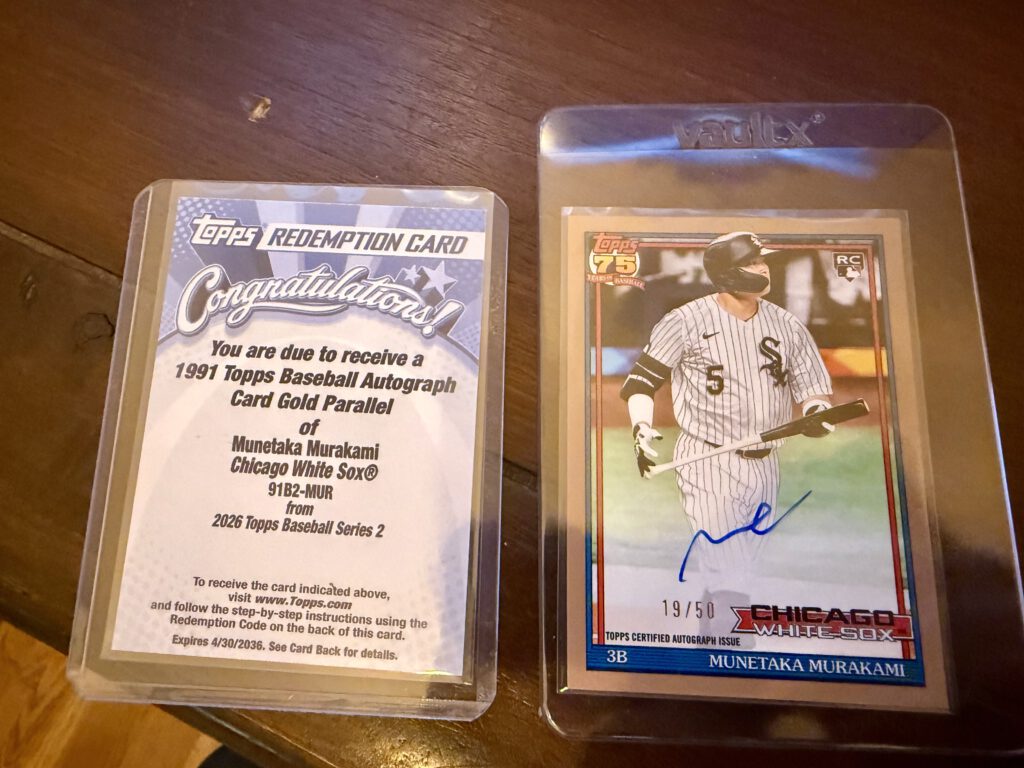
Redemptions can trade at a discount to physical cards because buyers assume the risks associated with fulfillment, waiting times and the unknown condition of the eventual card. By redeeming mine, I accepted those risks in exchange for the opportunity to own and grade the actual autograph.
The market could also have moved in the opposite direction. Had Murakami’s card prices increased substantially during those six months, redeeming the card might have turned out to be an excellent financial decision.
There is also a time-value component. At an illustrative annual return of 5%, the $813.45 in net proceeds from a July sale would have grown to approximately $834 over six months. That is another hurdle the grading outcome would need to overcome.
Once I submitted the redemption code to Topps, I effectively gave up my ability to react to changing market conditions by selling the original redemption.
That is the investment risk collectors should consider. A redemption is not simply a delayed autograph. It temporarily restricts your ability to sell an asset in a potentially volatile market.
My Verdict: I Am Grading the Card
Based on my current assumptions, grading offers a higher expected return than selling my Murakami autograph raw today. However, that advantage depends heavily on the eventual grade, submission costs and the market environment when the card returns.
Whether I would have been better off selling the redemption in July remains an open question. I will only be able to make that comparison once I know the grade and have a more reliable indication of the physical card’s market value.
For now, I am genuinely excited to finally own the card. But I still believe manufacturers need to reconsider how they ship valuable redemptions.
If PSA can use multiple layers of cardboard packaging to protect cards that are already encapsulated, I see little justification for shipping valuable, ungraded rookie autographs in relatively simple envelopes.
Collectors already assume considerable financial risk when buying boxes and redeeming autographs. Shipping should not unnecessarily add to that risk.
I will update this article once the card returns from PSA.
What do you think? Do you redeem your valuable autograph cards or sell the redemption while the market is hot?
Disclaimer: This article reflects my personal collecting experience and market analysis. Card valuations, selling costs and grading probabilities are illustrative assumptions, not guaranteed financial outcomes.