
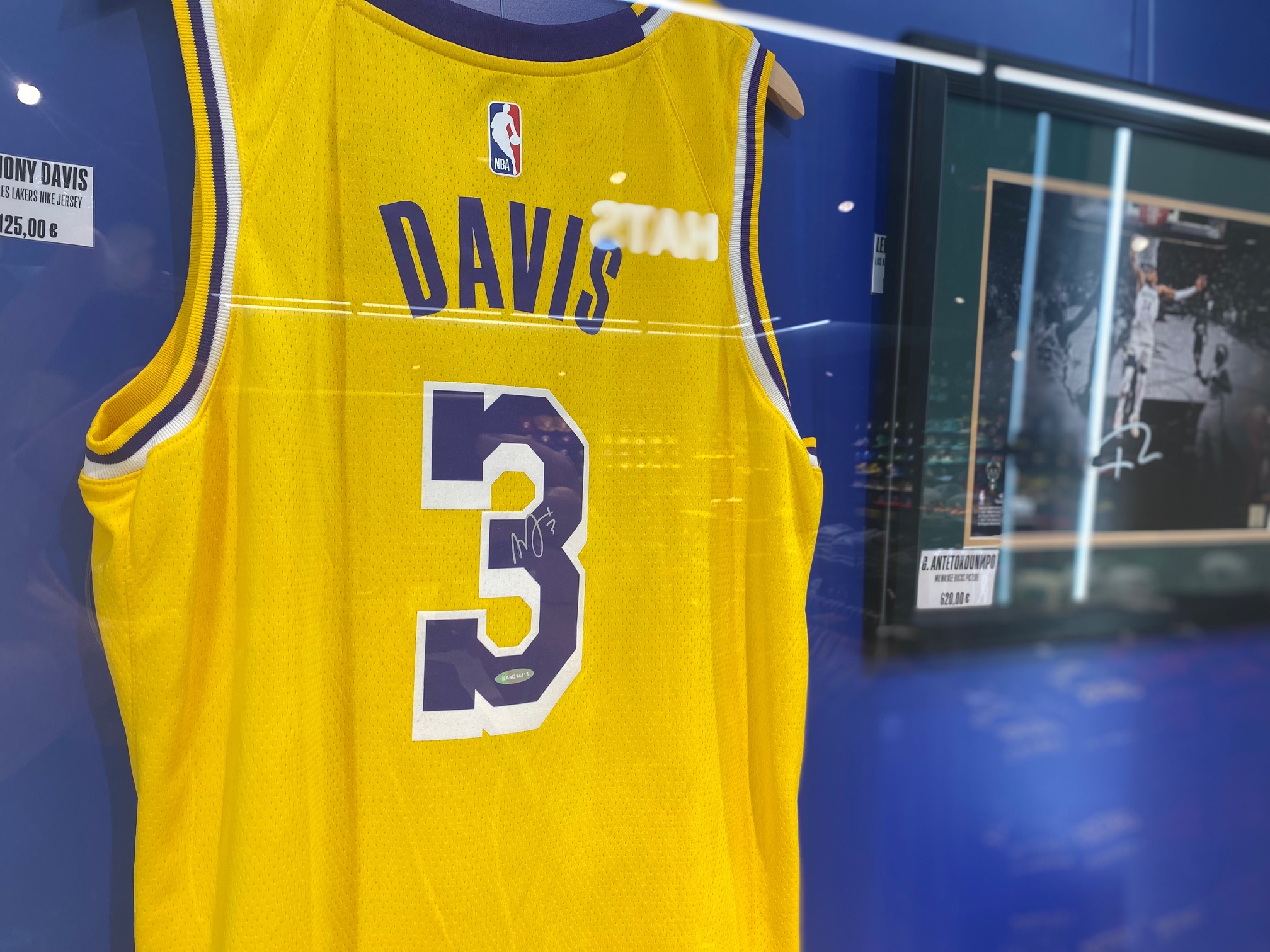
Anthony Davis has never been the obvious headline name in the sports memorabilia world, but the market around him tells a more nuanced story. While collectors often gravitate toward universally dominant figures like Michael Jordan or current cultural icons, Davis sits in a different category, one where value is shaped less by constant hype and more by moments, scarcity, and timing.
That became clear when one of his rookie cards quietly crossed into seven figure territory. The 2012–13 National Treasures Logoman Rookie Patch Autograph of Anthony Davis sold for $1,045,500 through Goldin, placing it among a very small group of modern basketball cards to reach that level. It was not just a record for Davis. It was a signal that the top end of his market had matured. A Prizm Gold rookie from the same year reaching $185,000 reinforces that this was not an isolated outlier but part of a broader revaluation of his early career material.
What makes that Logoman card significant is not just the player attached to it, but the structure of the asset itself. It combines every element the high end market prioritizes. It is a true rookie release from an elite product line, paired with a one of one patch taken from a game worn jersey, and supported by strong grading with a BGS 9 and a 10 grade autograph. These are the kinds of details that separate a collectible from a trophy piece. The price reflects that distinction more than it reflects Davis as a personality.
Anthony Davis Memorabilia and the Role of Upper Deck
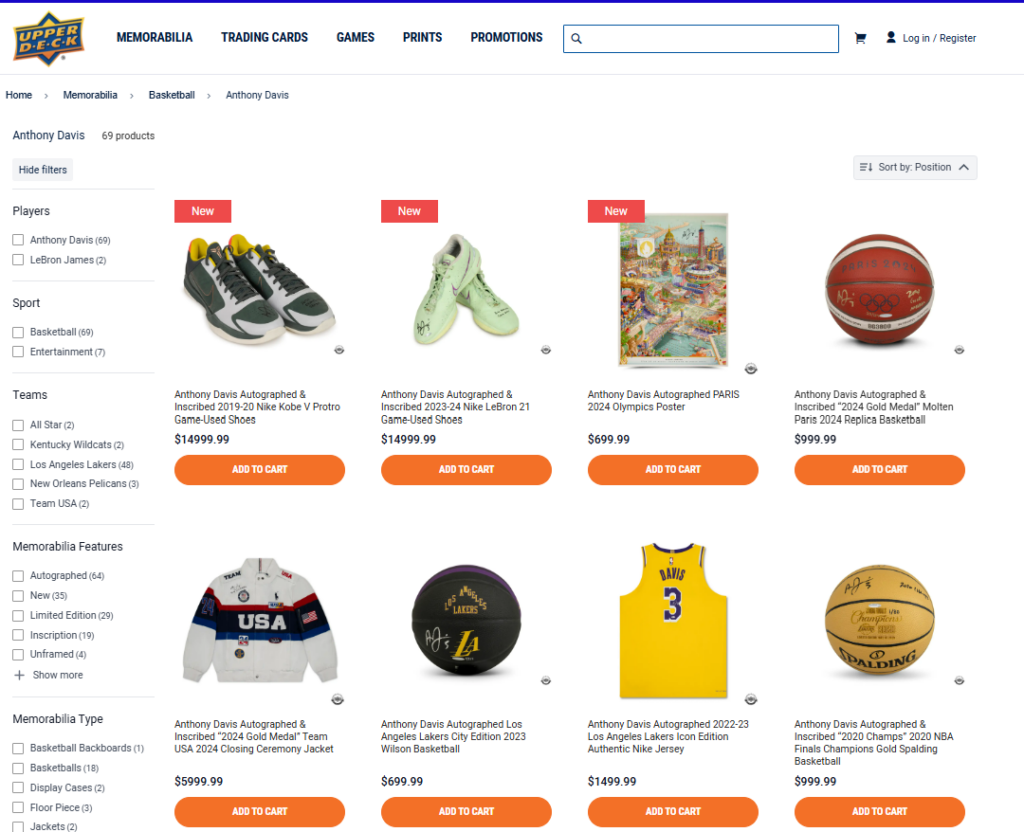
At the same time, it is important not to confuse that ceiling with the rest of the market. Outside of ultra high end cards, Anthony Davis memorabilia trades in a much more grounded range. Looking at current listings at Upper Deck, signed game used shoes tend to sit around the $1,500 mark, authenticated jerseys generally fall between $1,000 and $1,500, and signed basketballs and mid tier items often trade between $600 and $1,000. Even visually appealing pieces like Olympic themed posters or limited collectibles remain well below the prices seen in the card market’s upper tier. That gap between headline sales and everyday liquidity is where most collectors actually operate.
A signed jersey or basketball rarely experiences the kind of explosive upside seen in a rare card, but it also does not collapse in the same way when attention shifts elsewhere.
Anthony Davis himself plays a major role in how this market behaves. He has the résumé of a top tier player, an NBA champion, multiple time All Star, Olympic gold medalist, and former number one overall pick, but he has never maintained the kind of continuous spotlight that drives sustained hobby hype. Injuries, inconsistent availability, and the presence of LeBron James in the same market have all limited his visibility at key moments. As a result, his collectibles tend to move in cycles rather than on a steady upward trajectory.